
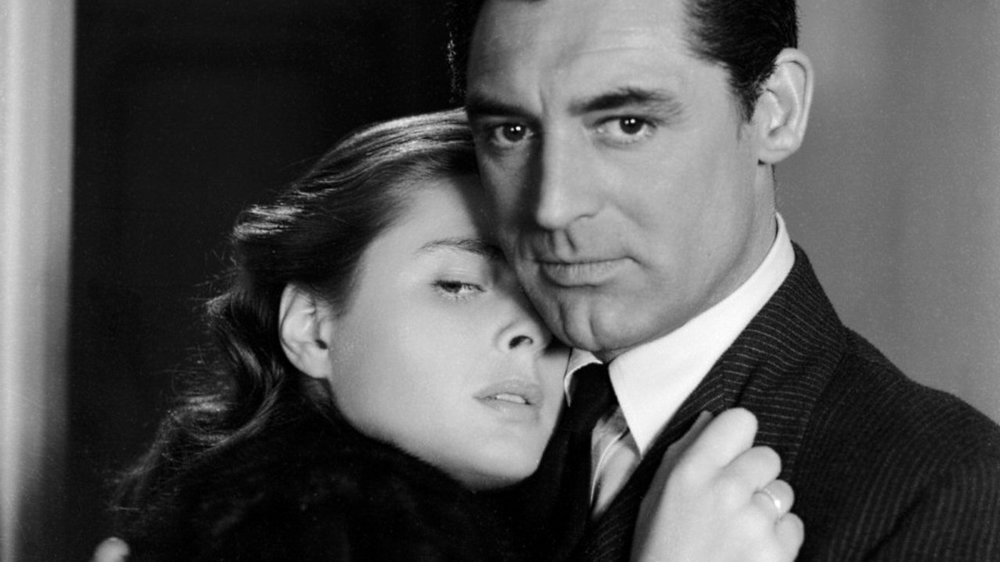
By the Autumn of 1945, Cary Grant, along with our global allies, surely breathed a collective sigh of relief. Germany surrendered on May 8, 1945. After the atomic bombs were dropped on Hiroshima and Nagasaki, Japan followed by surrendering on September 2, 1945. The second world war was over, but this was the deadliest global conflict in human history, with an estimated 50 to 85 million fatalities. As the world began to rebuild, including the Leach hometown of Bristol, UK where his mother still resided, Cary’s career was in full swing. A far cry from his early beginnings in Hollywood as the fresh face with a trained skill for physical comedy, Cary Grant was maturing into the leading man. The ultimate leading man.
Following the successes of SUSPICION (1941) and SPELLBOUND (1944), Alfred Hitchcock was ready for another partnership with both Grant and Ingrid Bergman. After her standout performances in CASABLANCA (1942) and GASLIGHT (1944), the beautiful and talented Swedish actress Ingrid Bergman would be an impressive first time pairing with Cary Grant. It would not be their last picture together, nor their last for each working with Hitchcock.

Grant had worked with Claude Rains prior on the film, THE LAST OUTPOST (1935) and Grant left a less than favorable impression on Rains. As with many of his films, Grant held an insistent belief that a picture’s success (and thereby his own) hinges upon a brilliant director. On set, Cary was persistent in his grousing about everything, but namely against the initial director, Charles Barton. At one point he attempted to pull Rains into his plot to replace Barton. In agreement with Barton’s direction, Rains wanted no part of this scheme and thought Grant was behaving unprofessionally. But Cary got his wish when a new director showed up, Louis Gasnier. While Cary was satisfied, the rest of the crew and cast, including Rains, let Grant know they would no longer cater to his grumbling whims. As a result, Claude and Cary may have begun filming NOTORIOUS a decade later with an air of coolness, but with the confidence of Hitchcock at the helm this time, this production would be a more pleasant experience for all.

Producer David O Selznick’s inspiration began with a Saturday Evening Post serial by John Taintor Foote, “The Song of the Dragon”. He originally purchased it as a vehicle for Vivian Leigh, who turned it down. Ingrid Bergman passed on it as well until she heard Hitchcock was attached to it. Hitchcock enlisted Ben Hecht to draft a script that focused on the idea of using sex as a political tool for espionage. A modern-day Mati Hari. But Selznick was heavily preoccupied with a major film undertaking- DUEL IN THE SUN (1946). To afford his own production and large budgets, he needed cash. According to biographer Scott Eyman, “He sold NOTORIOUS to RKO for $800,000, which included the script, Ingrid Bergman, and Hitchcock.” A distracted Selznick translated to more control for Hitchcock. So instead of Joseph Cotton as the male lead, “Devlin” as Selznick wanted, Hitchcock pushed for a pricier Cary Grant.
At some point, screenwriter Clifford Odets was brought in to expand upon what Ben Hecht had started, as Hecht went off to juggle other projects. Odets submitted a 136-page script in September 1944. Although Selznick no longer had any real power in the production, he made it known how much he loathed Odet’s script. Hecht was brought back in, with end results being a collaboration of both Hecht and Hitchcock. It’s been also suggested that another inspiration for the narrative is based on Marthe Richard, a French politician and spy. She is best known for proposing legislation to close brothels. But during the war, she was a former prostitute who spied for France against the enemy of Germany.

Another undeniable influence of the NOTORIOUS story was unfolding on the global stage. The definitive ending to WW2 was the result of the atomic bomb. Writer Ben Hecht was a very politically active man who passionately rallied against fascism with his own contacts in Washington, so he was keenly aware of the rumors of a top-secret race to create an atom bomb, towards the end of the war.

While NOTORIOUS is obviously a spy thriller, there is a stylized darkness that blankets the film and begs the question, “is it a film noir?” In the summer of 1945, Hitchcock traveled to London to supervise/edit a film, “Memory of the Camps,” of the allied forces liberating the concentrations camps in Poland. The documentary was intended to showcase the horrors for the German public. He needed to construct the images to be both shocking and realistic, so that there would be no deniability by the Germans. His name added the necessary credibility. But this film was not shown in the United States (… nor Britain, and France) until the 1980s, on television, after Hitchcock’s death. After spending a month looking at images of death camps, I cannot imagine Hitchcock not infusing a dark tone on NOTORIOUS. Whether you label it a film noir or not, it is certainly a film of style, suffering, and darkness.
As one can imagine, between the sex (including a very passionate kissing scene and the American government pressuring a woman to prostitute herself to obtain enemy secrets) and the political parallels of the atomic race, it’s a miracle the Breen office didn’t just toss the NOTORIOUS script out completely. The Breen office directed Hitchcock to obtain clearance from the FBI as part of gaining Production Code approval for the political references of nuclear materials and the Nazi storyline. But it was Alicia’s character that prompted the most pushback for the Production Code, whom Breen termed, “a grossly immoral woman, whose immorality is accepted ‘in stride’ in the development of the story and, eventually is portrayed as dying a glorious heroine … There is, too, in contrast with her immoral characterization, an almost complete absence of what might be called ‘compensating moral values.’”* It was communicated to the Breen office that the Alicia concerns would be met by making changes to avoid any direct implications that she was a woman of ‘loose sex morals.’ Even as shooting had initiated and was ongoing, pages were still sent over to the Breen office in a back-and-forth exchange between Hecht’s freshly inked pages and requested re-writes or entirely deleted clips. Principal photography for NOTORIOUS began on October 22, 1945 and wrapped in February 1946.

In November of 1945, during filming, the Nuremberg Trials were underway. But not all high-ranking Nazis were put on trial at that time, as many, such as Adolf Eichmann and Josef Mengele, had fled to South America. This premise is prophetically seen in the plot of NOTORIOUS, with the Nazi characters operating in Brazil. This was not the first film Hitchcock made that dealt with the rise of Hitler and Nazism. THE LADY VANISHES (1938), SABATEUR (1942), FOREIGN CORRESPONDENT (1940), and LIFE BOAT (1944) each tackled these topics. He would go on to include Cold War espionage themes in later films, as well.
Hitchcock themes and hallmarks:

Camera work- High crane camera/special scaffolding elevator (staircase), deep focus (key, teacup) are examples of the brilliant and innovative use of photography.
Mother themes- The domineering, stern mother (Madame Konstantine) to Alex Sebastian (Claude Rains) is a strong and controlling figure.
Staircase imagery- A significant component to the set design, it is an imperative tool to building tension in the storytelling.
Icy blonde- Here, the coldness comes mostly from Cary Grant’s character, not Hitch’s typical platinum blond of his reputation. But bitterly cold, nonetheless.
Voyeurism- In an early scene, at Alicia’s house we see her host a party and get drunk, but Devlin quietly watches, too- we only see the shadowed back of his head as he quietly and passively looks on. As the story progresses, Devlin is in love with Alicia but watches her from a distance with another man. He literally prostitutes her out but keeps her close.
Fear and darkness- Obviously a touchstone for Hitchcock, more so during this time of filming with the threat of nuclear war, his own witnessing of Nazi atrocities, and the Nuremberg trials. The fear and paranoia of Nazi spying was a very real threat.
Suspense- Suspense and building tension are more specific hallmarks for Hitch and he does so in small increments. He was not a fan of the ‘whodunnit’ style of a thriller. He lets the audience see everything. Then we watch, ever slowly, and tension builds- with close calls, near misses, and devastating consequences that hang in the balance. The wine cellar scene is just one example.
Politics- Hitch tackles fascism and espionage, but in not in glaringly black-and-white terms. Some aspects are obviously evil, but he also shows complexity. Devlin and the other Feds are not exactly kind to Alicia- and Sebastian is frequently depicted in a favorable and sympathetic light.
Complex or Ambiguous Morality- The earliest version of Alicia was an alcoholic prostitute. The final, censored version is more implied that she is a ‘notorious, loose woman’. What it is clear is that her father is a Nazi, and she begrudgingly assists the Feds. Her loyalties are not with her Nazi father, but she’s hardly a devout patriot either. As for her promiscuity, the censors are appeased when Sebastian is not a stranger but an old family friend with an old crush, and much of the jealousy and unfavorable assumptions by Devlin come with a lovers’ misunderstanding, rather a validation of actual past prostitution.

NOTORIOUS is a treasure for Hitchcock fans, but also for the performances of Grant, Bergman, and Rains. This film reveals many essential Hitchcock signatures. Grant and Bergman light up the screen in their combined beauty and talent. It’s especially gratifying to watch the Cary Grant performance, because we see the traits that are both skilled and instinctive for him. It is a matured, dramatic role with dark undertones. Cary pulls out Archie Leach’s distrusting, complicated views on women, which is perfect for this role, even if Bergman does most of the heavy lifting in screen time. There’s so much to unpack in this film- what are some of your favorite moments?
Cast and Crew:
Producer/Director: Alfred Hitchcock
Screenplay: Ben Hecht
Cinematography: Ted Tetzlaff
(Gregg Toland, the cameraman responsible for the deep-focus photography in Orson Welles’ films, shot location backdrops for NOTORIOUS in Rio. Hitchcock and his cast remained in California for filming.)
Editing: Theron Warth
Art Direction: Carroll Clark, Albert D’Agostino
Original Music: Roy Webb
Cary Grant – T.R. Devlin
Ingrid Bergman -Alicia Huberman
Claude Rains – Alexander Sebastian
Leopoldine Konstantin – Madame Sebastian
Louis Calhern -Prescott
SOURCES:
- “Cary Grant, A Brilliant Disguise.” By Scott Eyman. 2020. Simon & Schuster.
- “Hitchcock’s Films Revisited.” By Robin Wood. 2002. Columbia University Press.
- “Hitchcock, The Making of Notorious.” Aka “Les Enchaines.” By David Thompson. 2009. TCM Documentary.
- “The Ultimate Romance: The Making of Notorious.” Dir. By John Cork, Lisa Van Eyssen. (Video, 2008)
- IMDB

 Outspoken & Freckled
Oh Kellee!! Such great information. I gobbled it up and need to read it again. Notorious is one of my all-time faves.
I had no idea that Claude and Cary had a rocky working relationship. Nor had I heard about Hitchcock working on a film about concentration camps. That would certainly explain the darkness of this film…and it’s that noir aspect that keeps this at the top of my list.
thank you!!
LikeLiked by 1 person
I’m so glad you enjoyed my take on NOTORIOUS. I do love researching deeply and getting as much info as I can. Thanks again!
LikeLike
I don’t care what anybody says…this film has always had a “noir” feel to it. But…the question smacks a bit of “is a hot dog a sandwich?” Say what you will, we all fancy a hot dog occasionally 🙂
LikeLike
And I certainly crave this film, no matter what it’s labeled, am I right? Thanks so much for stopping by!
LikeLiked by 1 person