
(The following was included as part of my John Ford Film Study course which I taught in the winter/early spring semester of 2023. This is the last film featured in this Ford series. Please enjoy…)
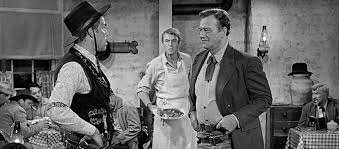
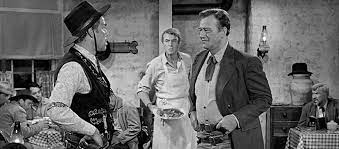
For our last film of this John Ford study, it seems rather fitting to end with the film that many consider to be Ford’s last great film, THE MAN WHO SHOT LIBERTY VALANCE. A somber story with heavy tones of irony, loss, and melancholy. If there was a cinematic swansong for John Ford, surely this was it.
In the early 1960s, America had changed considerably from the early days of Ford’s career in the industry of motion pictures. Silent films, technological advances in sound and photography, timeless masterpieces, westerns, a world war he witnessed first-hand, and turbulent American politics… Ford was there for it all, as a poet and a painter of the silver screen, and a legendary filmmaker for half a century. In 1952, the United States vs Paramount Pictures legal decision was the beginning of the end of the studio system. Films were granted free speech protection under the First Amendment for the first time. Yet the far-right politics at that time made the change unnoticeable until the winds of change beginning in the 1960s. By 1968, the Production Code was officially dead (replaced by the age-based coding to this day).
The conservative politics of the 1950s was being replaced by the next decade’s demands for change and social unrest. Civil rights finally drew attention into mainstream public. A young President John F Kennedy represented hope for a progressive, space-age future. Television continued to gain popularity and began edging out film. While some westerns were still featured on tv, films were slowly evolving from westerns of yesteryear into tales of gritty realism, often in crime and war drama or the counter-culture of a new, independent voice. A new guard in filmmaking would be on the rise, and John Ford was perceived as the old guard.
Audiences didn’t rush to see TMWSLV in droves as much as they had to Ford films in the past. Westerns had transitioned in popularity to the small screen in series like “Gunsmoke,” “Bonanza,” and “Maverick.” But even tv westerns were on their way out by the 60s. LIBERTY VALANCE was ranked #16 in the ranking of the 1962 film releases. In other words, it made a profit (last of his films to do so), but this was far from the days of Ford’s peak years.
Duke had a ten-picture deal with Paramount and his name made them money. Big money. Now, the son (John Wayne) was a bigger name with more industry clout than the father (John Ford). The star power of John Wayne and James Stewart is essentially what brought audiences into this western that would otherwise be considered passe. The film grew in popularity over the years because people began to see that LIBERTY VALANCE was much more complex, fascinating, and relevant than the 1962 audiences originally assumed at face value.
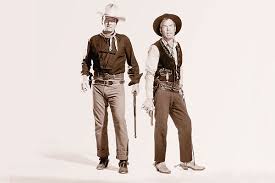
Dorothy Johnson published the short story, “The Man Who Shot Liberty Valance” in 1949. Jack purchased it in March of 1961, for $7,500. James Warner Bellah and Willis Goldbeck would work on the script together- each received $30,000 (Goldbeck got another $10k for producer duties). According to Scott Eyman’s book, “The days when a Ford western could be knocked off cheaply were over, largely because of star salaries, which must have galled him to no end. For The Man Who Shot Liberty Valance, John Wayne was getting $750,000 and James Stewart $300,000, against 7 ½ percent of the gross apiece. Ford was earning a comparatively minor $150,000, plus 25 percent of the profits. Lee Marvin got $50,000. The total budget was $3.2 million…”* The tables had turned. Ford needed Wayne more than Duke needed him. According to Paramount exec Howard W Koch, “Ford still had life, but the Big Cowboy was really the whole thing.”*
Why black and white?
Cinematographer William H Clothier questioned Ford’s choice for black and white film in lieu of color. B&W could still be seen in both TV and film, but color was viewed as the modern choice, so Paramount would’ve preferred color, too. “There was one reason and one reason only … Paramount was cutting costs. Otherwise, we would have been in Monument Valley or Bracketville and we would have had color stock. Ford had to accept those terms or not make the film.”**
Besides the budgetary reasons for passing on color, Ford convinced Clothier that a critical gunfight scene would be one of many scenes that would benefit from the artistic editing of black and white. This film was so unlike prior Ford films that featured exteriors of those grand, sweeping landscapes that obviously looked their best in Technicolor. But LIBERTY VALANCE relied on character and driving story- which translated into mostly interior shots. Add in the somber tones, Ford’s instincts for black and white were spot on.
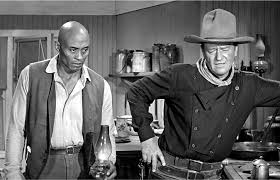
“He really was a genius,” remembered Clothier. “He’d listen, but if you were smart, you’d spend a lot of time listening to him. He knew more about photography than any man who ever worked in the movies. He’d force me into situations where I’d have to sit up and take notice.”*
One of the reasons this film has remained a classic, and undoubtedly one of Ford’s recognized top films, is the casting. Both John Wayne and James Stewart deliver strong performances after decades of perfecting their craft, and they really fit their characters. We are front-row access to the duel of characters that appear like black and white polar opposites on the surface, but we soon perceive all the complexities and shades of gray.

Vera Miles as “Hallie” as the center of a love triangle is an interesting character. She represents a fork in the road for these two very different men- one represents her past, the other her future. She seemingly ‘fits’ better with Tom. On the surface, it’s the more practical choice. But once Ransom has taught her to read, her world opens to a very different future. It’s more than a singular event that deceptively resides in myth more than truth. Ransom’s path is of a brighter optimism. Like the railroad and western expansion, Ransom offers the symbolism of hope and progress. Tom symbolizes a dusty forgotten myth of Old West lore- even though Ransom bankrolled that myth to gain his future. Tom was left behind. By the end of the story, Hallie remains in love with both men… each is an intregal part of her- they are her past and her future.

While the entire cast is talented and deftly carries the film, I do have one personal disappointment. Woody Strode’s character and his on-screen time is not developed enough for my taste. There was so much potential for more. Strode does such a great job of expressing so much even in his eyes that it leaves one wanting for more dialogue and backstory to his underdeveloped “Pompey.” Makes me wonder if the James Stewart story of him getting in hot water with Jack over Stewart’s slip of criticism over Strode’s costume looking rather “Uncle Remussey” somehow backfired onto Strode’s screen time.

Lee Marvin is unforgettable as “Liberty Valance.” He’s a menacing, terrorizing, and a brutal psychopath. Frankly, he’s brilliant in this role. Marvin’s portrayal needed to be this strong of a dark force, otherwise we wouldn’t see a battle of wills unfold for both Tom and Ransom. It was essential that these men’s characters and core values are tested in very black-and-white terms. It creates a very cornered sense of tension. As such, Ford chooses much tighter, closer framing of scenes in contrast to a typical Ford film, which contributes to that building anxiety.
In the many layers of theme, we see so much of the mystery of John Ford reveal itself in this film. For one, it represents the passage of time. Clearly Ford was facing that harsh reality, professionally and personally. Most would be thrilled to see their central pupil of your life’s work grow beyond your teachings and blossom radiantly in their own career. But that was hardly Jack’s paternal style. He was always the authoritarian in charge that often resulted in artistic masterpieces, while pretending it was just ‘a job for work.’ But if his cheating at cards and compulsive need to punish any challengers to his iron-fisted authority revealed anything about the true John Ford, it was that his tightly guarded privacy and ego likely resented Wayne’s rise to stardom while his own power was on the downslide.
We witness Duke’s “Tom Doniphon” as a relic from the Old West. All of his qualities are admirable in the wild frontier- masculine, brave, strong, but a loner who lives by his own code and he hides his vulnerabilities. He represents the past, and a part of how Ford views himself. Stewart’s “Ransom” represents the future. An intellectual with optimism, but he hides a vulnerability, too. A dark secret of decidedly less valor. Both characters are admirable and courageous, but in very different ways. As time passes for each of them, the symbolism of time sunsetting for Ford’s own life and career is palatable.
A huge theme worth addressing in Liberty Valance is irony, which can be found in nearly every aspect of this film. As we’ve discussed multiple times in this course, Ford’s military service was a core part of Jack’s life. He always felt a lingering disappointment in his star pupil, Duke Wayne, because he had never served in war. Yet Wayne was frequently portrayed as a war hero in his many films, and that celluloid myth was often misconstrued as Duke’s actual truth. So, it feels ironic that Duke’s role as “Tom” is the one who bravely embraces battle and violence without fear, while James Stewart’s “Ransom” is the passivist. A David and Goliath, of sorts. In real life, James Stewart served in WWII as a highly decorated pilot who faced real combat. One of the reasons Ford picked Lee Marvin was because he admired his time served as a Marine. He was a sniper in WWII and was seriously injured, and that military connection was a bond that shielded Marvin from the customary Ford abuse.
The LIBERTY VALANCE film stands the test of time because it is not a typical western. Ford delivers the character study, and nuances of solid storytelling. There are universal truths that unfold in this tale with a subtext that rings true for Ford as a man, and for us all, as well. In the closing scenes, the Ford sentimentality touch is present (like the cactus on a coffin). The funeral and a return to home is more than just saying goodbye to a man and the past- it is a bid farewell to the Old West itself. An era whose time has passed. And perhaps Ford himself felt a little Irish melancholy about his own time.
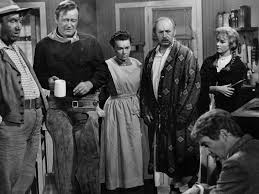
How does this film feel like a Ford film- how is it not?
Themes for discussion…
-Passage of time
-Myth vs truth (how does “print the legend” apply to Ford himself?)
-Haunting, somber tone
-Irony (what other examples do we see of irony?)
-Anti-hero, accidental hero
-Conflict
-Sense of loss
-Past vs future
-Teacher to student dynamic/education
-Funeral ritual is more than a farewell
Cast and Crew:
John Wayne – Tom Doniphon
James Stewart – Ransom “Ranse” Stoddard
Lee Marvin – Liberty Valance
Vera Miles – Hallie Stoddard
Edmond O’Brien – Dutton Peabody
Andy Devine – Marshall Link Appleyard
Ken Murray – Doc Willoughby
John Carradine – Major Cassius Starbuckle
Jeanette Nolan – Nora Ericson
Willis Bouchey – Jason Tully, conductor
Carleton Young – Maxwell Scott, Star editor following Peabody
Woody Strode – Pompey
Denver Pyle – Amos Carruthers
Strother Martin – Floyd, in Valance’s gang
Lee Van Cleef – Reese, in Valance’s gang
Robert F Simon – Handy Strong
OZ Whitehead – Herbert Carruthers
Paul Birch – Mayor Winder
Joseph Hoover – Charlie Hasbrouck, Star reporter
Anna Lee – Mrs. Prescott, woman held up at stagecoach robbery
Directed by – John Ford
Writing by – Dorothy Johnson (story by), James Warner Bellah and Willis Goldbeck (screenplay)
Produced by – John Ford, Willis Goldbeck
Asst Director – Wingate Smith (Mary Ford’s brother)
Cinematography by – William H Clothier
Music by – Cyril J Mockridge
Box office: $8 million
Release date: April 22, 1962
Production company: John Ford Productions/ Distributor: Paramount
SOURCES:
*Eyman, Scott (1999).“Print the Legend, The Life and Times of John Ford.”
**Munn, Michael (2004).” John Wayne – The Man Behind the Myth.” Robson Books.
***McBride, Joseph (2003). “Searching For John Ford: A Life.” New York: St. Martin’s Press.
“The Size of Legends, The Soul of Myth.” Paramount Pictures
 Outspoken & Freckled
LikeLike
Thank you for this. I grew up absolutely loving this movie from the first time my parents took me with th
LikeLiked by 1 person
So glad to hear that you’re a fellow fan! It certainly stands out in many ways amongst all the westerns. Thanks so much for reading my article.
LikeLike
Really enjoyed your post, Kellee — I finally got a chance to see this film a couple of years ago when I decided to take a western film journey. Reading your insights makes me want to revisit it.
— Karen
LikeLike
I remember seeing TMWSLV at the drive-in with my mom & her mother. I was about 10. The smell of coffee from a thermos & a grocery paper bag of buttered popcorn overwhelms me with certain movies & it does for this one. All the talking points above are subjects that I have thought about over the ensuing 60+ years of being a movie fan: westerns, Wayne, Stewart & Ford only a small portion of my interest in films and all those making them. Being a woman who was blessed to love good men, my Dad, my husband, son & grandsons, I am intrigued that I see something new after all these years of watching Ford’s view of women. Men decide women’s futures in Westerns, in any genre of Ford’s movies. And yet, in actuallity both of my grandmothers were strong women in spite of their time & origins, and education. My Mom’s mother (Granny) was half Native American & half western tumbleweed & my Dad’s mother (Gramma) an Irish servant who immigrated by herself for a better future. Both were women respected & mentioned in their new home newspapers & in the communities where they lived because of their many accomplishments & charitable works. Women in westerns & Ford movies are usually sentimental but rarely heroic.
LikeLike
Thanks so much for sharing your family insights, Melissa!
LikeLike