
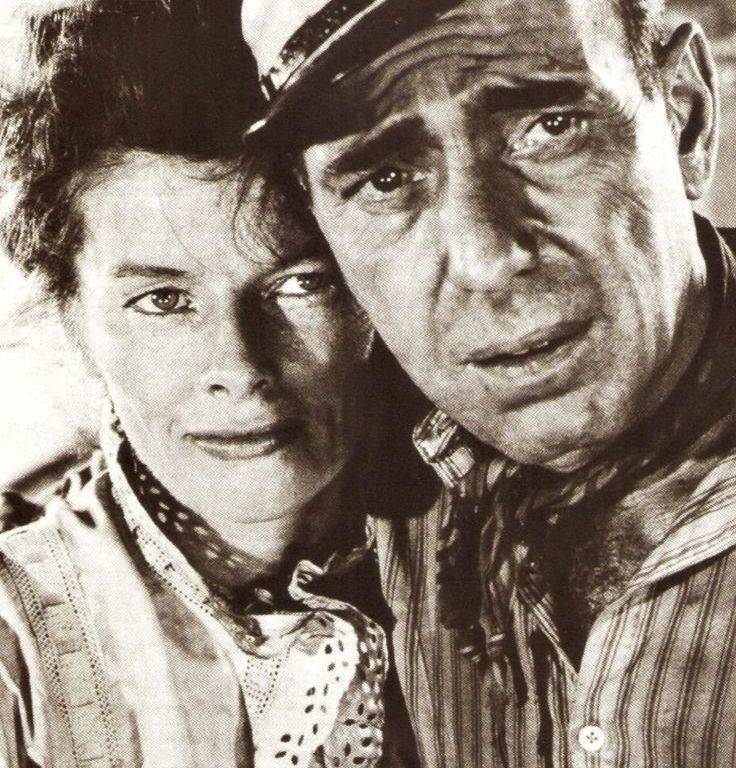
Despite Kate Hepburn’s reputation for relishing a good challenge and competitively pushing herself towards personal excellence, she couldn’t have possibly been prepared for challenges in THE AFRICAN QUEEN (1951). Today we’ll explore the unique production that pushed the boundaries unlike any other film before, the political climate at this time especially for this cast and crew, and the personal triumph that resulted in a classic. Hepburn was already an independent, successful woman in a male dominated industry, but she would face even more hardship and struggles in the remote wilds, deep in the African continent.
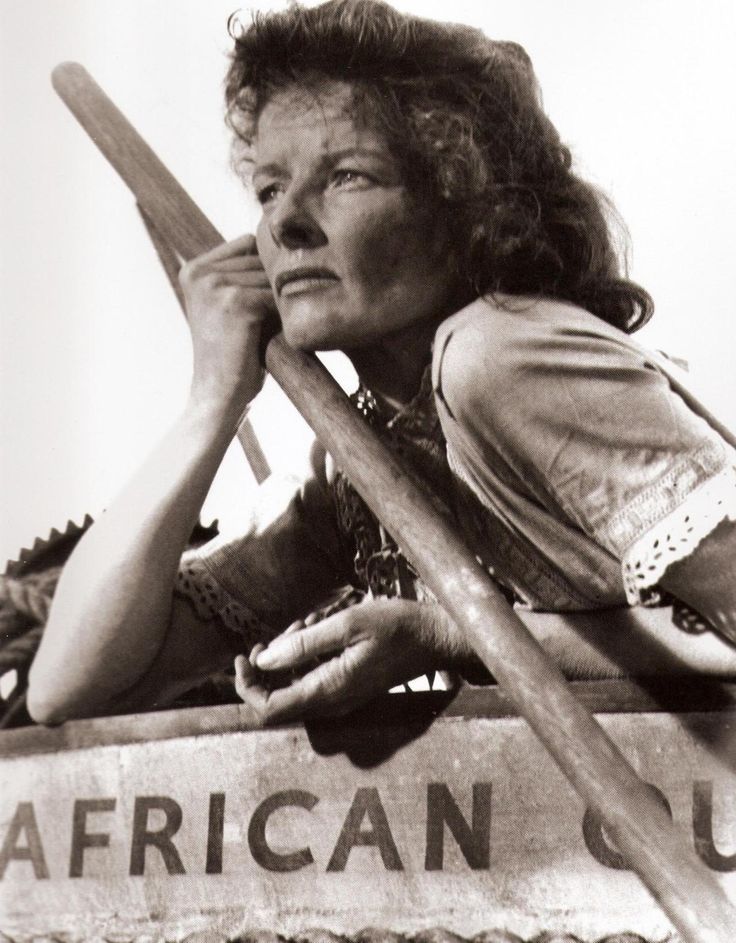
The adventure began with a fictionalized war novel by English writer CS Forester aka Cecil Louis Troughton Smith (1899 – 1966) who was noteworthy for his Horatio Hornblower series; it was published in 1935. Warner Brothers owned the rights for the book for several years. Initially Charles Laughton and his wife Elsa Lanchester were considered to portray the lead characters, “Charlie Allnut” and “Rose Sayer.” Then David Niven and Bette Davis were next on the list. However, the studio didn’t think a story about a mismatched middle-aged duo going down a river would sell tickets. It remained filed away for years.
Director John Huston was known for his preference of making films from literary sources. Whenever possible, his choice to shoot on location was inspired by his work on several documentaries for WW2. Lauren Bacall once noted on a guest appearance on The Johnny Carson Show that in his dogged pursuit of recreating an authentic experience, Huston had a knack for finding (nearly) impossible locations. This was a rather unconventional approach at the time, as most films were shot on backlots and soundstages at the studios. Enter independent producer Sam Spiegel. He had a controversial reputation as a difficult yet resourceful man and an immoral grifter. But he had an instinct to make great films. The two wanted to turn “The African Queen” novel into a film and knew they could purchase the rights for a good price.
Spiegel created a production company with Huston then approached Bogart, who had worked very successfully with Huston on several films in the 1940s such as THE MALTESE FALCON (1941) and KEY LARGO (1948). Bogart agreed. Meanwhile, Spiegel approached Katharine Hepburn with the lure of both Huston and Bogart on board. Kate, fresh on the heels of finishing her “As You Like It” national stage tour, read the book and thought she would be a great fit for the part of “Rosie,” possessing both a prim and proper exterior with an underlying grit and determination for a believable “Rosie.” She had never worked with Huston or Bogart but was intrigued to collaborate. She also knew filming on location would seal the deal.
The only problem now was the money. Without the backing of a major studio, Spiegel set forth to finance the picture in unconventional ways. Keep in mind, the HUAC (House UnAmerican Activities Committee spearheaded by Sen. Joseph McCarthy) had launched a major attack against Hollywood in 1947. As a result, this was a very cautious period of Communism paranoia for the entire Hollywood system. To obtain financing and distribution, Spiegel partnered with the Woolf brothers in Europe of Romulus Productions and Independent Film Distributors to finance and distribute. It was a good path to move forward while bypassing the typical route via Hollywood studios.
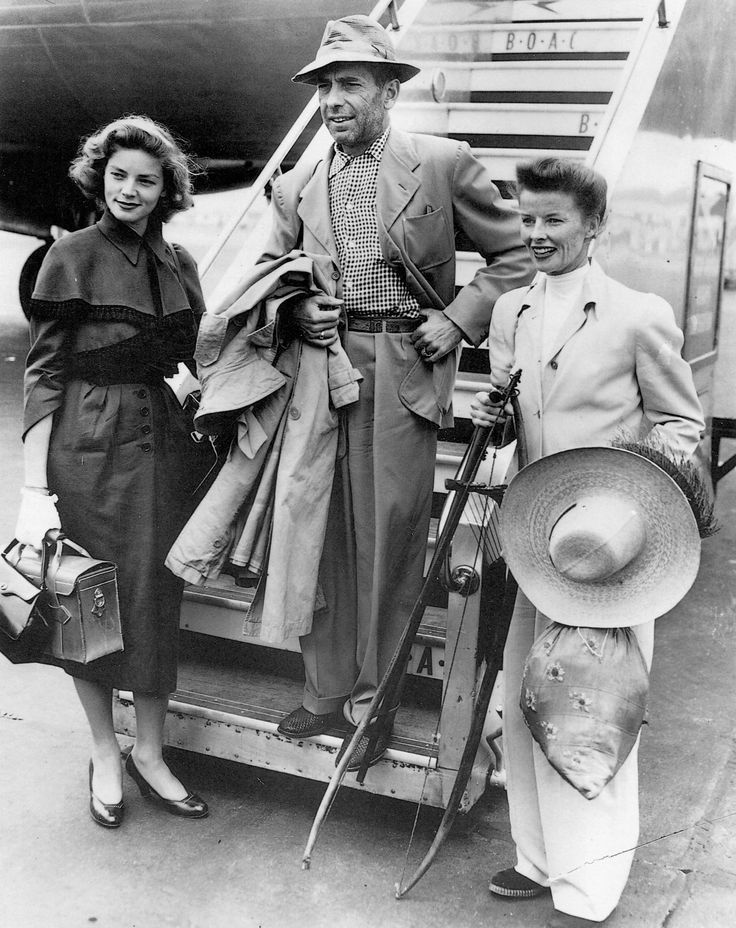
Huston, Bogart, his wife Lauren Bacall, and Hepburn were all actively involved in left-leaning politics. Bogart had been questioned and cleared but rebuked HUAC’s abuse of power, thus formed the Committee for the First Amendment along with many big Hollywood stars. In an unexpected backlash, Hollywood’s top star found himself now facing career suicide and was pressured to recant via a Photoplay article titled, “I’m No Communist.” Jack Warner, head of Warner Brothers, had just signed Bogart to a new WB contract and was the first to volunteer testimony before the HUAC in September 1947. Warner pushed Bogart to back down or face the consequences. Bogart’s next Warner Brothers film, THE TREASURE of the SIERRA MADRE (1948) was written and directed by Huston.
In support of former Vice President Henry Wallace of the Progressive Party, Hepburn made an anti-censorship speech in LA, which was also in protest of the McCarthyism slander against their industry and the target of fellow colleagues. Actor Edward G Robinson was originally scheduled to make this speech but backed out with career pressure. As Kate described,
“He’s Jewish and very left of center, so he would certainly be suspected by that committee [the HUAC]. My ancestors were ‘on the Mayflower’. There’s nothing that they can tack onto me. I’ve never been a member of any organization of any kind in my whole life. I’ll make the speech.”
She faced scrutiny by the public and media, and pressure to blacklist her along with 500 others during this time. But she never wavered.
“I thought somebody should make that speech and I thought that somebody should be me. I think the situation is idiotic and out of hand. People are being crucified who can’t afford it, and I can afford it.”
It was a tense, fearful time in Hollywood history as they all set out to make an underdog story of two unorthodox patriots during WW1.
James Agee (1909 – 1955) was a writer who wrote a Life Magazine piece on John Huston. Eventually Agee formed a connection with Huston and was invited to adapt the African Queen screenplay. He based the lead characters, Charlie and Rosie, on his own parents. Sadly, Agee died at the age of 45 years, with most of his accolades post-houmous.
Huston left first for the African continent to scout best filming locales. He began in Uganda, near Lake Victoria but Huston wasn’t satisfied. The crew joined in Nairobi. Then Huston flew off to the Belgium Congo, where he heard one could shoot elephants. Huston decided upon a small, dark river in the Biondo area. It was remote from any towns and thick in vegetation. A clearing had to be cut for the crew and cast tents. The 40-year-old diesel boat LS Livingston was secured to claim as the African Queen, with a camera boat tethered to a floating pontoon with a mockup of the African Queen for key scenes. Oscar-winning cinematographer Jack Cardiff [(1914 – 2009) known for BLACK NARCISSUS, 1947, THE RED SHOES, 1948] was tasked with the enormous, specialized camera equipment and two lights, hence the extra floating boat required to get the rich Technicolor effects.
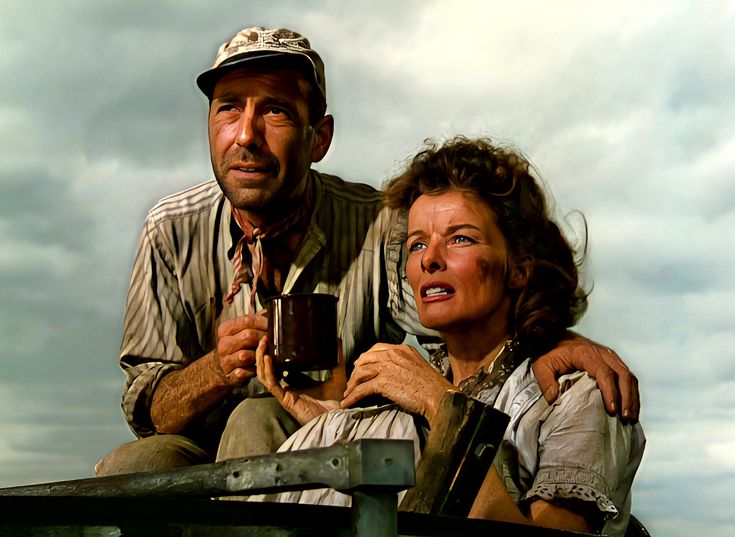
Huston loved to brag that he would go out to hunt elephants, which Hepburn found to be extremely troubling that he even considered murdering such majestic creatures. He invited her along one time and they were nearly trampled by a herd that was much too close for comfort, leading Huston to realize his actions nearly lost his leading star. However, Huston’s son later refuted that his father had any intentions of killing elephants at all. He claimed John Huston thought to kill an elephant was a sin. Perhaps an adventurous prank or bravado to get a rise from Hepburn.
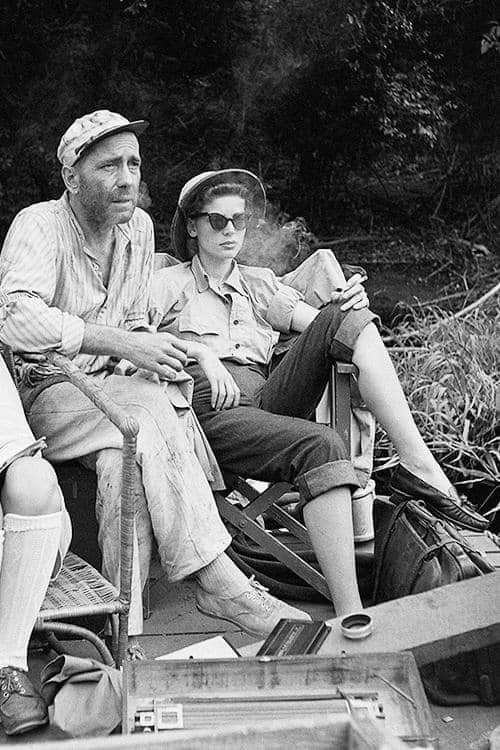
Lauren Bacall traveled along as a caretaker for not only her husband, but as a tremendous help to the entire crew. This was especially helpful when several members of the company came down with various illnesses from malaria to dysentery. Kate Hepburn was one of those who suffered the worst of it. She later accounted for her extreme illness in contrast to Huston and Bogart’s absence of any ailments to her drinking the water, and their daily substitution of whiskey. It turns out, that the water was sourced directly from the dark river- which of course also contained the feces of all the natural wildlife around them.
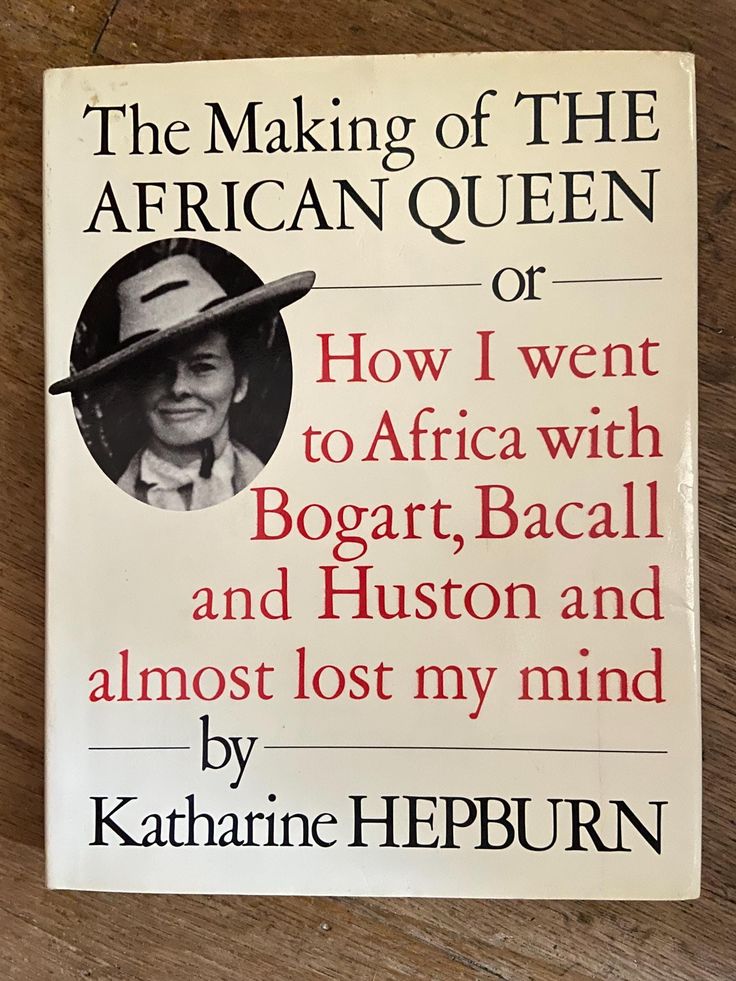
In vibrant Technicolor, you can see Hepburn’s green pallor in a scene where she’s playing the organ, and just off-screen the crew provided a bucket so she could vomit in between takes. No doubt, moments like this was the inspiration for one of Hepburn’s memoirs, “The Making of THE AFRICAN QUEEN or How I went to Africa with Bogart, Bacall, and Huston and almost lost my mind.” Other natural problems, in addition to illnesses, added to their production- soldier ants, parasitic fleas that burrow into feet (and did so with Bogart), and real predators all around them including venomous snakes, hippos, crocodiles, and baboons and near capsizing at any moment.
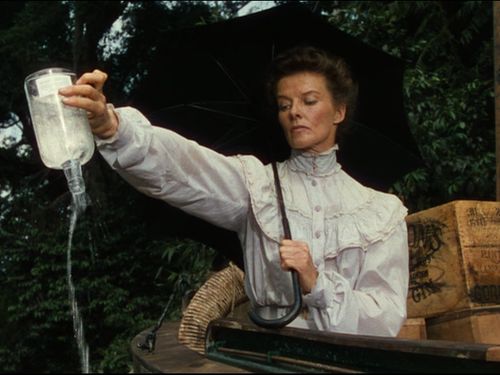
The filming (from May 1951 to August 1951) crew and actors spent weeks in the (then) Belgium Congo (now the Democratic Republic of the Congo), then another several weeks in (Lake Albert, Murchison Falls, Kabalega Falls) Uganda, followed by filming in London at the Shepperton/Isleton Studios. Any scenes where the cast or crew needed to be in water were filmed in London, including the memorable ‘leeches’ scene. (Don’t worry, no real leeches were nourished during filming.)
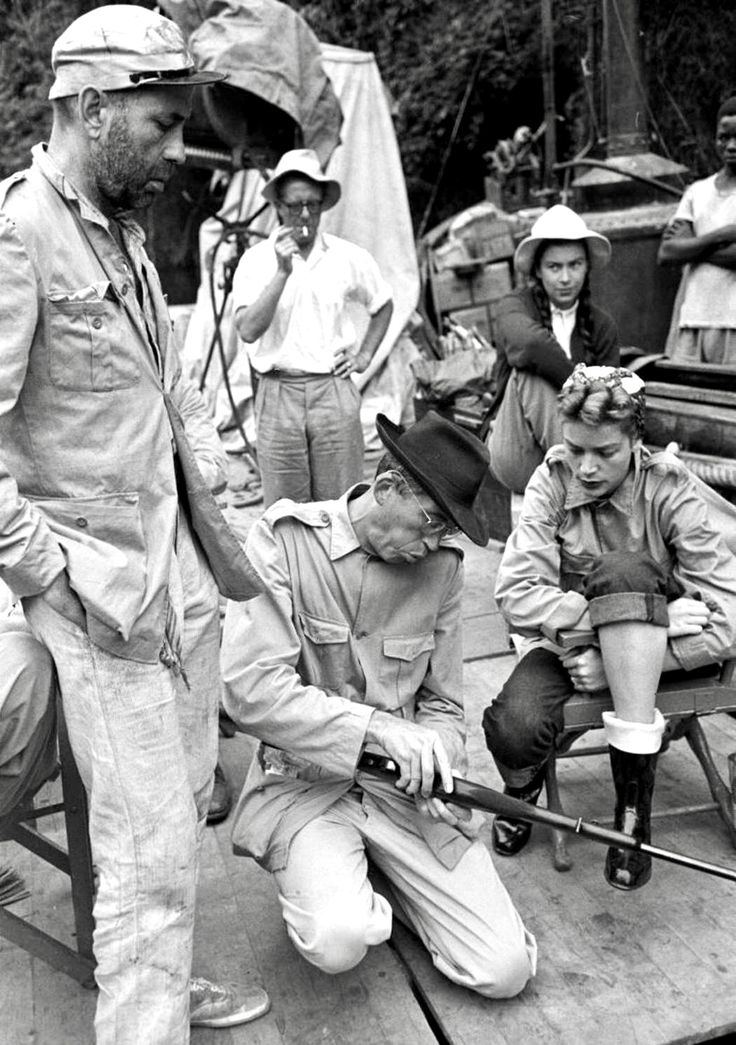
Despite seemingly insurmountable odds, THE AFRICAN QUEEN was a surprise hit. At a cost of a million to make the film, the box office eventually grew to $10.75 million. Audiences cheered for the adventure, the romantic comedy, the chemistry of this mismatched pair, and the irreplaceable realism of the African setting. Humphrey Bogart won the Oscar as Best Actor for this performance. Additionally, Kate was nominated for Best Actress, John Huston for Best Director, and James Agee and John Huston for Best Writing, Screenplay at the 1952 Academy Awards.
In discussion, explore the themes of what makes a good romantic comedy… a riveting adventure story… the right chemistry on-screen. Why do we as an audience find battling nature’s elements so compelling to drive a story? Often, Huston was drawn to tales of sympathetic losers. In what ways are Charlie and Rose sympathetic losers… or at least, underdogs we choose to root for?
Cast and Crew:
Directed by: John Huston
Produced by: Sam Spiegel
Written by: CS Forester (based on novel), James Agee and John Huston (screenplay)
Cinematography: Jack Cardiff
Music by: Allan Gray
Humphrey Bogart- Charlie Allnut
Katharine Hepburn- Rose Sayer
Robert Morley- Rev. Samuel Sayer
Peter Bull- Captain of the Luise
Theodore Bikel- First officer, Luise
Walter Gotell- 2nd officer, Luise
Peter Swanwick- 1st officer, Fort Shona
Richard Marner- 2nd officer, Fort Shona
Gerald Onn- Petty officer, Luise (uncredited)
Sources:
“50 Years: SAG Remembers the Blacklist”. Jan 1998. 22 Apr.2002.
http://www.sag.com/blacklist.html
“Me: Stories of My Life.” By: Katharine Hepburn. New York: Alfred A Knopf, Inc., 1991.
“Encyclopedia of the McCarthy Era.” By: William K Klingman. New York. Facts on File, Inc.,1996.
“Kate Hepburn: Tell Everyone I’m Doing Fine.” By: Neal Travis. The New York Post. May 16, 2000.
 Outspoken & Freckled