

In the Autumn of 2021, we were attempting how to navigate through a major pandemic. My goal was to continue teaching classic film courses; with masks on and social distance spacing, we somehow managed our best to stay safe while enjoying some old movies. That semester, I chose the topic of 1939: The Greatest Year in Cinema History. My intention was to highlight some magnificent films from that historic year that were left in the shadows of its two giants- THE WIZARD of OZ and GONE WITH THE WIND. That still left a great array of options.
For this first pick, we will explore a film that was a huge success for its studio, Universal Pictures; yet it barely squeaked into the top 20 greatest films of that momentous year. Despite its shuffle in that thick deck of filmography, we will discuss why this funny western remains a very influential and memorable classic.
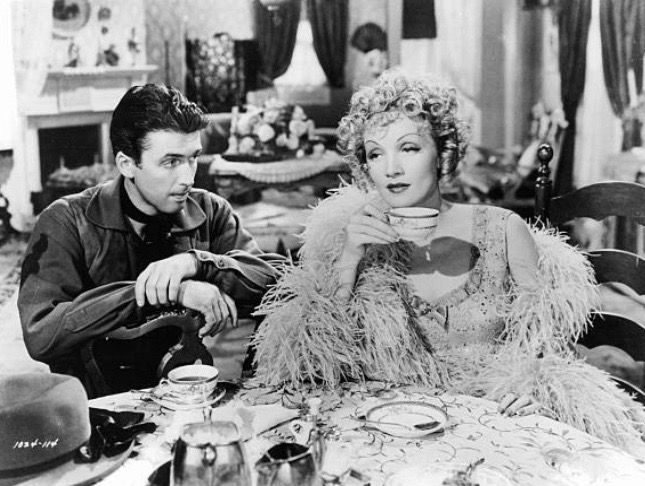
It was Universal Pictures biggest hit of 1939 and it marked the beginning of new era for both the studio and its leading stars. Universal specialized in westerns but the concept of a “comic western” was so successful in DESTRY RIDES AGAIN that it became a popular formula that followed for many years to come. This was the first western for both Marlene Dietrich and James Stewart. For Stewart, he embraced the western genre throughout the remainder of his career, even though he wouldn’t make another western after DESTRY until 1950 in WINCHESTER 73’. Perhaps it is sweetly fitting that Stewart’s last film role would be another twist on the western, as the voice of “Wylie” in AN AMERICAN TAIL: FIEVEL GOES WEST (1991).
Stewart and Dietrich seemed an unlikely pair of misfits. Marlene’s screen image exuded glamour and exotic seduction in her many successful films of the 30s. But by later in that decade, her film career hit a rough patch. Jimmy’s on-screen persona of the slender and humble fella next-door was a rising upcomer from the world of light musicals and romantic comedies. He had only been in the biz a few years but was already making a strong impression. Universal took a gamble that this mismatched, unlikely pair could make it work in a typical western with an atypical twist. They were right. And this film helped to reinvigorate Dietrich’s film career and launched Stewart into stardom.
At the heart of this film, DESTRY is a true western with all the standards audiences love and expect. But it is also peppered with very unexpected moments and characters. The comic element is undeniable and entirely welcomed. We see it in the supporting cast of characters, in the storytelling of Stewart’s Thomas Jefferson Destry, Jr., and in the irony of a sheriff battling a ruthless, lawless town brimming with crooks and villains without carrying a single pistol.
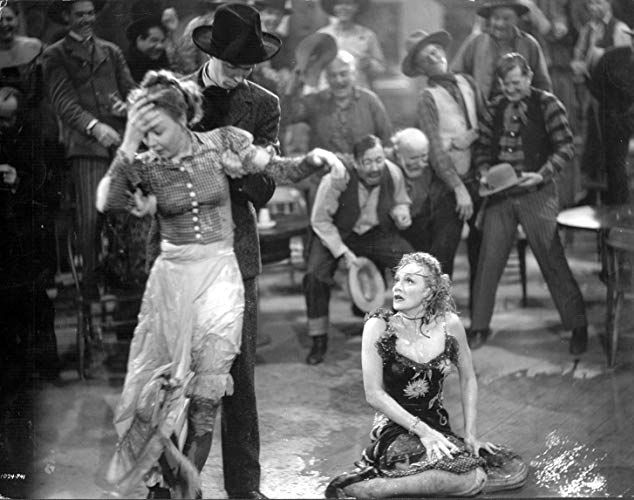
Any concerns that a glamorous screen goddess with a thick German accent could sling beers and bar brawl on the dusty saloon floors were quickly dashed as audiences fell in love with the no-nonsense “Frenchy.” Dietrich brings a necessary complexity to Frenchy’s character as we watch her evolve.
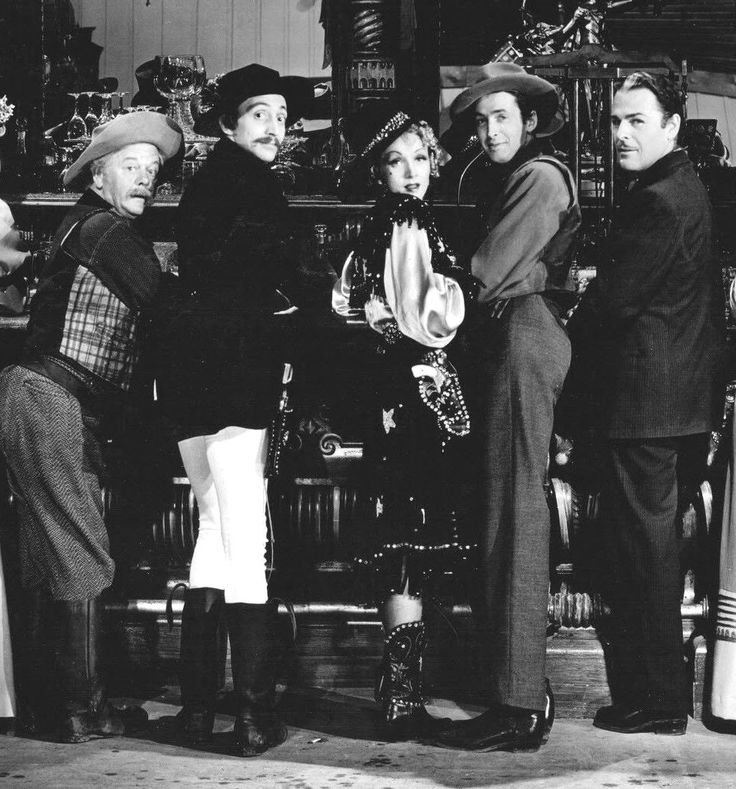
DESTRY is such a standout for its time that its quirky additions influenced films to come for decades. The bad-girl-gone-good saloon gal with a past who is drawn to the hero. A reluctant hero who wants to use words instead of violence, despite being the best shot in town. The town drunk who reforms and we discover his hidden talents. And of course, some female empowerment touches, too. All of these tropes may seem very familiar and almost common to modern audiences today, but it was DESTRY RIDES AGAIN that introduced them with brilliant finesse. That alone may explain why this film is such an important and remarkable inclusion in the greatest year in cinema history.

While you may not call DESTRY a “chick flick” by any stretch, there are clear nods to both female empowerment and a bending of the classic macho stereotype. From the strength of character of Frenchy herself, to a very realistic and very physical fight between Frenchy (Dietrich) and Lily Belle (Una Merkel) where both could hold their own against any rough and tumbling man, to a final scene of fearless women on the march with pitchforks in hand to save the town with their own courage, we see a clear message that women are not one-dimensional ‘sinner or saint’ props, nor just pretty prairie flowers fading into the background. For westerns in the talkie era, this is a refreshing change.
Stewart’s “Destry” also introduces a much softer approach to the otherwise typical western hero. Stammering, gangly, and passivist. He gets out of intense and violent scenes with a calming and slow pace. He makes no apologies for not wearing a gun and disarms his opponent with a distracting tale and a wise wit. He overcomes challenges by bringing the unexpected. That may be both its greatest strength and its recurring theme in DESTRY RIDES AGAIN- it is filled with the unexpected.
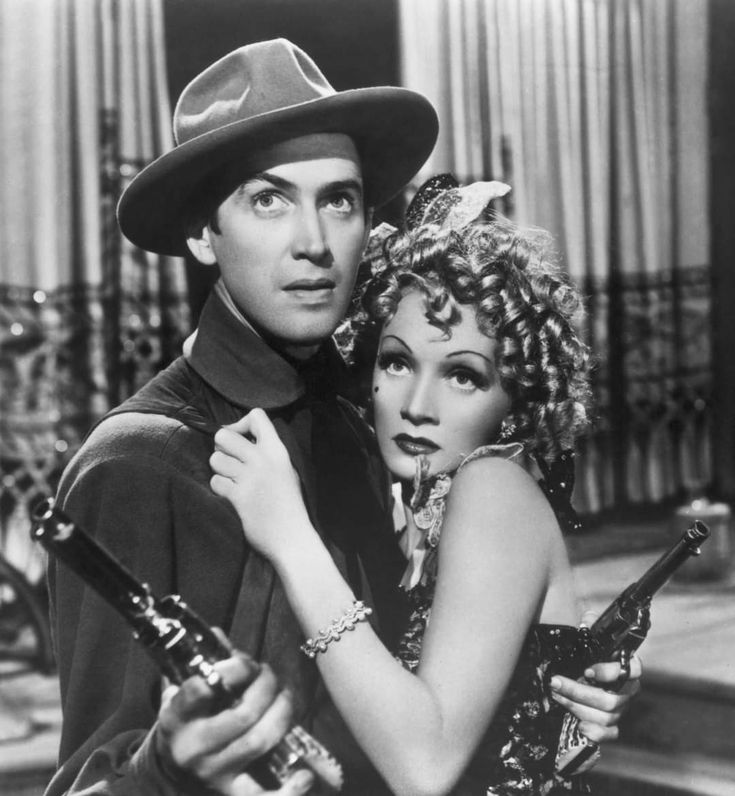
DESTRY marked a new beginning for its headlining star Marlene Dietrich. Her film career was in a slump and this film put her back on top. German born Dietrich started her career on the Berlin stage. She appeared in her first film in 1922, but it was her collaboration with director Josef von Sternberg that brought her international fame. Her first American film, Josef von Sternberg’s MOROCCO (1930), earned her sole Oscar nomination to go with her new Paramount Pictures contract. A string of successful films followed but by 1937 she hit a dry run with a couple of failures. A year before she was offered the role of “Frenchy,” she was labeled “box office poison.” The offer to play a saloon singer in a rustic western setting seemed like an unlikely fit for the sophisticated Marlene, but she needed a comeback.
It was her former director von Sternberg who convinced Marlene to leave her lounging into semi-retirement on the Riviera and take a chance and try something new with producer Joe Pasternak’s unique offer. “I put you on a pedestal, the untouchable goddess. He wants to drag you down into the mud, very touchable. A bona fide goddess with feet of clay—very good salesmanship.” By the time she arrived in America to begin filming, Hitler and Goebbels had already begun their propaganda campaign of extremism and division via Nazism. For Dietrich, one of the perks that lured her to accept this role was the promise of songs by Frederick Hollander (melodies) and Frank Loesser (lyrics). She was quite familiar with Hollander’s talents from “Falling in Love Again” from her earlier film, THE BLUE ANGEL (1930). They created the catchy and titillating “Boys in the Back Room” and “You’ve Got That Look” for DESTRY RIDES AGAIN, which became signature feature songs for her stage cabaret shows, well past her film days.
Based on the novel by Max Brand, DESTRY RIDES AGAIN was made into a film production in 1932 and starred popular Universal western star Tom Mix, a quietly strong presence. By the first attempt to re-write a new Destry, he no longer carried guns (Like Mix’s version) and behaved as a firm passivist. The entire plot feels quite different from the 1932 version directed by Ben Stoloff, centered on a wrongly imprisoned stagecoach driver seeking revenge and justice. But the essence of Tom Destry remained. Less than 50 pages of the script was complete by the start of production and new pages were added on the set daily. Despite what appeared behind the scenes to be pulled together in a flurry, the end results were polished.
Trivia:
-Both Gary Cooper and Joel McCrea were originally considered for the role of Tom Destry. Paulette Goddard was once considered for the role for Frenchy.
-It’s impossible to watch DESTRY without seeing Madeline Kahn’s inspiration for her role as “Lili Von Shtupp” in BLAZING SADDLES (1974) from Marlene Dietrich’s characterization and German cabaret singing in MOROCCO (1930), STAGE FRIGHT (1950), and DESTRY RIDES AGAIN (1939).
-James Stewart (age 31 yo) and Marlene Dietrich (age 38 yo) had an affair during the entirety of this filming
-Filming was held off until Stewart completed production on MR. SMITH GOES TO WASHINGTON
-Samuel S. Hinds who portrays the corrupt Judge Slade, worked with James Stewart again as his father “Pa Bailey” in IT’S A WONDERFUL LIFE (1946)
-Mischa Auer who brings comic relief as “Boris” was known for playing the “mad Russian” character in many films, including several popular Deanna Durbin films for Universal. Auer would work with Dietrich again in THE FLAME of NEW ORLEANS (1941).
-Una Merkel’s recall of the infamous fight sequence: “Neither of us knew what we were doing. We just plunged in and punched and slapped and kicked for all we were worth. They never did call in the stunt girls. Marlene stepped on my feet with her French heels. The toenails never grew back. She was stronger than me. She was very powerful and I was very thin. Luckily, I have a remarkable constitution. I was bruised from head to foot when it was over. I looked like an old peach, green with brown spots. And I felt like one too. At the end of the scene, Jimmy Stewart came in and dumped a whole bucket of water on us. He did it in long shot. Then he had to do it over for close-ups. Then Life Magazine wanted pictures so they did it over again. He dumped water on us for hours.”

Questions to consider as we watch scenes:
-What feels like a typical western, and what does not? How does this make for a better film?
-What messages do you see regarding passivism? How do you think that played out for audiences reading headlines about Hitler and the rise of Nazism in Europe? Do you think this influenced our views in delaying participation in the eventual war?
-What scenes or plot points seem ‘unexpected’ to you?
-Do you see any examples of feminism or gender role reversal?
-What other themes, styles, or external influences do you see?
-What makes this film an enduring classic for you?
Credits:
Directed by: George Marshall
Produced by: Joe Pasternak
Screenplay by: Felix Jackson, Gertrude Purcell, Henry Meyers
Based on: Max Brand’s novel “Destry Rides Again”
Director of Photography: Hal Mohr, ASC
Art Director: Jack Otterson
Film Editor: Milton Carruth
Set Decorations: R. A. Gausman
Gowns: Vera West
Assistant Director: Vernon Keays
Musical Director: Charles Previn
Score: Frank Skinner
Song Lyrics by: Frank Loesser
Song Music by: Frederick Hollander
Sound Supervisor: Bernard B Brown
Cast:
Frenchy: Marlene Dietrich
Tom Destry, Jr.: James Stewart
Boris: Mischa Auer
Washington Dimsdale: Charles Winninger
Kent: Brian Donlevy
Gyp Watson: Allen Jenkins
Bugs Watson: Warren Hymer
Janice Tyndall: Irene Hervey
Lily Belle: Una Merkel
Loupgerou: Billy Gilbert
Judge Hiram J. Slade: Samuel S. Hinds
Jack Tyndall: Jack Carson
Lem Claggett: Tom Fadden
Sophie Claggett: Virginia Brissac
 Outspoken & Freckled