
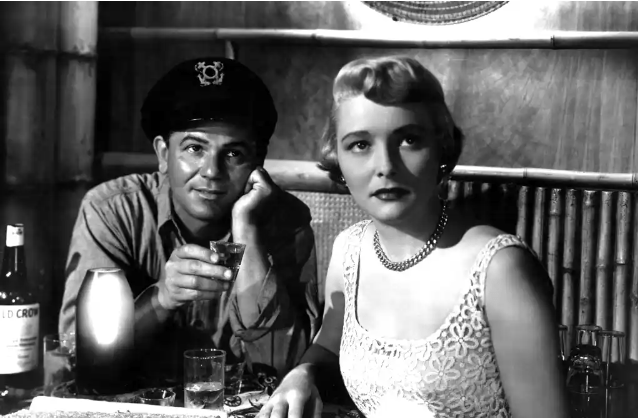
While Michael Curtiz would go on to make more films (22 more) in the decade following 1950, it is with good reason that I have chosen THE BREAKING POINT as the film to finish out our Curtiz journey. “Noir Czar” Eddie Muller while being interviewed on TCM by Robert Osborn once described this film as” brilliant,” and his favorite Michael Curtiz film; and yes, he included CASABLANCA on that list. If that alone isn’t reason to screen and discuss this film, don’t worry, there’s more.
Based on Ernest Hemingway’s 1937 novel, “To Have and Have Not,” more film fans will likely be familiar with Howard Hawks’ TO HAVE and HAVE NOT (1944) starring Humphrey Bogart and Lauren Bacall than today’s film adaption of the same novel. It’s interesting because it’s THE BREAKING POINT that is a much closer following to the original novel than Hawks’ version. As Muller noted, “the story goes that on a fishing trip Howard Hawks told Ernest Hemingway that he could make a good movie out of his worst book.” Hawks went on to call Hemingway’s novel “a piece of junk.” Muller added that the genesis of making this movie (THE BREAKING POINT) came when Warner Brothers’ contracted screenwriter Ranald MacDougall wanted to take a crack at making the book into a film, because it really hadn’t been attempted yet [noting how radically different Hawks version was from the Hemingway story].
While several leading male stars were considered such as James Cagney, Errol Flynn, and Kirk Douglas, MacDougall suggested John Garfield in the starring role. Garfield accepted, but only if Michael Curtiz was in the director’s chair. Garfield was one of Curtiz’s ‘discoveries’ when he transitioned from Broadway to Hollywood in FOUR DAUGHTERS (1938). But Garfield needed a good luck charm (with Curtiz) after his most recent film bombed. Garfield starred in UNDER MY SKIN (1950), directed by Jean Negulesco, also released the same year, and was based on Hemingway’s short story, “My Old Man.” Garfield had a great deal of influence on the set of THE BREAKING POINT, including casting. However, John Garfield was already beginning to find challenges in his professional and personal life by this time in 1950. Garfield would make only one more film, John Berry’s HE RAN ALL the WAY (1951) before he died on May 21, 1952.
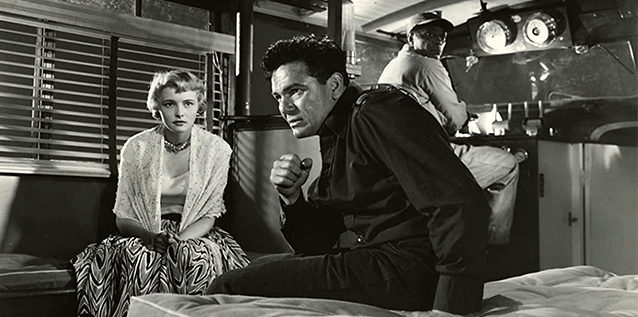
One of the few differences we’ll notice in the 1950 film adaption from the novel, is the enhanced scenes of dialogue that build up the intimacy and authenticity of the marriage between Garfield (as Harry Morgan) and his wife (as Lucy Morgan). It’s honestly a beautiful highlight to the film. Garfield insisted upon a realistic view of the financially troubled but loyal marriage. It also reveals the acting brilliance of both John Garfield (1913 – 1952) and Phyllis Thaxter (1919 – 2012). Thaxter, the impressive presence as Lucy Morgan, appeared in nearly seventy roles across film and television and may be best recalled as “Ma Kent” in SUPERMAN (1978).

The other difference from the novel that serves as an improvement is Juano Hernandez’s character (as Wesley Park). In the novel, Harry Morgan and his two shipmates are rough and openly racist. It was Garfield’s suggestion to make his pal (now a solo shipmate) a Black actor, via Juano Hernandez. Hernandez (1896 – 1970) portrayal of Wesley Park is of a sympathetic character with a nearly egalitarian friendship with Harry. Quite a reversal from the Hemingway characters. Producer Jerry Wald was the one to greenlight this project, but Garfield’s enthusiasm and exuberant stream of ideas meant he served as essentially an uncredited producer.
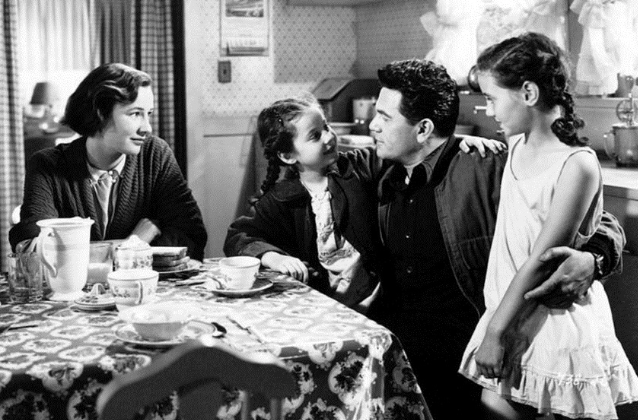
As we watch this complex performance of Garfield as the skipper captain who feels more and more torn in his role as a married family man under growing strain to provide via his threatened career, these webs of emotions were undoubtedly pulled from his own personal life. In his own life, John Garfield had an affair with a co-star while making UNDER MY SKIN just months prior – he felt conflicted with regret with an immense loyalty to his wife and kids. It was also during the release of this film early that summer that John Garfield was listed in the Red Channels publication on June 22, 1950. (The Red Channels was an anti-Communist pamphlet that listed 151 names in the entertainment industry in hopes to blacklist them, issued by the far right-wing “CounterAttack,” a weekly newsletter which ran from 1947 to 1955.) To fully understand the depth of his emotions and the mounting stress that Garfield endured during this time, I’ll share snippets of my thoughts on the background of this talented actor from a piece I wrote reflecting the work on his last film:
By the time the United States entered World War 2, Garfield attempted to enlist but was unable to serve due his weakened heart from his childhood illness of scarlet fever. So he and Bette Davis created the famed Hollywood Canteen. He contributed in the best way possible by promoting war bonds and giving back to soldiers who were able to serve. During wartime, Hollywood’s most dazzling stars volunteered to entertain, feed, dance, and waited on over 2,000 servicemen a day. It’s estimated that over four million uniformed military (officers were not allowed) came through those doors for an unforgettable experience as a thank you for their sacrifice, before it finally closed its doors on Thanksgiving in 1945.
During the war and post-war years, he continued to make films- many dramas, melodramas, and patriotic war themes. Highlights include THE POSTMAN ALWAYS RINGS TWICE (1946) and the antisemitism film, GENTLEMAN’S AGREEMENT (1947). In 1946, his contract with Warner Brothers expired and he was happy not renew and make his own choices as a free agent. He formed his own production company, Enterprise. His first film was the indie, BODY and SOUL (1947). With this prizefighter film noir, he earned another Academy Award nomination, this time for Best Actor in a Leading Role.
Despite Garfield serving his country in the only way he could, years later his country and the Hollywood system questioned his patriotism and loyalties. In the late 1940s and into the 1950s, Garfield was swept up into the controversy swirling around Hollywood- the paranoia of communism with McCarthyism and the House Un-American Activities Committee. In 1951, he was called to testify before the HUAC. He denied being a Communist and refused to name anyone who was. His statement: “I have nothing to hide and nothing to be ashamed of. My life is an open book. I am no Red. I am no ‘pink.’ I am no fellow traveler. I am a Democrat by politics, a liberal by inclination, and a loyal citizen of this country by every act of my life.”
Even though his loyalties to his country should’ve been obvious to anyone with a pulse, yet because he was one of those called to testify, he was essentially “greylisted” by the industry. With film work scarce with little support from industry backers for his production company, he continued stage work. He returned to Broadway in 1952 to revive “Golden Boy” in the role which was denied him years earlier. In attempt to clear his name and pave a path for his return to Hollywood, he planned to publish a magazine interview titled, “I was a Sucker for a Left Hook,” which would state his case for the American public, without naming names but admitting that he was conned when he had donated money to left-leaning groups that were fronts for the Communist Party and reassert his strong American values. He arranged to meet with the FBI to bring closure. Instead, they presented him with a file on his wife Robbe, noting that she signed an old Communist card in her past and attempted to turn him to testify against his own wife. He walked out.
In 1951, just two months prior to his April 23rd testimony in front of the HUAC, HE RAN ALL THE WAY was scheduled to premiere, on June 19th. Little did the world know at the time, that this film would be John Garfield’s last. Based on Sam Ross’s novel, Dalton Trumbo was hired to write the screenplay. However, this was shortly before Trumbo was scheduled to start his jail term from his own HUAC testimony, in which he refused the name names. As a result, screenwriters Guy Endore and Hugo Butler were called in to revise Trumbo’s work to finish director John Berry’s vision for filming. Co-producer (this film was produced by Garfield’s own production company) Bob Roberts who was successful in producing film noirs at this time faced his own Red Scare pressures and later fled to England with his family.
In early May of 1952, Garfield separated from his wife and moved out of their apartment they shared with their children. No doubt the stress of Garfield’s career and the political tyranny were walls closing in too tightly to keep a marriage intact. Friends said his wife was not supportive of his upcoming “public apology” magazine article. John and Roberta Seidman “Robbe” had been married since February of 1935. They had three children- Katherine, born in 1938 died as a young child of an allergic reaction in 1945, David, born in 1943 and died in 1994, and Julie was born in 1946. On May 20, 1952, Garfield spent hours playing tennis after a sleepless night. Afterwards while at a friend’s apartment, feeling unwell and chilled, he asked to lay down. He never woke up. His heart failed. At the age of only thirty-nine years, John Garfield died.
It may not be surprising that an intense actor, who smoked heavily with a weak heart condition, would not live a long life. But many of his friends and colleagues squarely blamed the intense scrutiny and direct threat upon his career on the HUAC and the FBI as a major contributor in expediting the speed of his shortened life expectancy. What we know in modern medicine today regarding stress and its effects on our overall health, I’m inclined to agree. It’s a heartfelt tragedy to consider what could’ve been- not only with John Garfield’s career if the Red Scare hadn’t brutalized so many creatives’ careers, but also to his family, and possibly to the longevity of his life.
—–
When watching these poignant scenes between Harry and Lucy Morgan, keep this background of John Garfield in mind. As for the other point of this film’s love triangle (well, sorta), Leona Charles as portrayed by Patricia Neal was the invention of screenwriter Ranald MacDougall, another departure from the novel. What’s fascinating about this femme fatale, is how much Harry Morgan rejects her. And despite Harry’s devotion to his wife, we can’t fault Leona for trying. Neal is perfect as the flirting, sharp-witted, and persistent third wheel.
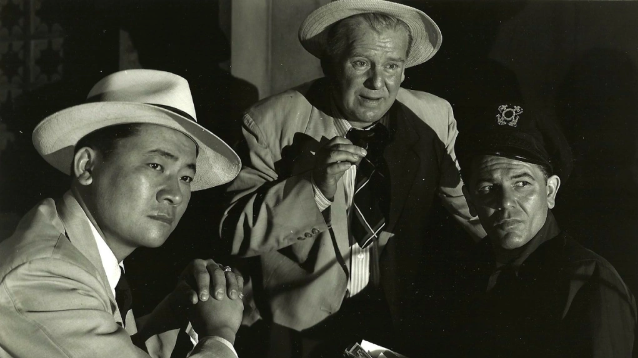
Some of the other actors that bring superior performances even in the smallest roles include Wallace Ford [FREAKS (1932), A PATCH of BLUE (1965), HARVEY (1950), SHADOW of a DOUBT (1943)], as the slimy, sweaty FR Duncan and Victor Sen Yung as Mr. Sing. Yung was a prolific actor across tv and films with over 160 acting credits, but you may recognize him best from his role in THE LETTER (1940).
The ending of this film is deeply heartbreaking, as we watch a wandering boy looking for his father on the dock. A father that will never show. That eight-year-old boy portraying Joseph Park is in fact the real-life son of Juano Hernandez, Juan Hernandez. I could only find one other acting credit, in the film ROOTS (1954). Juano Hernandez passed in 1970 at the age of 73, but it appears his son from that final scene is still with us. The ending also brings an interesting closure with an amputation. Harry loses a limb, but not his life. It represents a change going forward- one that he accepts and moves forward in choosing his family. The symbolism is more nuanced than a dramatic ‘lives or dies’ ending, and certainly presents a more realistic hero.
In addition to the moving performances by the superb cast, the aptly scribed script by Ranald MacDougall, and the strong direction by Curtiz – the cinematography is another example of Ted McCord’s (1900 – 1976) talent. He’s the same cinematographer who earned three Oscar nominations that range from JOHNNY BELINDA (1949) to TWO for the SEESAW (1963) to THE SOUND of MUSIC (1966). His 164 notable film credits as Cinematographer include THE TREASURE of SIERRA MADRE (1948) and EAST of EDEN (1955).
As we close out our adventure into the life and films of Michael Curtiz, look back at the films that we featured, beginning with a bizarre Science-Fiction horror in shades of orangy-pinks and emerald greens, to swashbuckling tales, a gangster film with emotional complexity, a beloved wartime classic that many consider the greatest film of all time, an unexpected thriller, a jazzy musical biopic, and now a film adaption of an American classic that was likely a ‘dark horse’ for most of you. I encourage you to continue your own journey of Curtiz discovery that didn’t make our list- like a romantic pirate swashbuckler in CAPTAIN BLOOD (1935), perhaps a patriotic biopic in YANKEE DOODLE DANDY (1942), or sing-along in Technicolor in Doris Day’s breakout role in ROMANCE on the HIGH SEAS (1948). Curtiz went on to make more films following his departure at Warner Brothers in 1954 yet slowed down in those last six years of his life (d. April 10, 1962) with his unbeknownst diagnosis of cancer. He made some fun films during the post-WB years, like the Christmas classic, WHITE CHRISTMAS (1954), an Elvis film, KING CREOLE (1958), and a western starring the Duke, COMANCHEROS (1961). Yet nothing compared to his 28 years at Warner Brothers where he was at the top of his game and made 86 films. For all his personal failings, there may never be another director with the scope of films like Michael Curtiz.
Sources:
“Michael Curtiz: A Life in Film.” Alan K Rode. University Press Kentucky. 2017.
“Noir Alley.” Eddie Muller. Turner Classic Movies network. July 26, 2020.
“John Garfield- The Final Bow.” Kellee Pratt. Outspoken & Freckled. May 25, 2024.
IMDB
 Outspoken & Freckled