THE UNSUSPECTED (1947) was the very first film Michael Curtiz made under his new production company, Michael Curtiz Productions. As such, it’s an important pit stop in our Curtiz journey. In the end, it was a mix of hits and misses; but overall, an important lesson in his life as a filmmaker.
With Hal Wallis’s post-CASABLANCA disgruntled exit at Warner Brothers and with Curtiz’s maiden voyage into the production side, he began to see its challenges of juggling both producing and directing. He created the production company because he ached for more control of his films. But he soon learned that one of the down sides, was having to front the money. Still in a relationship with the studio, he worked out a deal where they would split the costs and the profits fifty-fifty. This film was part of a 14-picture deal between Curtiz and WB. Ultimately, it was the poor distribution and lack luster marketing that he couldn’t control, and it sunk him.
Yes, the lack of distribution and marketing was a challenge as were parts of the storyline. But, before we get ahead of ourselves, let’s discuss why it’s a little-known gem in the Curtiz and film noir files. Based on a story by Charlotte Armstrong, who was a strong classic author of mysteries and suspense screenplays, plays, and short stories. Armstrong’s THE UNSUSPECTED story was initially published as a serial in “The Saturday Evening Post” in 1945. You may know her as the writer for one of Marilyn Monroe’s strongest performances in DON’T BOTHER TO KNOCK (1952). Curtiz passed the story onto screenwriters Ranald MacDougall and Mike’s own wife, Bess Meredyth to adapt it into a screenplay that he could work with. MacDougall worked with Curtiz when he wrote the screenplay for MILDRED PIERCE (1945), which earned six Oscar nominations (including Best Picture), plus Crawford won for Best Actress in her leading role.
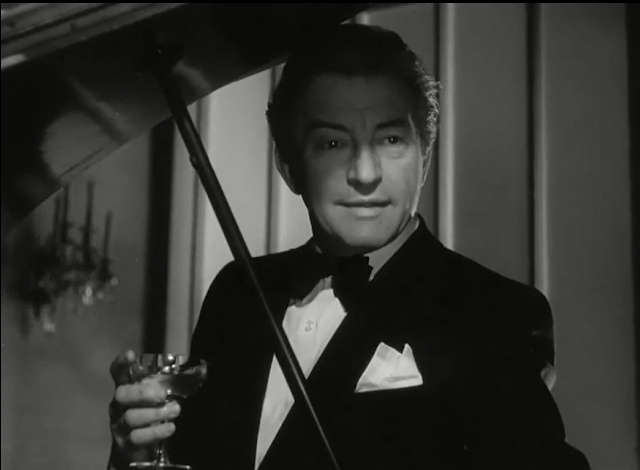
Curtiz had his mind set on Orson Welles for the lead role as Uncle Victor Grandison, Dana Andrews as Steven Howard, and Joan Fontaine as Matilda. Welles was suffering from some career blows after being let go from RKO and it was during filming LADY FROM SHANGHAI (1947), so he turned it down. Both Robert Alda and Humphrey Bogart were also considered at one point. Grandison’s character was supposedly inspired by the radio star, Alexander Woollcott, the New Yorker magazine drama critic and commentator known for his flamboyant style and razor-sharp wit. As a package, Andrews came with Virginia Mayo and Cathy O’Donnell. But Andrews turned it down when it became clear to him that this part was not a leading role, or even co-lead. Mayo and O’Donnell went with him- and Fontaine who was briefly wooed, left upon realizing that Andrews was out.
Mike knew he couldn’t afford all-star cast, so he had hoped for a mix of a couple of big names, character names, plus a ‘break-through’ role. As his initial options each fizzled, he knew he could rely on Claude Rains. He’s an excellent choice, whose performance fits the bill, although the idea of a Welles’ interpretation would be an interesting one.
It’s also interesting to note that one of the inspirations for this film is Otto Preminger’s LAURA (1944). Curtiz was a fan of this film, which prompted his desire to cast Andrews. But as soon as you hear that, the parallels between this film and LAURA seem almost too familiar. The radio broadcasters of Victor Grandison and Waldo Lydecker (Clifton Webb) are eerily similar. In personality, in profession, and in use of technology as an alibi. But don’t let that kill the joy of this film.
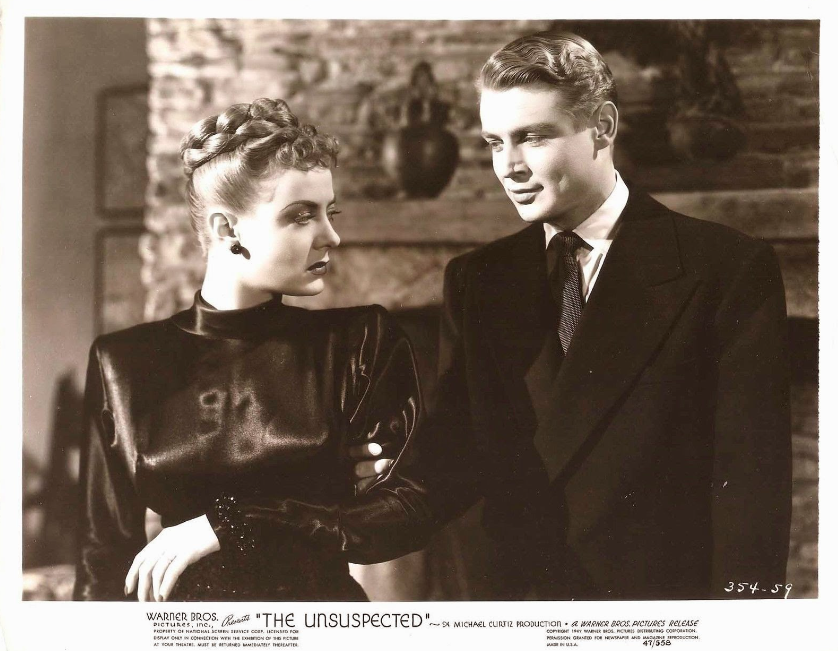
For the role of Steven, Curtiz wanted to introduce an unknown, as he was reputed for his discoveries (Errol Flynn, John Garfield, Doris Day…). In this case, Actor Ted North was not exactly his discovery nor was he lacking in screen time. He had screen appearances in small roles since 1940. In the same year of THE UNSUSPCTED release, North co-starred with Lawrence Tierney in THE DEVIL THUMBS a RIDE (1947). If he could handle Tierney, surely he’d have no issues with Curtiz. But he was still a relative unknown. Just to give the audience the effect of a ‘rising star’ or ‘newbie,’ Curtiz switched his name Ted to Michael, and the opening titles listed him as “introducing Michael North.” Not sure if audiences were fooled or not, but this was North’s last film appearance and he switched careers from actor to talent agent. Clients included many popular film and TV actors such as Red Skelton, Amanda Blake, and Milburn Stone (Gunsmoke).
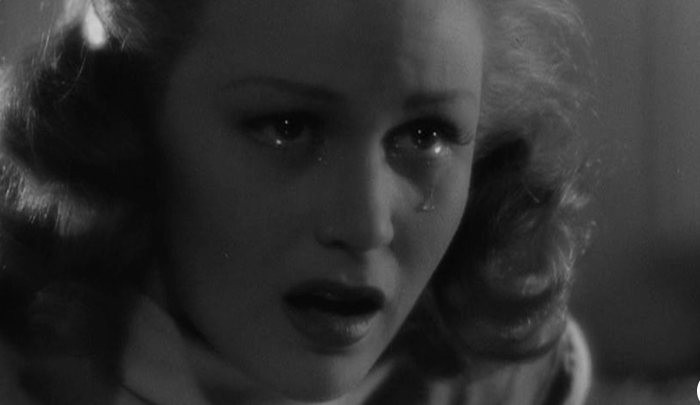
Joan Caulfield was borrowed from Paramount for the role of Matilda. She had a handful of roles, a few as the pretty faced accessory to Bing Crosby films. She fit the budget. In the early 1950s she transitioned to television where she found more work. Audrey Totter was borrowed from MGM and David O Selznick was not too keen on letting her go, but a deal was brokered, nonetheless. Hurd Hatfield as the drunk and weak husband Oliver is recognizable as the never-aging source of evil in THE PICTURE of DORIAN GRAY (1945). There’s even a little insider joke in this film as a reference to his former film, in that memorable role. See if you can catch what he says as he gazes up at a portrait of Matilda.
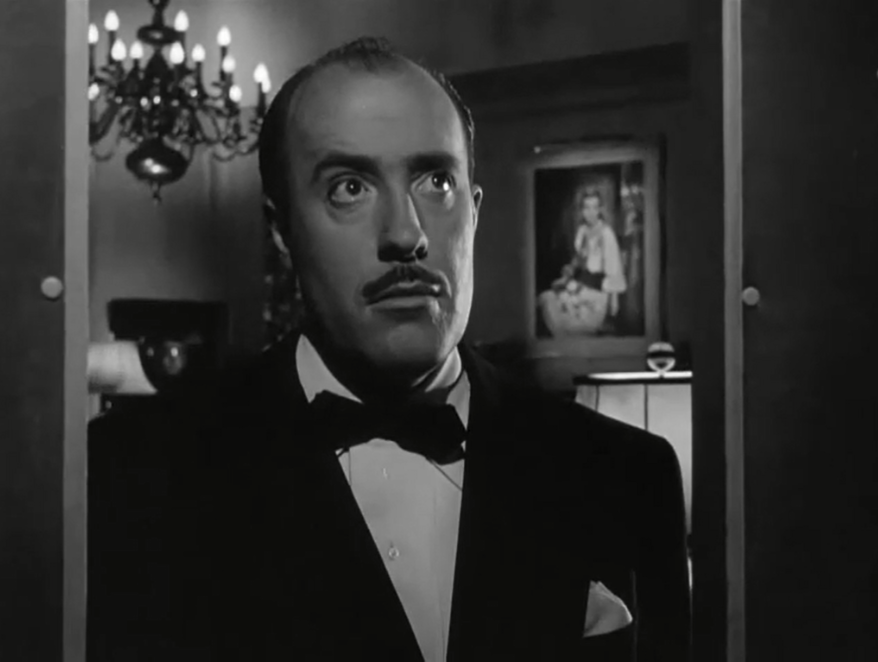
The stand-out performances go to Claude Rains- an actor who consistently delivered and expertly pivoted back and forth from character actor to leading roles, Audrey Totter, and Fred Clark. While this wasn’t really the film debut of Ted, ahem, Michael North, it was the film debut of Fred Clark. Unlike North, you could say he was a ‘discovery’ of Michael Curtiz. Although a character actor, he was reliably versatile in genres from comedy to dramas. He would go on to memorable films like WHITE HEAT (1949), SUNSET BOULEVARD (1950), and AUNTIE MAME (1958).
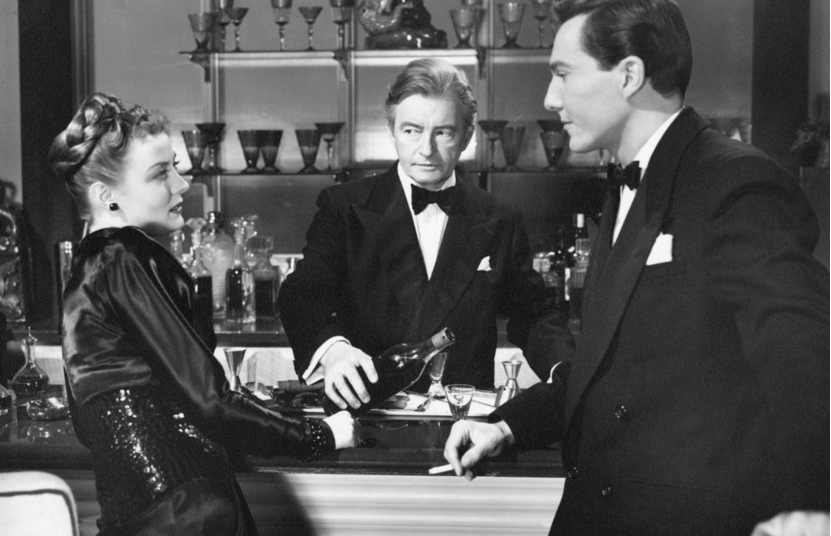
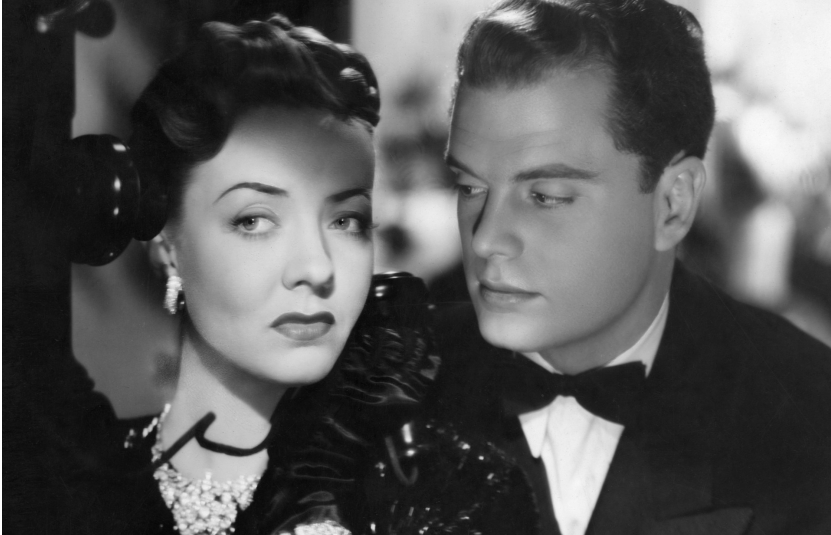
Audrey Totter really shines as Althea. No wonder Curtiz wanted to keep working with her. There are few faces as ‘Noir expressive’ (if I may be allowed to make up a term) as Totter’s. Her sharply deep glares, her large, expressive eyes, her snarled up lips, her cat that ate the canary smile then denies the act while a yellow feather curls out from her mouth… yes, she certainly stands out as a favored actress in film noirs. In looking for the role of Victor’s radio show director, Jane, Eve Arden was in the running early on. The role went to Constance Bennett, who started her prolific acting career in silent films, popular Pre-Codes, and screwball comedies (such as TOPPER films). Bennett’s role is smaller than it should be considering her performance, but it’s obvious that they wanted an ‘Eve Arden type.’
The film’s effective score was composed by Franz Waxman, who scored some of the best film scores in the classic era- BRIDE of FRANKENSTEIN (1935), REBECCA (1940), SUSPICION (1941), and SUNSET BOULEVARD (1950), to name a few. He won Oscars for SUNSET BLVD. and A PLACE in the SUN (1952) and earned nominations for three more.
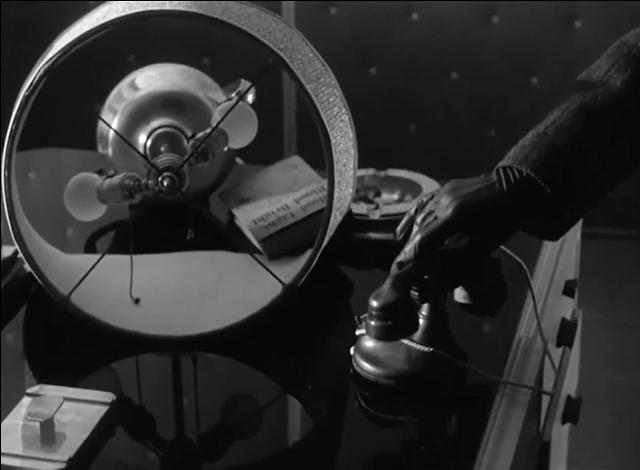
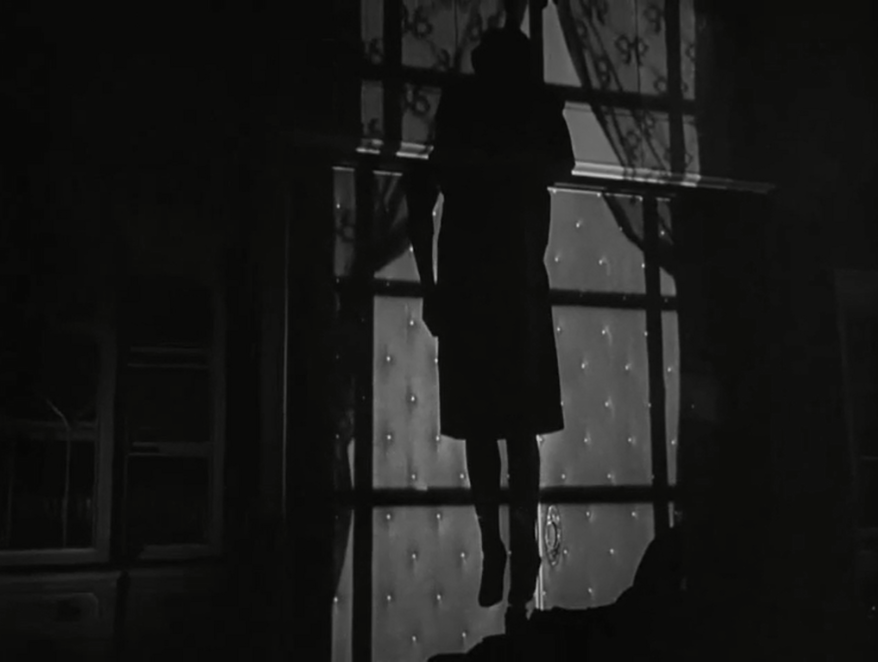
But the most outstanding reason to watch and thoroughly enjoy THE UNSUSPECTED is the cinematography and the artistic camera framing. Curtiz hired Woody Bredell as Director of Photography. Curtiz would work with Woody next on the Technicolor musical, ROMANCE on the HIGH SEAS (1948)- the discovery of Doris Day in her film debut. But it was Woody’s work as D.P. on the iconic film noir, Robert Siodmak’s THE KILLERS (1946) that really caught Mike’s eye. Visually, Curtiz had been working towards film noirs his entire career with his deep appreciation of shadows and German Expressionism. Together, Mike and Woody bring out incredibly artistic moments on film- even with everyday objects, close ups, and those gorgeous shadows everywhere. Practically every frame is like a piece of art.
While screening THE UNSUSPECTED, try to be forgiving of the areas that seem to fall just a tad short (like minor plot points that seem contrived or convoluted), instead focus on the noir visual feast. I don’t think you’ll be disappointed.
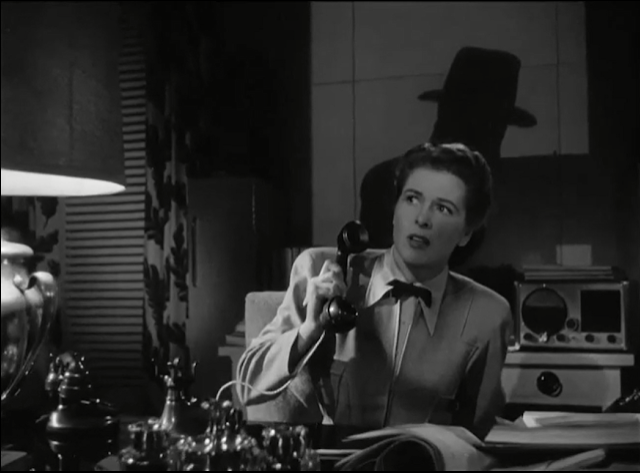
Cast and Crew:
Directed by: Michael Curtiz
Produced by: Michael Curtiz, Charles Hoffman, George Amy (Assoc. Producer)
Writing: Charlotte Armstrong (story), Bess Meredyth (adaption), Ranald MacDougall (screenplay)
Director of Photography: Elwood Bredell
Music: Franz Waxman
Editing: Frederick Richards
Art Direction: Anton Grot/ Set Decorations: Howard Winterbottom
Makeup: Perc Westmore
Wardrobe: Milo Anderson (designer in the Costume Dept that worked on- CAPTAIN BLOOD, MILDRED PIERCE, THE ADVENTURES of ROBIN HOOD…)
Joan Caulfield- Matilda Frazier (Grandison’s ward)
Claude Rains- Victor Grandison
Audrey Totter- Althea Keane (Grandison’s niece)
Constance Bennett- Jane Moynihan
Hurd Hatfield- Oliver Keane
Michael North- Steven Howard
Fred Clark- Detective Richard Donovan
Harry Lewis- Max
Jack Lambert- Press
Nan Bryant- Mrs. White
Walter Baldwin- Judge Maynard
Ray Walker- Donovan’s assistant
Barbara Woodell- Roslyn Wright
 Outspoken & Freckled
Loved your write-up on this woefully underrated film. I agree that the plot is not the most logical, but it’s certainly interesting and unique, and the performances of Rains, Totter, Bennett, Hatfield, and Clark are worth the price of admission.
Karen
LikeLike
Thanks so much, Karen! Although it’s more effective visually than anything else, the noir aesthetics are stunning. And Totter in any noir is aces!
LikeLike