
For classic film fans, the holiday season represents a time to wax nostalgic over those classic films that pop up this time of year. Everyone has his or her own must-see favorites. Perhaps you prefer a mainstream flavor like WHITE CHRISTMAS or IT’S A WONDERFUL LIFE, or perhaps you go for something a bit under the mainstream radar like HOLIDAY AFFAIR or IT HAPPENED ON FIFTH AVENUE. Personally, I like them all.
Recently, as I was watching Barbara Stanwyck flipping flap jacks with S.Z. “Cuddles” Sakall in Peter Godfrey’s Christmas in Connecticut (1945), I was reminded that this is not only a beloved holiday gem, it’s also a female-driven Screwball Comedy that deals with feminism head-on. This film makes the holiday lists, sometimes it makes the Screwball lists, but rarely the Feminist Film lists. So which is it? Let’s look at the clues.

For those unfamiliar with this film (Spoiler alert: here comes some plot reveals but I’m not here to share a full review), Barbara Stanwyck is Elizabeth Lane, the 1940s version of Martha Stewart, Food Network’s Giada De Laurentiis and HGTV’s Joanna Gaines all wrapped into one pretty domestic goddess package. Except, as it turns out, she’s not. She’s a phony. She writes a popular magazine column that features yummy homespun recipes and portrays her as a happy housewife in hyper-drive in an idyllic Connecticut farmhouse vision.

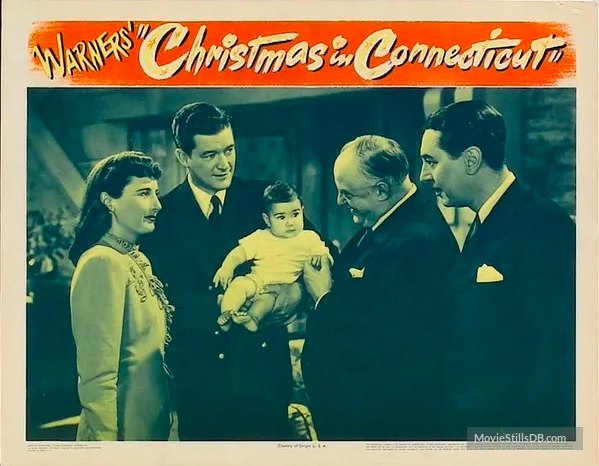
The recipes belong to Hungarian restaurateur pal Felix (Cuddles) and the farmhouse belongs to her architect beau, Reginald Gardiner as John Sloan. She can’t cook. She lives in the city. She’s a childless, single, career girl. WW2 sailor Dennis Morgan as Jefferson Jones, recovering from being adrift at sea after a German U-boat attack, is a big fan of her column and dreams of feasting in Connecticut at her farmhouse. Media publisher Sydney Greenstreet as Alexander Yardley sets up a visit for publicity. It all goes topsy-turvy when city mouse Elizabeth goes well past her comfort zone in the pretty countryside, pretending to be an ideal wife, mother and chef… and serendipitously finds love along the way.

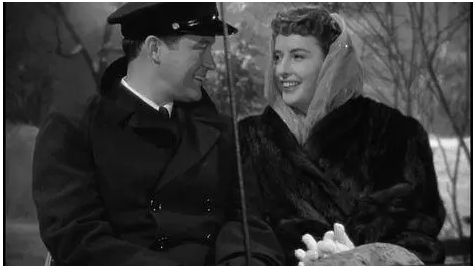
While the plot doesn’t deal with the holidays as straight-forward as some, it does take place at Christmas time and the word ‘Christmas’ is in the title, after all. Additionally, Elizabeth falls for hunky vet Jeffrey when he sings Christmas carols to her, as she’s trimming the tree. How romantically Christmassy is that?? There are romantic, wintery scenes abound when we see the farmhouse covered in snow, which is as pretty as a holiday card and reminiscent of other snowy sets such as HOLIDAY INN (1942). Plus a romantic sleigh ride looks perfection as Stanwyck gets cozy in a mink fur coat with a shimmering scarf, delicately framing her locks. Finally, Yardley breaks fourth wall to the audience with, “What a Christmas! Ho, ho, what a Christmas!” in his typically hardy laugh.
So, does it qualify as a classic holiday film? Most definitely.
If you read my article that I wrote on “Surviving the Holidays with the Screwball Leading Ladies,” you may recall the signature hallmarks of a Screwball Comedy, which I listed. Christmas in Connecticut meets many of these.
1) Female-driven: This film is centered on Barbara Stanwyck’s character as the focus of the entire film.
2) Mixed-up identities: We see mix-ups everywhere. Elizabeth is not who she says she is (and the multiple role mix-ups that ensue)- even babies get mixed-up, too.
3) Gender switch-ups: We see that played out in diaper dilemmas with the babies
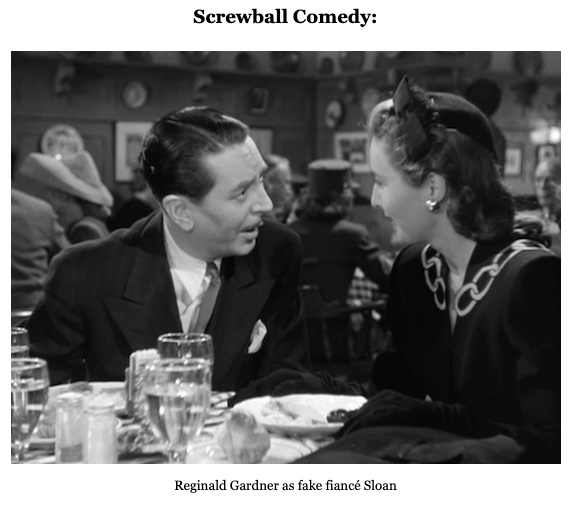
4) The less-dominant male in a love triangle: Fake fiancé Sloan is not exactly the strong, assertive male, although he may be in his career ambitions. The chemistry between Gardiner and Stanwyck is ZILCH, which conveniently allows a clear path for sparks to fly with Dennis Morgan. The only reason she’s finally agreeing to marry Sloan is for the sake of keeping her cover to protect her career. Let’s not kid ourselves here; no one believes John ever had real interest in marrying Elizabeth, except to serve as a cover for being ambiguously gay. Obviously not directly stated, but there are clues beyond his prim Brit demeanor that subtly hints at Old Hollywood code for gay:
Elizabeth Lane: “Oh, it’s Yardley. He’s sending me a sailor for Christmas.”
John Sloan: “Oh how nice… a sailor!”
5) Madcap pace: We see this briefly, in moments of trying to get secretly married and other scenes of attempting to hide the truth.
6) Wealth: Elizabeth is no eccentric heiress, but that farmhouse is big money. And as we all know, Connecticut is a favored geography for Screwball comedies.
So, is Christmas in Connecticut a Screwball Comedy? I’m convinced.
Finally, is there a core value message addressed in this film dealing with feminism and/or women’s roles? What’s interesting about this film in the context of 1945, it asks the question if women can/or should do it all? We are introduced to a woman who appears relatively realistic in her life as a single, city girl. Culinary expertise equals boiling water. She pretends to be a domestic goddess because who has the time to balance a successful writing career in addition to all of those roles in glossy magazine cover style?
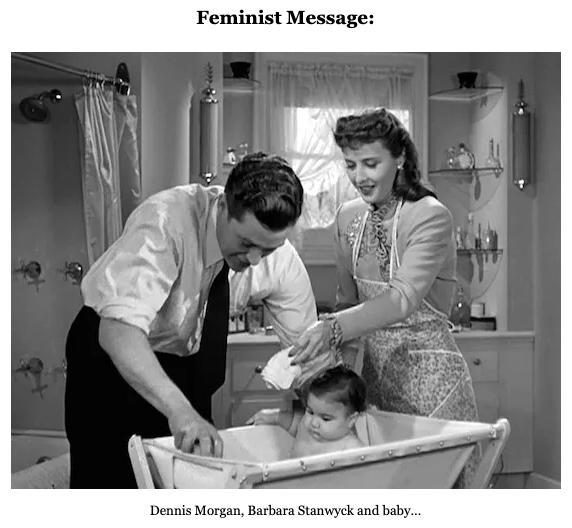
When we see her attempt domestic skills, she’s very awkward and unsure. It’s war-hero Jones that feels more at home in the stereotypical maternal roles, such as bathing a baby. Unlike many films at that time that would poke fun whenever men were shown performing basic parenting skills like diaper changing, this film shows this image of equality in a positive light.
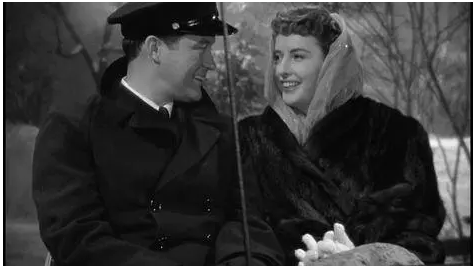
The flirting between Lane and Jones dances along the post-code enforcement censorship lines because she is very direct as a married woman seducing a man who isn’t her husband. Granted, the audience knows she’s not actually married, but I’m surprised this was so overt.
In the end, I believe the message is that the domestic goddess image as a goal for women is a fictional, unrealistic one. She is offered the opportunity to have it all – keep her job, with a raise, and still find bliss in love… domestic duties optional. If she chooses to keep Cuddles handy, and Jones appears to make an ideal hubby for parenting, who needs to learn how to cook and run a farm, anyway?
So, is it a feminist film?
Perhaps it’s not the strongest feminist definition, but it does project a more open-minded view for its time by simply asking the questions regarding women’s roles, even if it doesn’t take a firm stance on the answers. And by default as a Screwball Comedy, it plants the female lead into the driver’s seat. I think that’s a good start.
Ultimately, I truly enjoy Christmas in Connecticut, more so every time I watch it. Barbara Stanwyck is in her romantic comedy prime. Plus the setting is pure Christmas classic schmaltz, which I never tire of especially this time of year. Whether you consider it a holiday classic, a Screwball Comedy, or even a film that takes a chance in 1945 to question traditional gender roles, it’s got something for everyone.
*(This article authored by Kellee Pratt was originally published in the Classic Movie Hub. Explore the site for more classic movie goodness!)
 Outspoken & Freckled
I’ve always loved this film. It’s both –screwball comedy and feminist flick as only Ms. Stanwyck could do it all. From Femme fatale to adorable leading lady. I also suggest “Remember The Night” – a Christmas sub plot theme and love story with Fred MacMurray. AND, it has a happy ending without yielding to Hollywood’s ‘cop out’ ending. Plan to watch tonight.
LikeLike
I just remembered – “Arnold” directed a remake of “Christmas In Connecticut” with Kris Kristofferson and Diane _________(?–senior moment here. Diane who was also Mrs. Cary Grant). It was okay but not as good as the original.
LikeLike
A Christmas delight! The baby swapping is one of my favorite gags.
LikeLiked by 1 person
Agreed- I think mistaken identity is one of my favorite tropes in comedy.
LikeLike
Thank you O&S for an interesting piece. I will seek this film out for next Christmas, it sounds great. I have been searching for lesser known Christmas movies for awhile now and was hoping to see (your previously reviewed) Miracle at Morgan’s Creek this past Christmas but was unable to find it in the end either online or on DVD/BluRay. I did manage to find Remember the Night, which looked very promising with the personnel involved (Stanwyck, Leisen, Sturges, McMurray) but which I have to say I ultimately found very disappointing. It was more gratuitously wacky than funny and the script seemed like it was written in one afternoon and just did not click. I did manage to finally see The Lady Eve over Christmas after many years of trying, and that did not disappoint, a brilliant script and terrific performances and directed superbly; a truly great film, although without a Christmas backdrop, but which like your film reviewed above, ends up in Connecticut.
LikeLike