
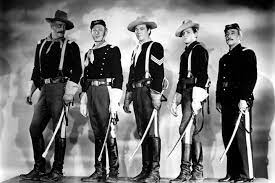

(The following is my handout from the John Ford course I taught in the winter semester of 2023.)
The film we’ll be screening tonight is one of Ford’s ‘Calvary trilogy’ films, SHE WORE A YELLOW RIBBON. So called for the use of the United States Calvary at the center of these stories. FORT APACHE (1948), SHE WORE A YELLOW RIBBON (1949), and RIO BRAVO (1950) … each film explored Ford’s passion for blending war and western themes in succession after World War II. Ford takes a romanticized and mythical view of American history during the 1870s when the mounted army assisted pioneers in their expansion westward, across Indigenous lands. In this case, our story appears to follow General Custer’s battle loss in the summer of 1876.

As we consider this trio of films, we find ourselves smack in the middle of one of Ford’s strongest hallmarks- the civilization vs. wilderness theme. Ford frequently takes us on a journey battling the rustic and untamed wilderness in a quest to seek the comforts and protections of civilization (home or military base). Ford often deals with this theme in a variety of iterations but none so plainly as we find in the Calvary trio.
Like so many complicated things we’ve discovered about John Ford, his presentation of Native Americans is no less easy. Post-war America was an especially popular time for westerns- both on screen and later on television- and the overwhelming perspective of them demonized Indigenous People. White colonialism continued to re-write history with a racial bent against the Native culture. Although to a varying degree in each film, Ford was no less affected by this bias.
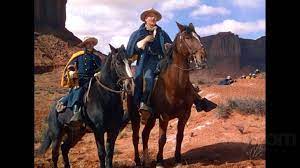
Classic Hollywood often romanticized the Confederacy in period depictions of the Civil War or of the Jim Crow era, as well. Here, we see a funeral scene that included a trooper that was a Confederate Brigadier General in the war under the name Rome Clay, but in the U.S. Cavalry was known as Private John Smith. John Wayne’s “Capt. Brittles” makes an emotional, stronger designation when revealing his Confederate identity in passionate plea. We also see Mildred Natwick’s “Abby Allshard” make a “proud to do it” sacrifice of her red flannel petticoat material to sew a partial flag. It’s a very sympathetic tone to the Confederacy.
I wondered how factual and common it would be to have Confederate soldiers, even an officer, slumming it in the United States Army Cavalry under a pseudonym. There were indeed “galvanized Yankees” plucked from POW prisons that volunteered and were approved by President Lincoln to fight for the union. They were frequently appointed in remote, western posts in the frontier- so they wouldn’t easily slip back over to the Confederate side.
Other themes and Ford-esque signatures in tonight’s film, worthy of our discussion:
– Irish culture and stereotypes
– the sense of honor and duty as rooted in militarism
– blend of violence and beauty within the landscape
– rituals
– graveside/funeral melancholy
– contemptuous love story
– humor

The best examples of Irish moments in SHE WORE A YELLOW RIBBON are portrayed by Victor McLaglen and used for the purpose of comic relief. Ford used Irish heritage actors whenever possible, such as Arthur Shields in SWaYR. Ironically, in tonight’s film, like in several of Ford’s films, the actor he chose to deliver some of the strongest, or most camp, Irish characterization is Victor McLaglen, who is not Irish at all. But McLaglen’s portrayal as “Top Sgt. Quincannon” is also a nod to Irish Catholic rebellion. He follows rules when honor is at task but breaks rules in little moments, like hiding a whiskey bottle. Which eventually leads to slapstick comic relief.

It is noteworthy to recall the complicated history of Ireland- both politically and in Ford’s personal life. In WWII, Ireland officially chose neutrality to protect its ports from already embattled nation, although many accounts show Ireland would help allied Axis in cases of unintended crossings and casualties. Ford’s family and upbringing supported the centuries-long Irish fight against British Imperialism via the IRA rebellion, while his westerns take on the side of American Imperialism rather than the independence of the ‘First Americans’ Native community. Contradictory and complicated- a perfect description of Ford himself.
Here are some quotes by Ford that exemplifies his standing regarding Native Americans:
Peter Bogdanovich: “The Indians are always given great dignity in your films?”
John Ford: “It’s probably an unconscious impulse—but they are a very dignified people—even when they were being defeated. Of course, it’s not very popular in the United States. The audience likes to see Indians get killed. They don’t consider them as human beings.”
“[on Native American Indians] “I’ve killed more Indians than Custer, Beecher and Chivington put together…Let’s face it, we’ve treated them very badly, it’s a blot on our shield; we’ve robbed, cheated, murdered and massacred them, but they kill one white man and God, out come the troops.”*
“Who better than an Irishman can understand the Indians, while still being stirred by tales of the US cavalry?”
Music serves a strong role in SHE WORE A YELLOW RIBBON. The title song was an altered version for the film and was recorded by Russ Morgan. Subsequently, it was re-recorded by other artists including The Andrew Sisters and Mitch Miller. It has a long history origin, dating back centuries. To this day it is still used in “the US military to keep marching cadence. The song/poem has appeared in various forms for at least four centuries and is based on the tradition of a yellow ribbon being associated with those waiting for the return of a loved one or of military troops who are temporarily unable to come home. It appears to have been brought to America from Europe by English settlers and the origin of the yellow ribbons probably came out of the Puritan heritage. The first copyrighted version was by George A Norton in 1917, which he titled “Round Her Neck She Wears a Yeller Ribbon (For Her Lover Who Is Fur, Fur Away).”***
Along with the title song, “The Girl I Left Behind Me” is repeated in score, opening credits, and sung by the troops. There are also traditional Irish tunes including “Garryowen” (which was also the 7th Cavalry Regiment marching tune) and “St. Patrick’s Day” in score.
Although the casting doesn’t always accurately follow their roles (John Wayne portrays a man 20 years his senior with a little dusting of gray at the temples), but the performances are strong enough to carry it. Wayne worked hard to prove he was worthy of this role, and both audiences and “uncle Pappy” agreed. Following an impressive performance in Howard Hawks’ RED RIVER (1948), Duke wanted to be taken seriously as an actor, not just a charismatic cowboy. At the end of production of SWaYR, Jack presented Duke with a cake and a single candle; congratulating him, announcing him as “a real actor now.” It was one of Wayne’s proudest works of film.

While the cast is talented throughout, Ben Johnson (1918 – 1996) is a standout. His real-life path to Hollywood could make for a fascinating film itself. He was born on an Osage reservation in Oklahoma and grew up wrangling cattle and horses. He was first hired by Howard Hughes for the film THE OUTLAW (1943) to bring in horses, and quickly realized he could make a quite a deal more in Tinsel Town as a horse specialist on sets and working as an extra/stuntman. He stunt-doubled for major western stars of the day like Joel McCrea and Gary Cooper. Johnson signed a contract with John Ford when he was doubling for Henry Fonda on the set of FORT APACHE (1948). One day on set, horses became spooked while filming and bolted away with a wagon. Johnson jumped into action, leapt on a horse and was able to bring them back safely. Impressed by his quick-thinking, Ford presented him with a contract for a rate of $5,000/week.
Undoubtedly, the biggest draw to this film is that stunning landscape- the majestic Monument Valley in gorgeous Technicolor. Ford is a visual storyteller and that is on full display in SHE WORE A YELLOW RIBBON. While this film is not the first nor the last of Ford’s films filmed in Monument Valley, cinematographer Winton “Winnie” Hoch made the stellar views unforgettable. The Academy certainly didn’t forget his breathtaking work when they nominated and gave him the Oscar for this film.
Rumors circled of a conflict between Hoch and Ford on location in shooting one scene in particular, as an impressive storm was brewing across the landscape. Many said that Hoch was ready to pack it up for fear of lightning hitting the cameras and Ford refusing to stop work. Hoch later filed a complaint with the American Society of Cinematographers.
But a more plausible explanation by Harry Carey Jr. recounted that day in a slightly different light. Dobe claimed that Ford had finished shooting for the day, but when the storm brewed, he asked Hoch if they could shoot in the declining light. Hoch answered, “It’s awfully dark, Jack. I’ll shoot it. I just can’t promise anything.” Ford then instructed, “Winnie, open her up [the camera lens] and let’s go for it. If it doesn’t turn out, I’ll take the rap.” Winnie complied, saying, “Fair enough, Jack.”**

This was Ford’s first Technicolor western shot in Monument Valley. To keep on budget yet create epic vistas, Ford kept an astoundingly tight 7-day/week, 4-week schedule. Actors were treated to egalitarian yet rustic accommodations of sleeping cots in tents, with most filming around/at the Goulding trading post, saving the wide-angle days for the valley. The final results created a heartfelt tale of the frontier, with the lessons of the experienced teaching the younger leaders, and the violent clashes of cultures when we fail to seek understanding.
“Lest We Forget…”
Payroll****:
James Warner Bellah – $12,000 (“Big Hunt” and “War Party” stories, 24 pages treatment, plus a 124 pages script draft)
Frank Nugent – $1,000/week, Laurence Stallings – $2,500/week for scripts
Winton Hoch – $750/week
John Wayne – $100,000
Victor McLaglen – $35,000
George O’Brien – $15,000
Joanne Dru – $10,000
Harry Carey, Jr – $5,000
Ben Johnson – $5,000
Francis Ford – $160/week (for 8 weeks for one week of work)
200 local Navajos – $18/day each for 20 days ($72,000)
Cast and Crew:
John Wayne – Captain Nathan Brittles
Joanne Dru – Olivia Dandridge
John Agar – Lieutenant Flint Cohill
Ben Johnson – Sergeant Tyree
Harry Carey Jr – Lieutenant Ross Pennell
Victor McLaglen – Sergeant Quincannon
Mildred Natwick – Mrs. Abby Allshard
George O’Brien – Major Mack Allshard
Arthur Shields – Dr. O’Laughlin
Michael Dugan – Sergeant Hochbauer
Chief John Big Tree – Pony-That-Walks
Fred Graham – Sergeant Hench
George Sky Eagle – Chief Sky Eagle
Tom Tyler – Corporal Quayne
Noble Johnson – Red Shirt
Francis Ford – Connelly, the barman
Irving Pichel – narrator
Harry Woods – Karl Rynders, the sutler
Cliff Lyons – Trooper Cliff
Mickey Simpson – Wagner, the blacksmith
Fred Libby – Corporal Kumrein
Rudy Bowman – Private Smith
Paul Fix (Harry Carey Jr’s father-in-law) – uncredited, Rynder gunrunner
Directed by: John Ford
Produced by: Merian C Cooper, Lowell J Farrell, John Ford
Asst Direction/2nd Units: Edward “Eddie” O’Fearna (yes, Jack and Francis’s brother), Wingate Smith, Cliff Lyons
Writing by: James Warner Bellah (story), Frank S Nugent and Laurence Stallings (screenplay)
Cinematography by: Winton C Hoch
Music by: Richard Hageman
Film Editing by: Jack Murray
Art Direction by: James Basevi
Set Direction by: Joe Kish
Asst Editing: Barbara Ford (yes, Jack’s daughter)
Production: Argosy/ Distribution: RKO
Budget: $1.6 million
Sources:
* John Ford, book of interviews by Peter Bogdanovich, 2nd Edition.
**Carey, Harry Jr. (2013). Company of Heroes : My Life as an Actor in the John Ford stock company (First Taylor Trade ed.). Lanham, Maryland: Taylor Trade Publishing. p. 67.
***Songfacts.com “She Wore a Yellow Ribbon” by Traditional https://www.songfacts.com/facts/traditional/she-wore-a-yellow-ribbon
****”Print the Legend: The Life and Times of John Ford” by Scott Eyman. 1999
 Outspoken & Freckled
She Wore a Yellow ribbon is actually my east favorite in the trilogy, but your post makes me think I should give it another chance. I will be checking it out again — thanks, Kellee!
— Karen
LikeLiked by 1 person
Thanks so much, Karen! I’m so glad my post made you think to give it another go!
LikeLike