
John Ford’s THREE GODFATHERS (1948)
(The following is my handout from the John Ford course I taught in the winter semester of 2023.)
It’s no longer the holiday season. You might have too much holiday fatigue to appreciate the oft debated topic of just what prequalifies a film to be a “Christmas movie.” For example, you may or may not agree that DIE HARD (1983) is a Christmas film. But after tonight’s screening, I want to hear your answer to the question, “is THREE GODFATHERS (1948) a Christmas movie?”
Tonight’s THREE GODFATHERS (1948) is actually the FIFTH film adaption of Peter B Kyne’s 1913 Saturday Evening Post novelette which is supposed to be an American western twist on the tale of the biblical Magi or ‘the three wise men.’ The other adaptions:
THE THREE GODFATHERS (1916), starring Harry Carey
MARKED MEN (1919), also starring Harry Carey and directed by John Ford (lost film)
ACTION (1921), (lost film)
HELL’S HEROES (1929), directed by William Wyler
HELLS HEELS (1930), Walter Lantz directed “Oswald the Lucky Rabbit” animated short
THREE GODFATHERS (1936), starring Chester Morris
TOKYO GODFATHERS (2003), Japanese animated film loosely based on novel
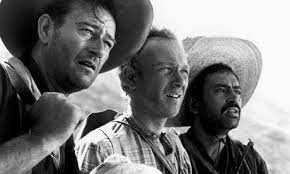
You’ll notice that two of these other versions included western star Harry Carey. Along with his brother Francis, John Ford always accredited Carey as the person who gave him his big break into the business. They remained close friends. Carey died in 1947 and Jack was determined to retell this tale, but this time in Technicolor. The tribute to HC in the opening credits is more than fitting.
Additionally, Ford wanted to ‘pay it forward’ by casting Harry’s son, Harry Carey, Jr. (1921 – 2012), in a leading role as “the Abilene Kid.” The opening credits “introduce” Harry Carey, Jr. He actually had a few acting roles prior, including when he was a baby in John Ford’s DESPERATE TRAILS (1921), starring his dad. Nicknamed “Dobe” as a baby for his red ‘adobe’ hued hair, Harry Carey, Jr. jumpstarted his acting career in this film which followed with a very long filmography (over 150 credits across tv/film), often as reliable characters, mostly in westerns.

Dobe was born and raised on his parents’ (Harry and Olive, both western actors) thousand-acre ranch in rural California with early hopes of a singing career. Yes, that’s his real voice we hear in tonight’s film. At the onset of war, Dobe enlisted in the US Navy in the medical corps in the Pacific. Against his own wishes, he was transferred eventually stateside, serving in the OSS (precursor to the CIA), making training and propaganda films under direction from John Ford’s unit. After WWII, the singing career dreams took a turn to acting.
“Uncle Jack,” as John Ford asked Dobe to call him, warned the young Harry Junior right before filming began that Ford’s infamous verbal abuse would not be spared on him. “You’re going to hate me when this picture is over, but you’re going to give a great performance.”* Jack was true to his word. He behaved sadistically mean, both physically and verbally abusive, towards Dobe every day on the set. Sometimes he’d taunt him by frequently pointing out that he should’ve hired Audie Murphy instead, and even asking him to bend over then kicking him hard. [SPOILER alert] After Dobe’s first attempt at his death scene, Uncle Jack reacted, “Well, Jesus H Christ. Now we really are up shit creek! Well, it’s too late to get Audie. I mean- what are we going to do with you, kid?”* He went on to call the young actor ‘yellow’ and a ‘coward’ and upon Dobe’s protest, Jack Ford yelled, “Then lie back down there, goddamn it, and die like a man. Goddamn it, I want to see you die. So die for me, for Christsake, and make us all right here believe it.”* He instructed everyone to leave Dobe alone under the blistering sun for 30 minutes without water, then the crew returned. Then they reshot the scene and Dobe nailed it on this take. “Why didn’t you do that the first time? See how easy it was? You done good! It’s a wrap!”* He was paid $350/week as the “Abilene Kid.” Ford was notoriously abusive to most of the actors on all his films, but Dobe certainly learned by fire on THREE GODFATHERS.
Mildred Natwick (1905 – 1994), a Ford regular, mostly dodged his typical fury though. A thorough professional devoted to her craft, she suffered less verbal barbs than the others. But the forty-three year-old actress was otherwise an odd choice to portray a young mother in her late twenties for this film. Her performance was strong enough that the age disparity quickly vanishes from our minds. She worked on 4 John Ford films. We will see her in our class again in SHE WORE A YELLOW RIBBON (1949) and THE QUIET MAN (1952).
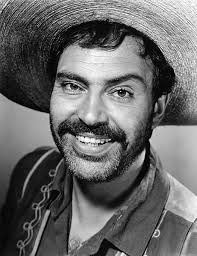
“Pedro” is portrayed by Mexican American actor Pedro Armendariz (1912 – 1963). This is not Pedro’s first film with John Ford. He worked along with Henry Fonda and John Wayne on Ford’s THE FUGITIVE (1947) and FORT APACHE (1948). He worked prolifically in over a hundred films in American and international films. But his career was cut short at age fifty-one. His last film was the charming and witty “Kerim Bay” in FROM RUSSIA WITH LOVE (1963). It has been suggested that his death was precipitated by an unfortunate filming location while he was in production on Howard Hawks-produced, Dick Powell-directed THE CONQUEROR (1956). Filmed in Utah, nearby atmospheric nuclear testing in Nevada, within 25 years, 91 of the 220 people (41%) in that film’s production had developed cancer, 46 whom died of cancer or related complications. Armendariz developed neck cancer. Suffering severe pain during filming FRWL, he endured for the sake of financial responsibilities to his family. In June of 1963, Pedro took his own life with a gun he had smuggled into the hospital.
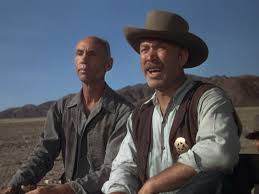
It’s hard-pressed to discuss John Ford without including John Wayne and Ward Bond. Both actors possessed enormous, memorable screen personalities that carried them through long careers, including many for John Ford. As complicated of a man John Ford was, his relationship with these two actors were even more so. Both Wayne (then Marion Morrison) and Bond were on the USC football team and working part-time on the Fox studio lot when hired by Ford for tiny roles in Ford’s SALUTE (1929). Throughout the 1930s, Ford’s career continued to rise in success, while Wayne and Bond worked whatever bit parts they could find. Outside of their film lives, the threesome built a ‘drinking friendship’ and would often take excursions together on Jack’s boat “Araner,” often down to Mexico (while Ford was secretly photographing naval activity for the military). By the end of this decade, “uncle Pappy” (as Wayne called Ford) found a film that suited him as a way to break out of bit parts and into a starring role. The role was the “Ringo Kid” and the film was STAGECOACH (1939).
But the threesome would begin to disagree on politics starting in WWII. Prior to the war, they avoided discussion of politics generally as Ward Bond was known as an outspoken right-wing conservative with anti-Semitic outbursts, Ford was an FDR Democrat with deep passions for his military commitments and belief in American ideals, and the Duke was (back then) non-political. However, when war became inevitable, things changed. Bond was rejected by the draft due to his medical epilepsy. And while Ford continued to push Wayne into joining the war effort, even offering him a position in the OSS unit as he did with Harry Carey, Jr., Wayne refused to sign up. It was a decision that would weigh on him for decades and put a significant strain on his relationship with “uncle Pappy.”
When the war broke out, thirty-one year-old Wayne was now a big Hollywood star with a wife and three children. He wasn’t ready to let go of his stardom.
“Throughout the war, Ford urged the young actor “to get in it,” and each time Wayne would beg off until he finished “just one more picture.” Ford was disappointed to say the least, and he let Wayne know it. Wayne was growing richer as other men died. As the war continued, Ford’s strong disappointment fueled a growing conflict between the men and fostered a sense of guilt within Wayne. Wayne’s decision to stay out of the service would haunt him for the rest of his life.
In the years following the war, Ford’s films grew increasingly nostalgic as his disillusionment with post-war America grew. Injustice, racism, and greed seemed to be replacing the values he felt he and others had fought for. On the other hand, as Ford grew more introspective, Wayne saw the world open up in front of him with each new movie triumph. As their perspectives changed so did their relationship.”**
After the war, a combination of being an on-screen symbolism of American patriotism and the guilt of not serving in the war drove Wayne into embracing right-wing politics, that was growing increasingly paranoid of Communist involvement in Hollywood. Both Wayne and Bond were active members of the Motion Picture Alliance for the Preservation of American Ideals, also known as MPAPAI or MPA. The organization was founded in 1944 to thwart Communism in the industry and was known for its red-baiting, anti-union, pro-Jim Crow laws, and antisemitic principles with star-studded list of members. In the process of investigating Hollywood, the House Un-American Activities Committee, a large majority of ‘witnesses’ were provided by the Alliance. Wayne served as president of the Alliance from March of 1949 to June of 1953.
Meanwhile, John Ford was vice president of the Motion Picture Democratic Committee (1938), which promoted left-leaning candidates. He was also involved in the Hollywood Anti-Nazi League, which united liberals in opposition to fascism. He referred to himself as a ‘socialist Democrat’ who supported unions and the IRA, and opposed the witch-hunting and blacklisting that emerged during those dark times. But Ford’s political stances during those dark times were sometimes ambiguous or on the surface contradictory.
He also served on the MPA at the beginning. Some believed he did so to bring a moderate voice to the Alliance (as Wayne once told Dan Ford his grandson years later) and some thought he remained close to Wayne and Bond to keep off the blacklist himself. These were conflicting and politically polarizing times, but Ford was a strategic survivor. In 1950, right-wing factions of the Screen Directors Guild, led by Cecil B DeMille, imposed a mandatory anti-Communist oath by all its members. Then SDG president Joseph Mankiewicz refused to take the oath and opposed singly out others. DeMille’s intent was to oust Mankiewicz. Ford came to his defense and questioned the witch-hunts tactics. At the recall meeting, Ford stood up and announced, “My name is John Ford. I am a director of westerns. I have been on Mr. Mankiewicz’s side of this fight all through it… I have been sick and tired and ashamed of the whole goddamned thing.”*** In the end, Jack was persuasive and savvy enough to save both Mankiewicz’s presidency and salvage both their roles within the SDG.
Why bring up all this political behind-the scenes perspectives on Ford, Wayne, and Bond? It highlights the very complicated dynamics of these three and of this period in history. As such, during this time of filmmaking, with so much tension and restraint under the surface for a man who valued his independence above all else, Ford leaned into what he did well. The thoroughly American art form of westerns. But as we move forward, glimmers of Ford’s post-war ponderings can be seen in a dimmer view. By the 1950s and 1960s the power shift was flipping from “uncle Pappy” to his star son; but Duke never forgot who was responsible for his career.
Cinematographer Winton C Hoch (1905 – 1979) was an excellent choice for John Ford’s THREE GODFATHERS. Hoch began his career as the photographer for the James A Fitzpatrick’s “TravelTalks” travelogue shorts, famed for its globe-trotting Technicolor vistas. He would go on to receive 4 Oscars, including for SHE WORE A YELLOW RIBBON (1949) and THE QUIET MAN (1952). He was also the cinematographer for THE SEARCHERS (1956) so we will be enjoying a great deal of his work in the rest of our Ford journey.
Look for a colorful cast of characters tonight, including Ford stock company members Hank Worden, Ben Johnson, Francis Ford, and Jane Darwell. Guy Kibbee also makes his final film appearance.
In addition to the many examples of Christian/biblical themes, what other themes and symbolism do you see? Let’s discuss the complexities of character in the three godfathers of good vs. bad. How does this film address what is Ford’s definition of manhood? How does respect play a role in how we view each character- and how they see each other? Where do you see touches of humor?
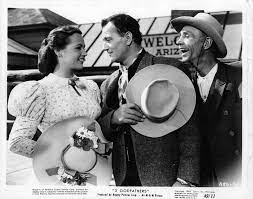
Cast and Crew:
John Wayne – Robert Marmaduke Hightower (in namesake after a fave stuntman of Ford’s)
Pedro Armendariz – Pedro Encarnacion Escalante y Rocafuerte aka “Pete”
Harry Carey Jr. – William Kearney/ “The Abilene Kid”
Mildred Natwick – dying mother
Ward Bond – Sheriff Buck Sweet
Mae Marsh – Mrs. Sweet
Jane Darwell – Miss Florie
Guy Kibbee – Judge
Hank Worden – Deputy Curly
Dorothy Ford – Ruby Latham
Charles Halton – Oliver Latham
Jack Pennick – Luke
Jack Curtis – bartender
(Amelia Yelda as the baby boy)
Directed by – John Ford
Produced by – John Ford, Merian C Cooper (production companies: Argosy/MGM, distribution: Loew’s)
Writing by- Laurence Stallings, Frank S Nugent (screenplay), Peter B Kyne (story)
Editing by- Jack Murray
Music by- Richard Hageman (Oscar winner for scoring STAGECOACH)
Cinematography by- Winton C Hoch
Release date: December 1, 1948
Budget: $1,243,000 / Box office: $2,841,000
Sources:
*”Print the Legend: The Life and Times of John Ford.” By Scott Eyman, 1996
** PBS “American Masters” S20 EP1: John Ford/John Wayne: The Filmmaker and the Legend. “Pappy and the Duke” by Ken Bowser, May 10, 2006
*** Los Angeles Times. “The Convoluted Politics of John Ford.” By Joseph McBride, June 3, 2001
 Outspoken & Freckled
I learned so much new stuff from this enjoyable post, Kellee! First off, John Ford was a real piece of work, amirite? I knew he was hard-nosed, but DANG! And so sad about Pedro Armendariz — and so many others, really, from The Conqueror. I have never seen 3 Godfathers, but I’ve wanted to for years. It’s on my watchlist now, thanks to you!
Karen
LikeLike