
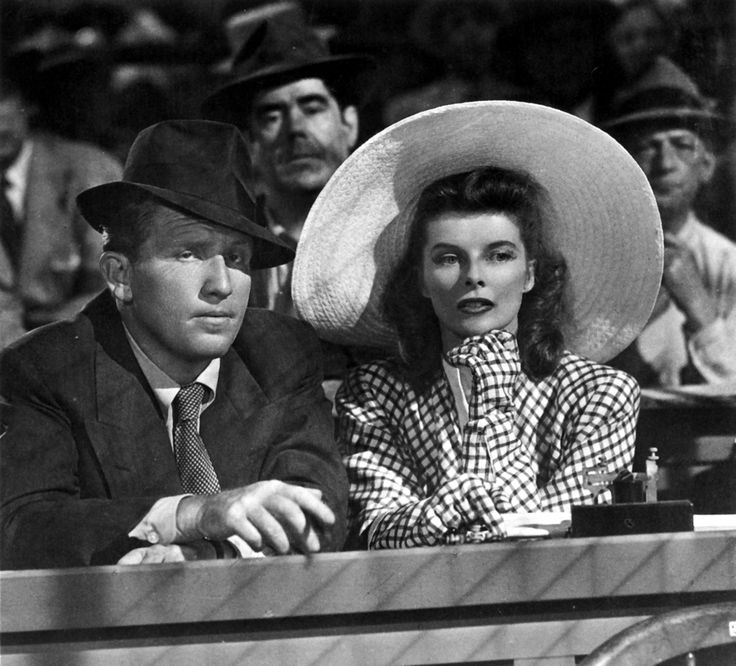
Along our Kate adventure thus far, we have explored her upbringing, her early start on the stage, her romances that eschewed marriage, her ups-and-downs in Hollywood in the 1930s, and now we have arrived at her WW2 era films. And more precisely, this is the origin of the ‘Kate and Spence’ era.
As we discussed with THE PHILADELPHIA STORY (1940), the early 1940s represented her comeback. She was able to transform her image from “box office poison” and make some savvy business decisions in the process. A rebranding, so to speak. She wanted Gable and Tracy to be her leading men in THE PHILADELPHIA STORY, but fate cast Cary Grant and James Stewart with successful results.
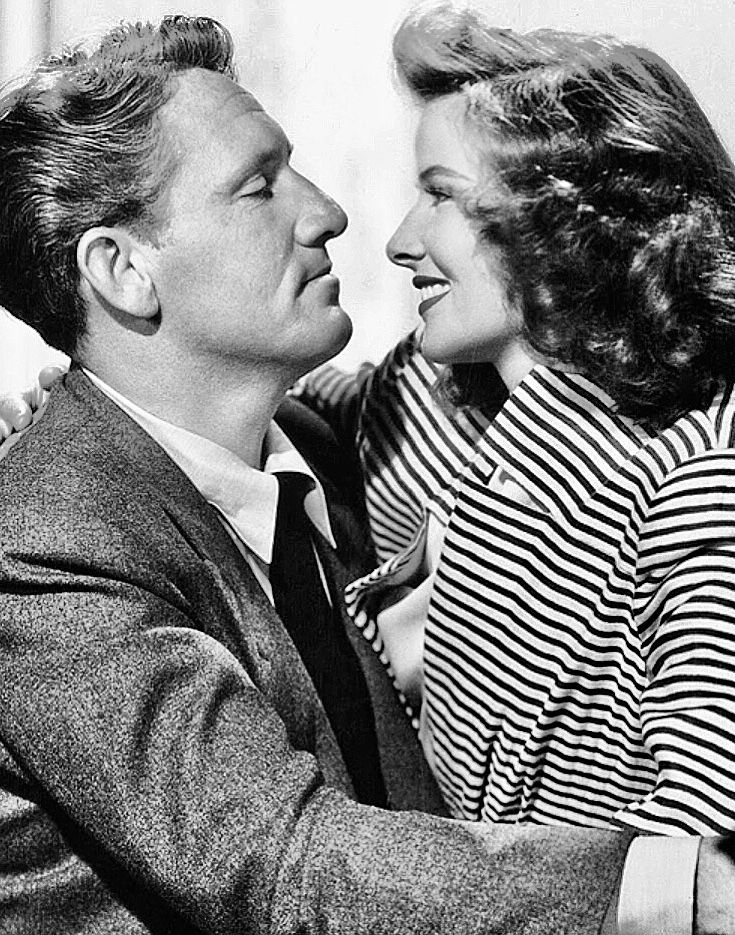
You may recall from my first handout the real scoop on the oft told story of how Kate and Spencer met via an introduction by Joe Mankiewicz. That laid the foundation of their sizzling power dynamic and fueled the fire of their chemistry- both on and off the screen. What’s more fascinating is how many films they paired up in which the plot and their fictional roles seemed to reflect this feminist-meets-traditional tension of their real lives. Audiences gobbled it up.
Friend Garson Kanin, who was in the army at the time, came up with the idea for WOMAN of the YEAR. He passed this idea along to Garson’s brother Mike and fellow writer Ring Lardner, Jr. Together they wrote a 75-page treatment. Kate presented it to Joe Mankiewicz (who also produced THE PHILADELPHIA STORY) without revealing the writers, “I want Spencer Tracy or I won’t sell it to the studio.” Mankiewicz loved it and Kate moved on to LB Mayer. As Hepburn describes in her autobiography…
“I flew out and I went in to talk to Mayer. He said, “Who wrote it?”
I said, “Mr. Mayer, I can’t tell you.” I added, “I want such and such for me. It’s even Stephen. Two amounts. Each $125,000.
He said, “We’d give you more than that, but I want to know who the writers are.”
I said, “Mr. Mayer, I cannot tell you who the writers are, and there is no way that you are going to find out. There is no possible way.”
He said, “I don’t like to do business that way.”
I felt that he was going to turn me down, so I said, “Besides, it’s not for sale. I simply wanted to know how interested you were. It’s a great part for Spencer. If you are interested in seeing the script when it’s done, then fine. The script will be for sale.”
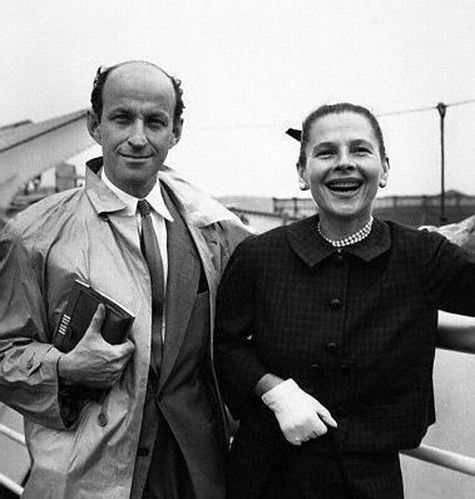
Garson Kanin (1912 – 1999) was a writer (plays, books, films) and director. He and his wife Ruth Gordon (1896 – 1985) were a writing team that were nominated for three Oscars- A DOUBLE LIFE, 1947 (Best Writing, Original Screenplay), ADAM’S RIB, 1950 (Best Writing, Story and Screenplay), PAT and MIKE, 1952 (Best Writing, Story and Screenplay). You may recall Ruth Gordon from her on-screen performances as the quirky character in films like ROSEMARY’S BABY (1968), EVERY WHICH WAY BUT LOOSE (1978), and HAROLD and MAUDE (1971).
Michael Kanin (1910 – 1993) signed an RKO contract in 1939 as a writer, following in the footsteps of his brother, Garson. WOMAN of the YEAR was his 4th screenplay in Hollywood, but he was relatively unknown when Hepburn protected his and Ring Jr’s identities until the ink was dry on their contract for this film. Ring Lardner, Jr.’s (1915 – 2000) father, Ring Lardner, was also a writer- the famed humorist, playwright, short story writer, and sports columnist. In addition to WOMAN of the YEAR, Ring Jr also won an Oscar for MASH (1970). He was noteworthy in history as one of the infamous ‘Hollywood Ten’ who refused to name other left-leaning in Hollywood. For many years following the HUAC scandal, he wrote tv and films as uncredited or under a pseudonym. With Kirk Douglas giving Dalton Trumbo screen credit in his own name for SPARTACUS (1960), thus began the fall of the Hollywood blacklisting. Ring Lardner, Jr wrote screenplays for both THE CINCINATTI KID (1965) and MASH (1970) in his own name.
Kate claimed to not know the business side, but her instincts were usually spot on. She knew when to tread lightly, how to dangle the carrot, and not too much, but to never budge. When the script was finished, Spencer read it and agreed to accept the part. George Stevens was Kate’s choice for director. And Mayer signed off without even meeting again. He knew her instincts were bankable. Following WOMAN of the YEAR, Mayer and Hepburn made a deal where she would always bring him material first. And Garson Kanin had a lot of material to create for his friends, Kate and Spencer.
Kate and Garson’s recall of events alter slightly. She had never met Tracy prior to offering him this role but knew he would be ideal- in practically anything. Garson claimed her reaction was, “Oh — I don’t know. I wonder whether we would be good together. We’re so different.” Garson claimed Spencer had similar concerns regarding their differences prior to accepting the role, as well. “Oh, really – do you think that we would be good together? We’re – so sort – of different.” Another claim of a first impression attributed to Spencer: “How can I do a picture with a woman who has dirt under her fingernails and who is of ambiguous sexuality and always wears pants?” Supposedly he saw THE PHILADELPHIA STORY then changed his mind.
As discussed, this was the decade of rebranding Katharine Hepburn. Less cold and highbrow, more warm and vulnerable. Less ivory tower, more approachable. THE PHILADELPHIA STORY initiated this transformation. But the pairing with Spencer Tracy solidified it. He was everything she wasn’t. In their case, opposites attract, not clash. And their partnering brought out a more feminine, sexual edge to Kate that audiences had not seen before. But no one would believe that Kate wasn’t very much still Kate. Many of her roles opposite of Spencer Tracy dealt with themes of battle of the sexes and challenging gender conventions, while adding the layer of sexual chemistry between the two. In essence, it was the perfect compromise.
On the subject of his dear friend, Garson Kanin explained the secret of a successful Hepburn film. “I believed at that time, that I had discovered the formula of a Hepburn success: a high-class, or stuck-up, or hoity-toity girl is brought down to earth by an earthy type or a lowbrow or a diamond in the rough, or a cataclysmic situation. It seems to have worked time and time again… The Hepburn formula works, possibly because the audience is drawn to her, yet wants reassurance that she is real– that she is not entirely unlike itself. Nothing more endears a queen to her subjects than a hiccup in public, a slip on the ice, a fall from a horse, or, best of all, a marriage to a commoner.”
Even though Kate was personal friends with director George Cukor (she even stayed at his house during the filming of WOMAN of the YEAR) and they partnered in many films, she was strategic in choosing George Stevens for her first duo with Spencer Tracy. Cukor was known as a ‘woman’s director.’ She knew this film need a more masculine touch with a focus on Spencer’s side of the story that would not be balanced with Cukor at the helm. As usual, she was right. George Stevens (1904 – 1975) was a film director, producer, screenwriter, and cinematographer. He won Oscars for directing A PLACE in the SUN (1951) and GIANT (1956) and nominated for 7 more Academy Awards for great American classic films.
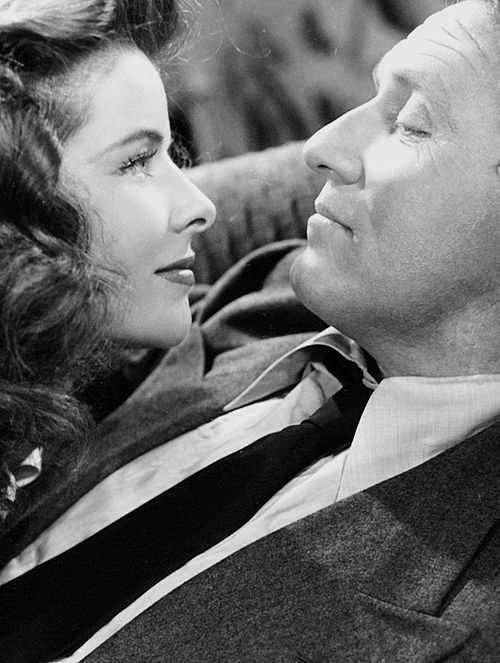
Kate was nominated for an Oscar, Best Actress in a Leading Role, and both Mike Kanin and Ring Lardner, Jr. won the Oscar for Best Writing, Original Screenplay for WOMAN of the YEAR. Production was filmed entirely at MGM studios. The filming dates: August 27, 1941 – Oct 26, 1941. Released (in the United States) on February 5, 1942. Why are these filming and subsequent release dates important and how does the timeline affect filming?
For this film, consider exploring the various examples of themes- feminist vs conventional norms, gender roles, implied rules of marriage, power balance in couples, compromise, WW2 issues including refugees, examples of humor.
Cast and Crew:
Directed by: George Stevens
Produced by: Joseph Mankiewicz, George Stevens
Writing by: Michael Kanin, Ring Lardner Jr. (screenplay), John Lee Mahin (additional treatment)
Music: Franz Waxman
Cinematography: Joseph Ruttenberg
Art Direction: Cedric Gibbons
Costume design: Adrian
Spencer Tracy- Sam Craig
Katharine Hepburn- Tess Harding
Fay Bainter- Ellen Whitcomb
Reginald Owen- Clayton
Minor Watson- William J Harding
William Bendix- ‘Pinkie’ Peters
Gladys Blake- Flo Peters
Dan Tobin- Gerald Howe
Roscoe Karns- Phil Whittaker
William Tannen- Ellis
Ludwig Stossel- Dr. Lubbeck
Sara Haden- Matron
Edith Evanson- Alma
George Kezas- Chris
Sources:
“Me, Stories of My Life,” by: Katharine Hepburn. Alfred A Knopf, NY. 1991.
“Hepburn and Tracy,” by: Garson Kanin. Viking Press, New York. 1971.
IMDB
 Outspoken & Freckled