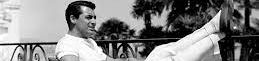
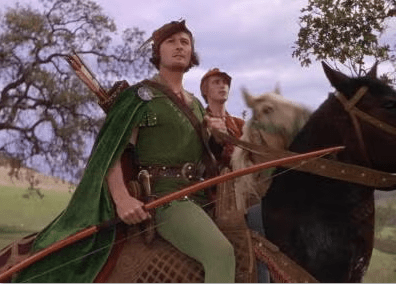
We venture forth in our Michael Curtiz adventure with our next film, THE ADVENTURES of ROBIN HOOD (1938). To pivot from 2-strip color Pre-Code horror with cannibalistic themes to the Technicolor swashbuckling men in tights of Robin Hood is a perfect example of the Curtiz versatility.
As a reminder, the Pre-Code era (late 1929 – summer of 1934) has ended, and as such Joseph Breen has a firm grip on the studios’ implementation of the Production Code. (No more disturbing themes with depictions to illegal activities like alcohol consumption and hanging out in brothels with any excuse to show women in their lingerie. But alcohol was legalized after the Pre-Code era ended, so we will see it legally referenced now, and with less focus.) The other change of this period in the later 1930s is the advancement of Technicolor technology. Still very expensive and more laborious than black and white, but the visual results are full-spectrum and deeply saturated in colorful spectacle.
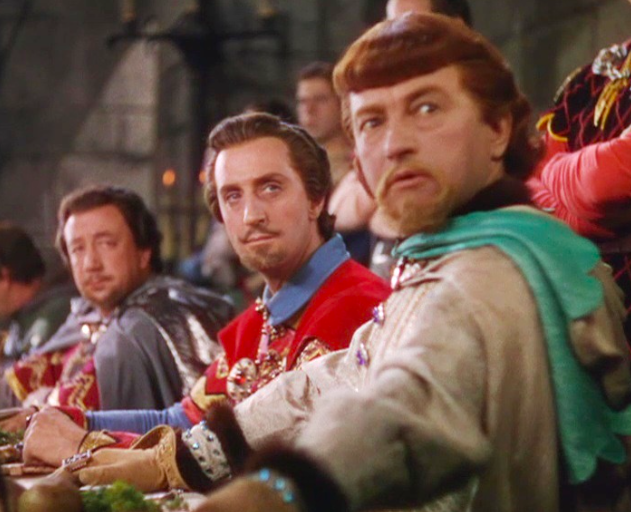
Warner Brothers in the 1930s was the studio known for its gritty gangster films with stars like James Cagney and George Raft, or big production musicals like Busby Berkley choreographed films. To evolve their brand into something more sophisticated, Warner Brothers started to make more melodramas and classic storylines. Produced by Warner Brothers and directed by Max Reinhart, Shakespeare’s ‘A Midsummer Night’s Dream’ did a production of this classic tale at the Hollywood Bowl in 1934, followed by a film adaptation the next year, starring Warner Brothers contract players. This included big WB stars James Cagney, Joe E Brown, Olivia de Havilland (this was her film debut), and Mickey Rooney. As a follow-up to Midsummer Night’s Dream, it was suggested in the summer of 1935 that Cagney would make a great ‘Robin Hood’ along with a band of merry men that were also popular stock players such Frank McHugh, Allan Jenkins, etc. This would be a different tone as the Douglas Fairbanks version.
The story of a mythical character named Robin Hood dates back centuries and has evolved over time. Sometimes a trickster, then a romantic (eventually a Lady Marian character and love interest was included), and then a noble character, taking on the corrupt powers. Ultimately Robin Hood became the epic hero, even in children’s stories. In 1922, a silent film of ROBIN HOOD was released, starring Douglas Fairbanks (as Robin Hood), Wallace Beery (as Richard the Lion-hearted), Enid Bennett (as Lady Marian), and Alan Hale, Sr. (as Little John). It’s considered one of the first motion pictures to have a Hollywood premiere (at Grauman’s Egyptian Theatre on October 18, 1922) with an enormous budget for that time at nearly a million. It was a big success and made $2.5 million.
Warner Brothers also discovered that they had the rights to the “Robin Hood” operetta by Reginald de Koven. Meanwhile, over at MGM, Jeanine MacDonald and Nelson Eddy were very popular in film operettas like NAUGHTY MARINETTA (1935). Script developer Edward Smalls wanted to write up something for the Robin Hood story. A deal was brokered so that Warner Brothers could develop a film titled THE ADVENTURES of ROBIN HOOD (not just ROBIN HOOD and not an operetta), so that MGM could create an operetta starring MacDonald and Eddy based on the DeKoven music. In return, Warner Brothers would receive the initial script material by Edward Smalls. The first draft of a screenplay was scribed by Roland Leigh, but Production head Hal Wallis was left wanting more characters and a more developed storyline from the original tale. For example, Leigh wanted to exclude Lady Marian and that was vehemently opposed by Wallis. Then Norman Reilley Raine (known for THE LIFE of EMILE ZOLA) and Seton I. Miller were brought in for another try at an original screenplay. While the screenplay and pre-production was finally running smoothly, their key lead, Cagney, walked away from Warner Brothers entirely, after a volatile dispute.

In 1935, 1.2-million-dollar budget Michael Curtiz’s CAPTAIN BLOOD is released as an immense success, starring newcomer Errol Flynn. Robert Donat was originally slated for the male lead but turned it down with concern that the many action scenes would be too much for his asthma. He was replaced by unknown Flynn who tested well. Born in Tasmania, Flynn was a fresh face in Hollywood when Warner Bros. signed him in January of 1935, prompted by his performance in MURDER at MONTE CARLO, a British B film. Flynn could bring a British sound and the swashbuckling athleticism ideal for this role.

In addition to Flynn, fellow CAPTAIN BLOOD co-stars Olivia de Havilland, who made a beautiful Lady Marian with intelligent substance, and Basil Rathbone, who portrayed a sharp villain with terrific swordplay, were added to the roster. The chemistry of the highly attractive duo of de Havilland and Flynn sizzled on-screen. They would make a total of eight films together.
The rest of the casting is phenomenal. Stand-out characters actors included Alan Hale, Jr. (who portrayed Little John in the Douglas Fairbanks version and once again in the 1950s), Claude Rains as a perfectly vain Prince John, Patric Knowles as the dashing pal Will Scarlett, Melville Cooper as the Sheriff of Nottingham, Ian Hunter as King Richard. Plus rounding out the comedy characters with Eugene Pallette as Friar Tuck, screeching Una O’Connor as Bess, Herbert Mundin, and many more familiar faces of both merry and unmerry men. A strong cast makes a strong film.
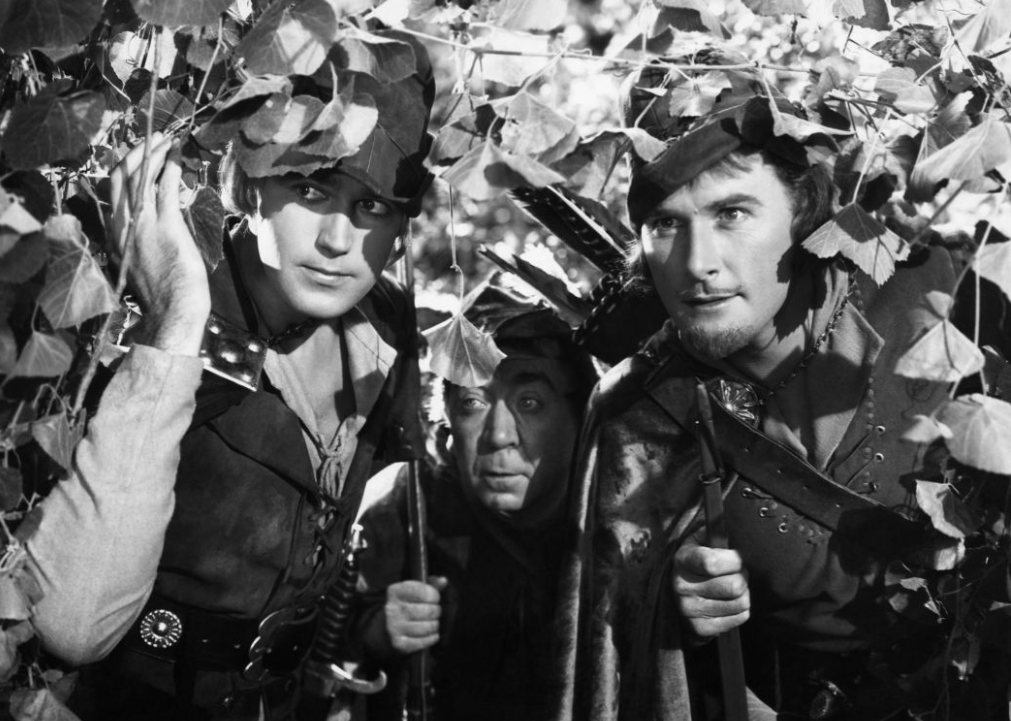
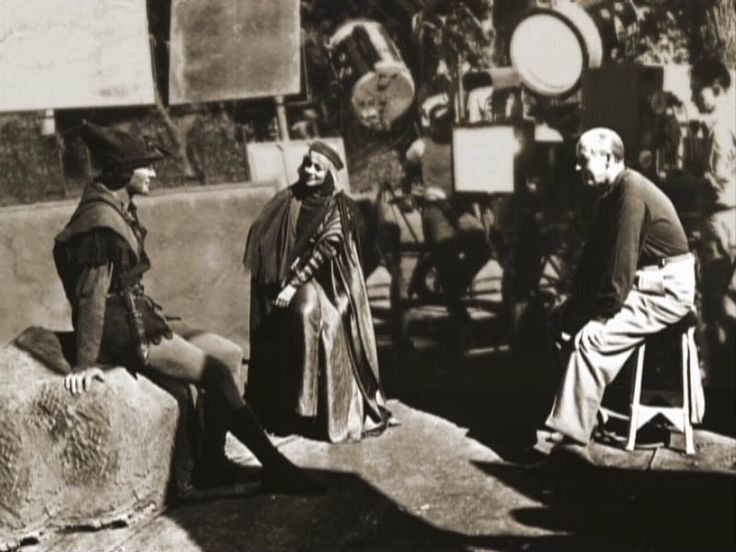
William Keighley was brought in to direct. He was a stock director who mostly churned out gangster and crime dramas as well as comedies (THE MAN WHO CAME TO DINNER, 1942) and he had worked with Flynn prior in THE PRINCE and the PAUPER (1937). However, nearly halfway into this major production, there were concerns that Keighley was behind schedule and not a right fit for the action sequences. Curtiz finished the unfinished sequences and added more little touches of action that helped boost the film. Wallis knew he could count on Michael Curtiz to fix both issues and complete this film. Curtiz stepped in and both names are credited on the final cut.

Most of the filming for “Sherwood Forest” took place in Chico, California nearly 400 miles away from the studio. It was Autumn and the trees and grass were already turning brown, so many of the leaves and greenery were spray painted green to keep the Technicolor visuals. The archery competition was filmed in the same spot as a notable exterior scene in GONE WITH THE WIND. Speaking of archery, one of the most memorable experiences in watching this film is that unique ‘zing’ sound of the arrows. Popular figure and archery expert Howard Hill was brought in, who used very unusual arrows that were large with large feathers. For scenes that displayed a cast being struck by an arrow in the chest, a steel plate with a layer of balsa wood was placed under the costume to a realistic effect. All the scenes with archery were created by a very different sound and has forever stayed with us in association with the grand scale of this classic film. The score by composer Erich Wolfgang Korngold and costumes in completed the final touches with tremendous results.

In the end of production, it was the most expensive film Warner Brothers had ever made at two million dollars. They were over budget and over schedule. But Hal Wallis and Michael Curtiz saved the day- and had made choices that would ultimately pay off. It was immediately popular with audiences and has remained a beloved classic.
THE ADVENTURES of ROBIN HOOD was nominated for an Oscar in four categories, including Best Picture and won three: Best Art Direction (Carl Jules Weyl), Best Film Editing (Ralph Dawson), and Best Music, Original Score (Erich Wolfgang Korngold). In the 1939 Academy Awards, Michael Curtiz’s films were highlighted. For ANGELS WITH DIRTY FACES, Curtiz was nominated for Director and James Cagney for Best Actor. For Curtiz’s FOUR DAUGHTERS, John Garfield was nominated for the Best Actor in a Supporting Role. Additionally, Hal Wallis received the Irving G Thalberg award. A very busy and successful time for this filmmaker!
In screening this film..
– Look for the action sequences that Michael Curtiz enhanced (such as the merry men dropping from the trees, use of shadows, etc.)
-Where do we see examples of other memorable action scenes (archery, swordplay)?
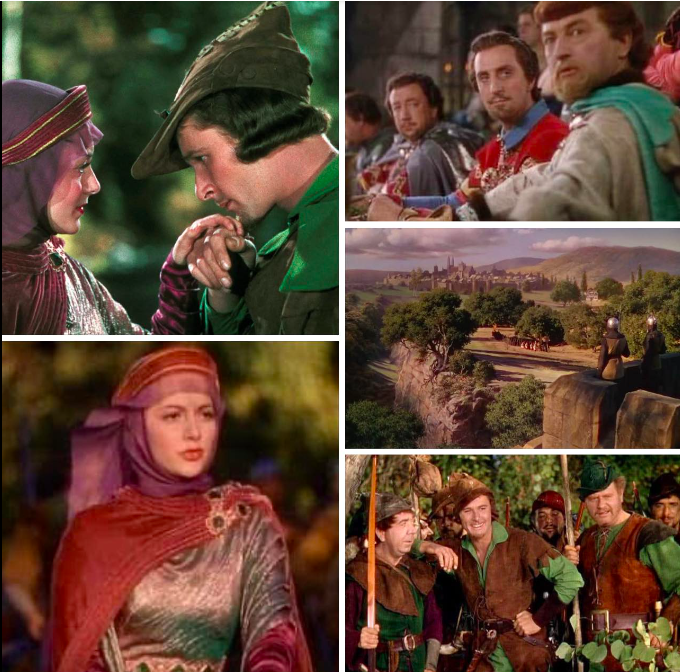
-How does the costumes and glorious Technicolor enhance this film?
-What themes do we see in loyalty to a monarch, classism, abuse of power in a society, fairy tale storytelling… and do they have staying power? How were these themes relevant in 1938- and are they still relatable to this day?
-How are tones of romance and comedy used?
 Outspoken & Freckled