
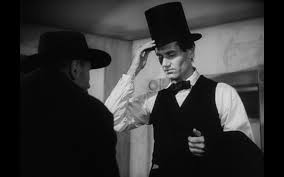
As we celebrate our nation’s Independence Day under polarized politics that grows increasingly similar in tension to an era over one hundred sixty years ago when our union was splintered in turmoil, let’s explore a cinematic tale of likely the most iconic of all American figures in John Ford’s YOUNG MR. LINCOLN (1939). In the role of the young Abe Lincoln is Henry Fonda. Fonda did seven films with the great director John Ford, and this was their first collaboration. It seems fitting, as we ponder the future and fabric of our democracy, to look back upon a unifying American figure in history, steeped in optimism for a brighter tomorrow. Even if it was only a cinematic version of a John Ford Americana dream.

Fonda was hesitant to take this role initially because to him, playing Lincoln was “like playing God.” When John Ford was assigned as director, he was also initially concerned to take on this film– but for the reason that several films had already taken on the topic of President Lincoln, including his own THE PRISONER of SHARK ISLAND (1936) which focused on the conspirators of assassin John Wilkes Booth. John Ford’s brother Francis, a prolific silent film era director, portrayed Lincoln on screen many times. It’s been said that the entire family grew up with an obsession with Lincoln. Producer Darryl F Zanuck knew both John Ford and Henry Fonda were the right combination to create this legendary man’s story, before he became a legend. When Ford met with Fonda, their first time to ever meet, he essentially “shamed him into doing it” by emphasizing that this was not “the great emancipator” Lincoln, but rather a ‘green’ lawyer from Springfield, Illinois.
From March 1939 to March 1940, four incredible Ford films were released: STAGECOACH (March 3, 1939), YOUNG MR. LINCOLN (June 9, 1939), DRUMS ALONG THE MOHAWK (November 10, 1939), and GRAPES OF WRATH (March 15, 1940). None of these are included in the famed “Ford Calvary Trilogy” which he made in the late 1940s. While known for his beautiful westerns (John Ford made close to 50 westerns); but in all, he directed a total of 146 films. YOUNG MR. LINCOLN is an example of one of his best non-westerns and is considered one of Ford’s personal favorites.
Like Henry Fonda, during this period of time, Ford was a leftist politically, a member of the Hollywood Anti-Nazi League (formed in 1936) and called himself a socialist. They both supported loyalists in the Spanish War. The Hollywood Popular Front was a collaboration of liberals and communists in support of social justice at home and anti-fascism abroad. We see themes that reflect this demand for social justice in Lincoln’s defense of the wrongly accused. Later in life Ford was perceived to be more conservative politically but was always rooted in his moral stance of championing for the underdog causes.
Background… the HANL board of directors in 1937 included Hollywood heavy weights like Jack Warner and Carl Laemmle and represented a full variety of the political spectrum in its supporters like Herman Mankiewicz, Myrna Loy, and Melvyn Douglas. In August of 1939 the Molotov-Ribbentrop Pact was signed, a neutrality act between the Soviet Union and Nazi Germany, which meant any communist-backed organizations were no longer allowed to oppose Nazism. As such, the HANL continued under a new name, “Hollywood League for Democratic Action.” It eventually joined with other anti-Nazism front groups under the title, “American Peace Mobilization” in 1940, but served as more of a passivist approach to avoid entering a world war. They opposed FDR’s Lend-Lease program. Group agendas completely reversed when the Soviet Union was attacked by Nazi Germany and the Pact was resolved; it eroded further when the United States was attacked at Pearl Harbor and we entered war.

YOUNG MR. LINCOLN was nominated for an Academy Award for Best Writing, Original Story- Lamar Trotti. While the specific details are fictionalized, the core components of this screenplay are based on real speeches by Lincoln and an actual court case from his earlier career. Trotti would team up again with Fonda in William A. Wellman’s THE OX-BOW INCIDENT (1942).

Questions to consider:
Is this film more a reflection of its time (based on our 1939 signatures) or of the John Ford style? If so, in what ways is this typical of a 1939 production? In what ways does it feel like a Ford film?
Do you recognize any actors as being part of the famed “John Ford stock company”? (ex. Jack Pennick aka “Big Buck Troop” was also a bartender in STAGECOACH and appeared in a grand total of 41 of Ford’s films.)
What message is Abe trying to tell us in the mob scene at the jailhouse? How does this reflect our nation’s real-life struggles in a measured response to entering World War II?
What references do you see/hear (“Battle Cry of Freedom” song in opening credits) to the Civil War (even though this story takes place in New Salem, Illinois in 1832, prior to the onset of war)? What symbolism do you see with the two brothers and their loyalty/love of mother? Could the two brothers be symbolic of the Union and the Confederacy? Could the pie judging moment be a symbolism of Lincoln’s later tough position of having to pick a side in the Civil War? Equally symbolic are the log splitting and tug-of-war scenes.
What themes and symbolism do you see? Circle of fate… destiny… mothers… books… love and loss… common man capable of greatness… social justice… strong moral code of right and wrong… eloquence under threat of violence… division and other Civil War themes… credit and debt and other economics as metaphors… humor to disarm… shame… river represents Ann Rutledge but also progress, future… (Ford’s) Irish nostalgia for the dead… importance of family
More to Consider:
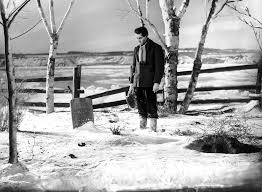
Opening poem by Rosemary Benet in a collection of poetry originally published in 1933. This poem is on Abraham Lincoln’s mother, Nancy Hanks. Why do you think Ford chose this?
In the scene when Lincoln rides up on a donkey to Springfield to practice law, this iconic town square was the chosen location for (then Senator) President Barack Obama to announce his Presidency as the first African American President.
In interviews, Henry Fonda spoke of watching a real lynching as a boy in Omaha, NE. His father owned a printing shop and was one of the few liberals in a conservative region. His father brought him up to the second floor where they watched a frenzied mob took over a jail and lynched a black man in the town square. Fonda said it forever left an impression upon him and his political views. Undoubtedly, it surely was on his mind for Fonda’s mob at the jail scene.
With the exception of the river scenes being shot in Sacramento, all the filming was completed on Stage 3 of the 20th Century Fox studios in Century City, California. Ford was a director who preferred to shoot on the studio lot to exercise full control (lighting and other environmental factors).
While there were some battles between Darryl Zanuck and Ford, a majority of their working relationship was very compatible. Ford directed nearly fifty films for Fox studios, where some of his best films were created.
Fonda and Ford had a great partnership and friendship over the course of 7 films. But there was an argument and physical altercation on the set in the production of MISTER ROBERTS (1955) when Ford threw a drunken punch at Fonda. Ford’s alcoholism was becoming a problem. Ford quit the picture and was replaced by Mervyn LeRoy. It ruptured Fonda’s friendship with Ford and they never worked together again.
PRODUCTION:
Directed by: John Ford
Written by: Lamar Trotti (original screenplay)
Produced by: Darryl F. Zanuck, Kenneth Macgowan
Music by: Alfred Newman
Cinematography by: Bert Glennon, Arthur C. Miller
Film Editing by: Walter Thompson, Robert Parrish
Art Direction by: Richard Day, Mark-Lee Kirk
CAST:
Henry Fonda … Abraham Lincoln
Alice Brady … Abigail Clay
Marjorie Weaver … Mary Todd
Arleen Whelan … Sarah Clay
Eddie Collins … Efe Turner
Pauline Moore … Ann Rutledge
Richard Cromwell … Matt Clay
Donald Meek … Prosecutor John Felder
Judith Dickens … Carrie Sue
Eddie Quillan … Adam Clay
Spencer Charters … Judge Herbert A. Bell
Ward Bond … John Palmer Cass
Francis Ford … Sam Boone


This is probably my favorite Ford movie, hands down.
LikeLiked by 1 person