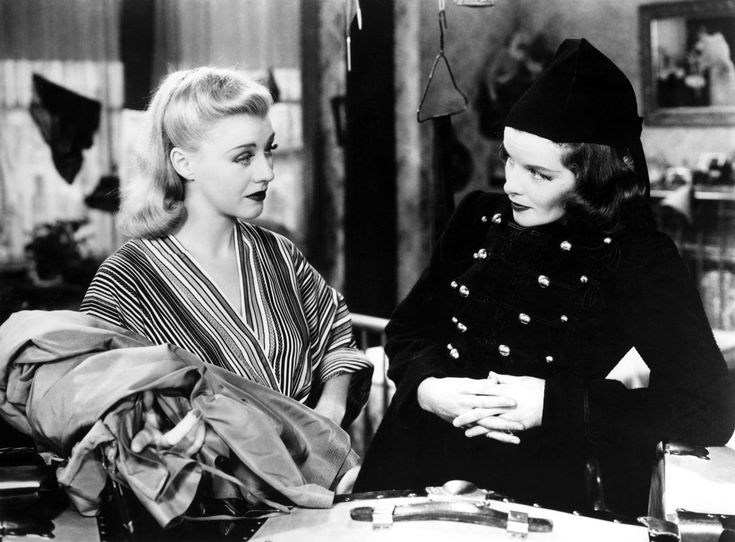
As we begin our Kate Hepburn voyage, let’s explore Gregory La Cava’s STAGE DOOR (1937). This film was her thirteenth. All with RKO, as required by her studio contract. She started off strong, with her third film (MORNING GLORY, 1933) bringing her the first of her Best Actress Oscars and the huge success of LITTLE WOMEN (1933). However, by 1937, Kate was starting to feel the slump of a few flops.
The following year, she would make her first true screwball comedy, BRINGING UP BABY (1938). Although today it remains a beloved classic, then it was a commercial bust. 1938 was a pivotal year when she was labeled “box office poison” and the hurricane that wiped out her family home. In true Kate fashion, she rebounded.
Based on the successful stage production, STAGE DOOR centers on a Manhattan boarding house for aspiring stage actresses. The stage play was written by Edna Ferber and George S Kaufman. It was first produced in 1936 at the Music Box Theatre in mid-town Manhattan, where it ran for 169 performances and closed in March 1937. It was inspired by the real-life “Rehearsal Club.” The stage production casting included Margaret Sullivan as “Terry Randall,” Lee Patrick as “Judith,” Tom Ewell as “Larry,” and Mary Wickes as “Mary.” Popular with audiences and critics alike, it only stopped when Margaret Sullavan became pregnant. The role of Terry was so identified with Sullavan that the producer decided to close the show rather than replace her. There was also a 1936 national tour of the play which starred Joan Bennett as “Terry Randall.”
In November of 1936, RKO Pictures purchased the film rights for $130,000. The screenplay, which is considered very different from the stage play, was written by Morrie Ryskind, Anthony Veiller, with additional uncredited writing treatment from SK Lauren, William Slavens McNutt, and George Seaton. Ryskind was notable as the writer for A NIGHT at the OPERA (1935) and MY MAN GODFREY (1936). Noteworthy differences in the play not found in the film version: Terry Randall is from a rural family whose father is a country doctor, Jean Maitland is a shallow girl who then becomes a big movie star, and while Kay Hamilton does commit suicide, but for a very different reason and not on an opening night.
Originally, Kate Hepburn wanted the stage role of “Terry” for STAGE DOOR. Producer Leland Harris aka Leland Hayward had been boyfriend to Hepburn for several years. They began dating shortly after she arrived in Hollywood. While Kate made MARY of SCOTLAND (1936), it was rumored that she was more than just friends and engaged in a brief affair with her director, John Ford. Meanwhile, Kate described her relationship with Leland as running smoothly like an old married couple. But he wanted to marry, she did not. She described their relationship as easy, unproblematic, “Joy was the constant mood. Everything was like a delightful surprise. He found life so easy. I don’t remember any fights. We just enjoyed – enjoyed – enjoyed. Almost four years.”
Rumors persist today that Leland was jealous of Kate’s deepening relationship with director John Ford at the time and gave it to Sullavan instead. Kate describes it as simply that Margaret Sullavan got the “Terry” role for the stage production of STAGE DOOR and off Leland went back east (as producer). In short time, Sullavan became his wife and the play came to a screeching halt when Maggie became pregnant. Katharine recalled, “Years later he tried to explain it to me and he really couldn’t—any more than I could explain my refusal to marry him.”
Kate discovered that her beau had married his client Margaret Sullavan via wired telegram. She initially expressed anger and hurt feelings to friend/director George Cukor and her mother. They essentially reminded her that she shouldn’t be surprised. “But you didn’t want him, Kath. Maybe he just wanted to get married. Poor man. You can’t blame him. It’s your fault. You must send them a wire. Don’t be a poor sport. It’s your fault,” her mother set Kate straight in typical Hepburn “just buck up” fashion. After 3 children and 11 years of marriage, Leland and Margaret divorced in 1947. Leland would go on to marry Slim Keith, Howard Hawks’ ex, from 1949 to 1960, then Pamela Harriman, Winston Churchill’s ex daughter-in-law, from 1960 to 1971. When Leland was dying, Pamela called Kate to see if she could come visit him, claiming he loved her most of all.
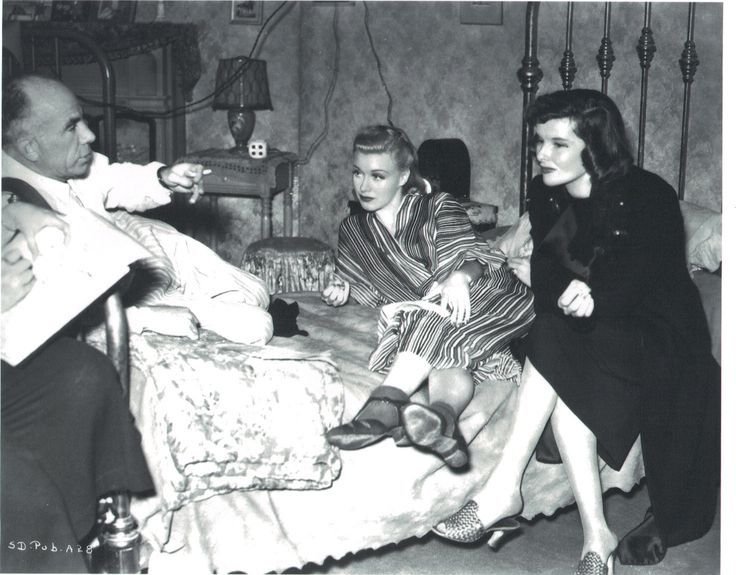
Kate landed the screen role for STAGE DOOR. Once again, Kate took a less meaty role and made it more memorable. Hepburn describes her STAGE DOOR experience in her autobiography:
“Director- Gregory La Cava. Starring Ginger Rogers and me, using all the good girls at RKO: Lucille Ball, Gail Patrick, Andrea Leeds, Eve Arden, Ann Miller. My career was at a low ebb, and as we started to shoot Stage Door I began to observe that I was sort of listening in on scenes instead of dominating them. After about two weeks of this I went to Pandro Berman and said, “Gosh Pandro, don’t you think –”
He answered, “Listen, Kate, you’d be lucky to be playing the sixth part in a successful picture.”
I decided to say something to La Cava: “This character, Gregory, I don’t know who I am. Who am I, Gregory?”
“You’re the human question mark.”
“What’s that supposed to mean?”
He looked at me seriously: “I’m damned if I know, Kate.”
I listened. I said, “Thank you.” I departed. I gave up. And I shut up. I knew that it would be hopeless to say anything more to anyone. I knew that there was nothing as boring as an actor on the skids who is sorry for herself.
Shutting up and being jolly was the cleverest thing that I ever did. La Cava got sorry for me playing the rich girl and handed me the whole last part of the movie.
I had no idea until much later that in the first preview Ginger Rogers was billed over me. I don’t even think that Ginger knew. At this preview so many cards came back saying, The best Katharine Hepburn picture we’ve seen and she is great. I’m talking about preview cards which would be given to the audience as they were leaving the theatre to jot down their opinions. They returned me to my first position. Lucky me. “
This is one of many examples of how Kate handled her career- with that competitive and strategic drive to consistently outperform, garnering every opportunity. She demanded perfection from others because demanded it from herself first. And yet, she often referred to her life and career as… lucky.
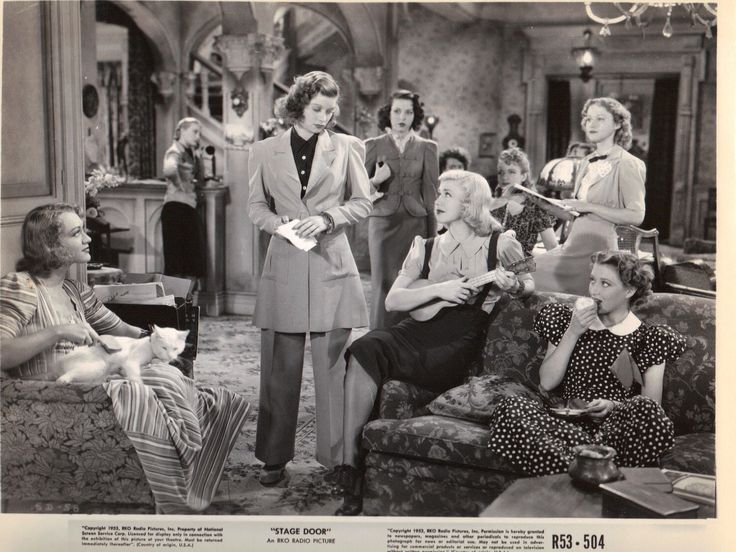
What stands out to most regarding this film is the ensemble of young actresses, many who were only at the early stages of long careers as big stars. Some, like Ginger Rogers and Adolphe Menjou were already big names in 1937. Independence, Missouri-born Rogers (1911 – 1995) had starred in 43 films and shorts including two popular Busby Berkley musicals (42nd STREET and GOLD DIGGERS of 1933) and six fan-favorite films partnered with Fred Astaire by the time STAGE DOOR role came along as Kate’s wise-cracking roommate, “Jean Maitland.” Rogers’ career continued its successful trajectory for decades beyond STAGE DOOR and she won many awards including a Best Actress Oscar for KITTY FOYLE (1940).
Menjou (1890 – 1963) (as “Powell”) began his prolific acting career in the silent era with over 150 acting credits, working on camera from the teens to the sixties in the industry. Always dapper dressed, with his distinctive mustache, Menjou was notable for roles that capitalized on his charm, whether he portrayed the scoundrel or the wooing suitor.
Some familiar faces in STAGE DOOR cast include: Eve Arden (1908 – 1990) who wears a cat around her shoulders with as much ease as her witty line delivery, Lucille Ball (1911 – 1989) who we can tell already can hold her own, Gail Patrick (1911 – 1980) who portrays the beauty with an icy edge (a role she was frequently stereotyped), and the dancing sensation of Ann Miller (1923 – 2004).
Arden had only performed in a few films when she got the role of “Eve” in STAGE DOOR. This film launched her career of the frequent characterization as the wise-cracking best friend to the lead female. This type would be repeated in career highlights such as MILDRED PIERCE (1945). She continued to find work in television in popular shows, including “Our Miss Brooks.”
Lucille Ball had appeared in over 40 films in small roles by the time she portrayed “Judith Canfield“ in STAGE DOOR, including a few musicals with Rogers and Astaire. Of course, we all know she eventually found her biggest success in television and tv production.
Gail Patrick found many roles as the cold, calculating beauty. She performed in over 30 films by the time of her STAGE DOOR role as the ambitious “Linda Shaw.” Patrick would continue acting in films and television. Well-educated, she would often use her savvy contract negotiating skills from acting to production work; most notably as the executive producer for the Perry Mason tv series (1957 – 1966).
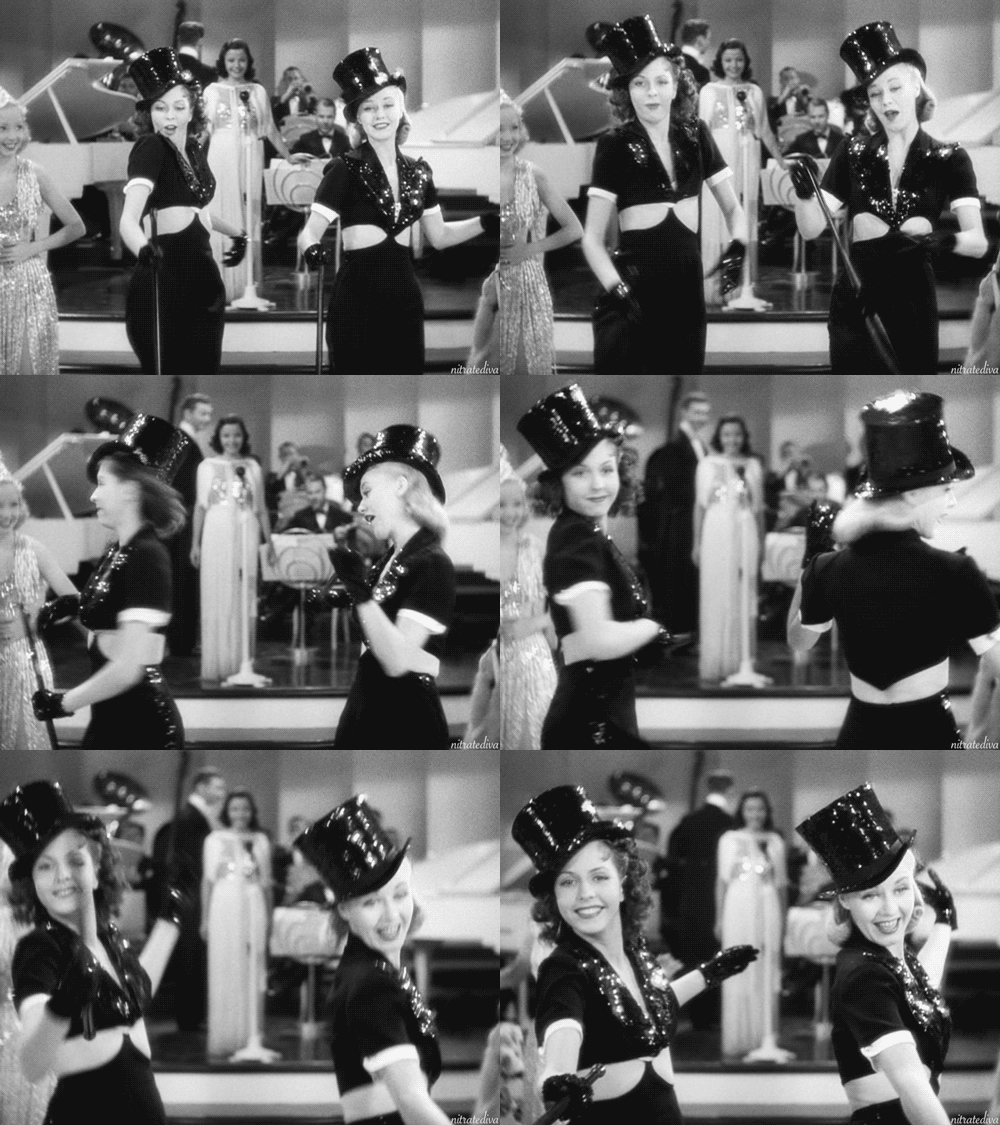
Miller would go on to wow audiences in many Technicolor musicals, such as ON THE TOWN (1949) and EASTER PARADE (1948). However, you may not realize that Miller was barely 14 years-old when she was cast in STAGE DOOR. She and her mother moved to Los Angeles when she was nine years old where she began financially supporting mother, who was hearing-impaired and found difficulty securing employment. They acquired a fake ID to prove she was at least eighteen to obtain a contract at RKO studio. She had only done a handful of mostly uncredited dancing roles prior to her STAGE DOOR role as “Annie.” She became an even bigger hit on Broadway, later in her career.
Andrea Leeds, in the pivotal role as “Kay,” brings a very sensitive and emotional performance. Her career in Hollywood was relatively brief in films from 1933 to 1940. However, this compelling portrayal as the struggling actress earned her an Oscar nomination for Best Actress in a Supporting Role. STAGE DOOR earned four Academy Award nominations in total: Best Picture, Best Directing for La Cava, and Best Writing (Adapted Screenplay) for Veiller and Ryskind.
Director Gregory La Cava (1892 – 1952) began his career in animation and silent films, working with many greats of the time… Bebe Daniels, Richard Dix, and WC Fields. He worked his way into sound features. La Cava was best known for his comedy films, including MY MAN GODFREY (1936), which earned him his first of two Best Director Academy Award nominations, the year prior to his STAGE DOOR nom. His directing work slowed down significantly in the 1940s and he passed at the age of 59.
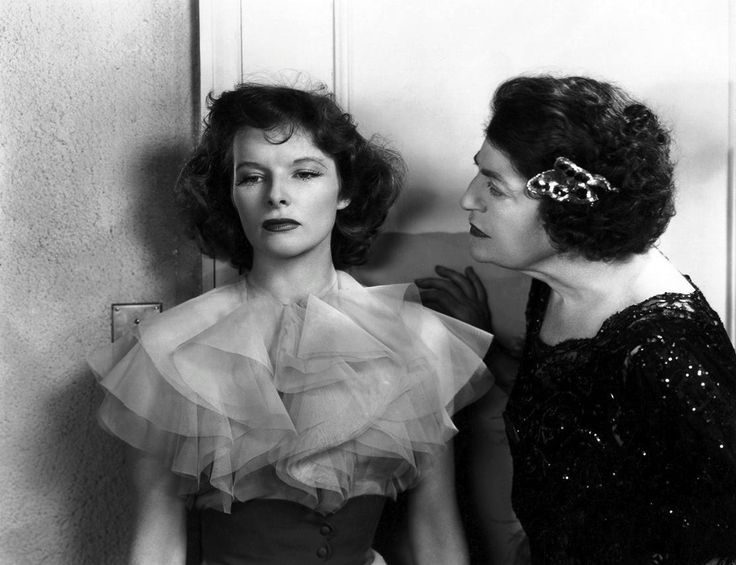
Interesting tidbits: After listening to the young actresses interact during breaks and rehearsals, the writers decided to utilize their style of banter into the film. Additionally, La Cava even allowed the actresses to ad lib during some scenes. Hepburn’s iconic lines, “the calla lilies are in bloom again…” are actually plucked from “The Lake” (1934), a play Hepburn performed in, only a few years prior. Dorothy Parker famously blasted her though as she quipped her performance as “running the gamut of emotions from A to B.”
Additional Cast/Crew:
Constance Collier – Ann Luther
Samuel S Hinds – Henry Sims
Franklin Pangborn – Harcourt, Powell’s butler
William Corson – Bill
Pierre Watkin – Richard Carmichael
Grady Sutton – “Butch”
Frank Reicher – stage director
Jack Carson – Mr. Milbanks, lumberman from Seattle
Phyllis Kennedy- Hattie
Margaret Early- Mary Lou
Florence Reed – uncredited
Cinematography- Robert De Grasse
Editor- William Hamilton
Music- Roy Webb
*This film was released in the United States on October 8, 1937 with positive reviews and a modest profit. (Budget= $952,000/Box Office= $1,762,000)
As we screen STAGE DOOR, note the range of emotions– from comedy to heartbreak– that this film offers. How do each of the individual characters provide this emotional variety and depth to the story? How does this allow for us as the audience to become invested in these characters? Do you recognize any of the bit players or smaller roles? Do you believe Katharine Hepburn was well cast? How do these characters represent a realistic look into the struggles of becoming a stage actress? What does this film evoke regarding friendship? Overall, what do think of Hepburn’s performance?
Sources:
“Me: Stories of My Life.” By: Katharine Hepburn. Alfred A Knopf, New York. 1991.
IMDB
(This is part of a Katharine Hepburn series and reflects the content I shared with my students in my Katharine Hepburn Film Study, part of my ongoing classic film series.)
 Outspoken & Freckled