
Hitchcock was in the business of making movies. “The master of suspense” was at the height of his game during his years at Paramount while making VERTIGO, a film that would later become a classic, and many have claimed it as the greatest film of all time.
For Hitchcock, his storytelling goes above and beyond a solid murder mystery or a fun whodunnit. With each film, and since his first days of filmmaking began with British silents, Hitchcock challenged himself to go bigger, bolder, more majestic in visual storytelling, and more haunting and twisted in plot. One of the key signatures of a Hitchcock film can be found in the setting. In several Hitch films, well-known monuments or iconic landscapes or cityscapes serve as the background, or sometimes directly involved in the action. According to Alfred Hitchcock’s daughter, Pat Hitchcock, her father adored the cosmopolitan glamour of San Francisco and viewed it as an ‘American Paris.’ What a beautifully ideal setting to unravel a twisted case of obsession and murder. Six years after his dreams of a Frisco-based murder, it would finally culminate on the big screen.
Based on the 1954 French novel “D’Entre Les Morts” (aka “The Living and the Dead” or “Living Among the Dead”) by Boileau-Narcejac, Hitchcock began scouting out more locations to bring this vision to the screen. In 1955, Herbert Coleman searched for an historic Spanish mission for the film’s dramatic scenes and decided upon the Old Mission San Juan Bautista would be perfect. As the 15th largest mission church in California, it was built in 1797. However, this mission was missing the most critical element- a bell tower, which was burnt down many years prior. That was solved by movie magic with illustration and set design.
After months of painstakingly structuring the story and script, titled as “Listen Darkly,” Hitchcock hired screenwriter Maxwell Anderson (uncredited), followed by Alec Coppel which still left a vague and unsatisfying script. Then Hitch brought in the screenwriter of SABRINA (novel, “Sabrina Fair”), Samuel Taylor, and the two spent a full year revising the script. As a result, the script became a much deeper and more complicated journey, emotionally.
With production about to start, James Stewart in the role of ‘Scottie’ and Vera Miles as ‘Madeleine’ were cast. But delays created setbacks right before the start of filming due to Hitch’s health (gall bladder surgery) and Miles announced that she was pregnant. Kim Novak was cast to replace Miles. Principal filming began in September of 1957 in San Francisco. Exterior on-site filming took sixteen days.
Cinematographer Robert Burks followed Hitch’s vision of red and green color themes. He also used a fog filter to create the dream-like fantasy moments. Burks worked with Hitch on eleven films.
Henry Bumstead, the Art Director on four of Hitchcock’s films, built over fifty individual sets for VERTIGO. Many of these sets were built from the sketches and designs of Hitch’s own vision and hand via storyboards. We are treated to beautiful interiors which are examples of the 1958 MCM interior design, and furnishings. Scottie’s apartment is a blend of traditional yet clean, simple lines of modernist style. Like Scottie, his home aspires to be progressive while still playing it safe.
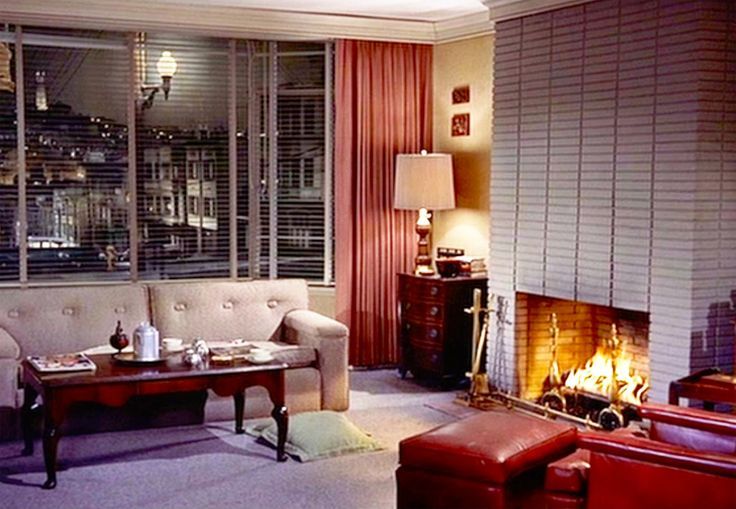
Midge’s art studio apartment on the other hand is chic. It’s an eclectic, bohemian blend of Mid-Century Modern pieces in a youthful apartment. She sits in a white Bertoia chair. The iconic wire chair series was designed by Harry Bertoia for Knoll in 1950 – an experiment that involved bending metal rods into practical art. “If you look at these chairs, they are mainly made of air, like sculpture. Space passes through them,” said Bertoia. The sofa is low slung, with hair pin legs. It’s messier because she’s an artist with her work in progress, in motion all around her. But she’s more on trend, less conservative; more casual and comfortable in her choices. Midge is open, real, and grounded in every way. She’s the one who attempts to warn Scottie about dangers ahead. He doesn’t heed her warnings and pursues a reckless journey of fantasy. She can’t save him.
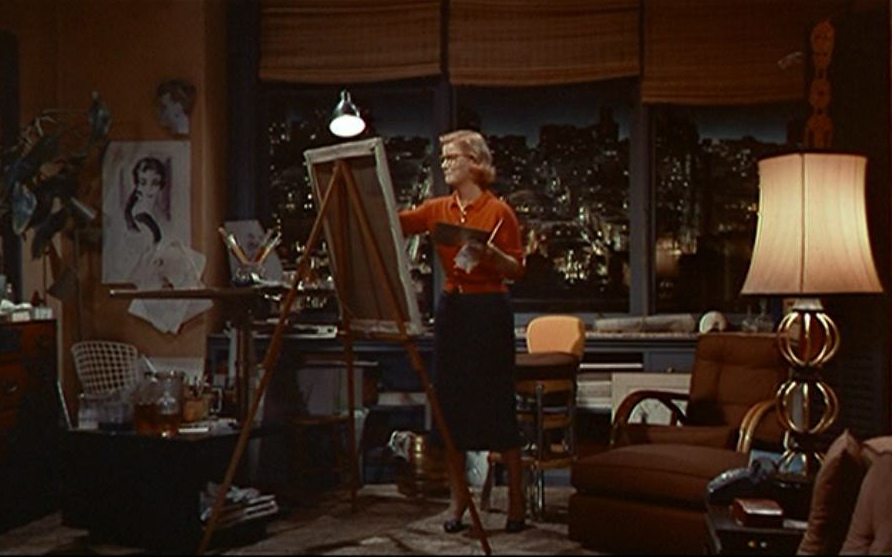
Additionally, Midge’s dynamics with Scottie evokes a motherly relationship. There are several dialogue exchanges where they both refer to her as his mother, jokingly yet directly. This is further supported by their platonic status and Midge’s protective and nurturing treatment of him. It’s indicated there were sparks in the past of college days, but currently she’s unsuccessful in pursuit of any romance. The mother thematic is not exactly a new theme for Hitchcock, as he’s used it in several of his films.
Interesting to note are the age differences of these actors at the time of VERTIGO. Kim Novak (aka “Madeleine” and “Judy”), who turns 91 this year and is very much still with us, was 25 years old. Barbara Bel Geddes (“Midge”) was 36 but has such a youthful look that her college days seems like a recent memory. But James Stewart (“Scottie” “John” “Johnny-O”) was 50 so realistically he was too old to play this part. Stewart was often chosen not only for his acting skills, but for his ‘everyman’ boyish quality and likability. There’s a trustworthy integrity the audience bequeaths to Stewart. It makes it more palatable to go along his ill-fated journey, even when he makes poor choices; even when he rejects the nice, real woman and forces a nonconsensual identity change on another. With anyone else, he’d be viewed as a predatory and delusional stalker, here we feel as protective of him as Midge does.
Saul Bass (1920 – 1996) was an American graphic designer and Oscar-winning filmmaker/designer of film title sequences and movie posters. His innovative poster and opening title designs of VERTIGO are not only legendary, but also an iconic reflection of Mid-Century Modern design. He worked with the top directors such as Billy Wilder, Otto Preminger (THE MAN WITH A GOLDEN ARM), Stanley Kubrick, and Martin Scorsese. But his collaboration with Hitchcock may be his most recognizable- in films like NORTH BY NORTHWEST and PSYCHO, in addition to VERTIGO. Bass was also in many ways the real life equivalent of “Mad Men,” as he was responsible for the creation of a remarkable list of corporate logos throughout the 1960s, ‘70s, 80s, and ‘90s … such as Warner Brothers, Bell Telephone, AT&T, Continental Airlines, United Airlines, Geffen Records, Dixie, Quaker Oats, Kleenex, Girl Scouts of America.
But he was not alone. He worked with his wife Elaine beginning in 1955. She directed and produced title sequences beginning in 1960 when they met working on the film SPARTACUS. Saul and Elaine married in 1961 and years later had two children. They partnered together for over thirty years. What makes the Bass style so impressive, and so representative of the Mid-Century Modern aesthetic, is how it can take an entire film and edit it down to a modern, simple, and bold design or within just a few minutes of a title sequence.
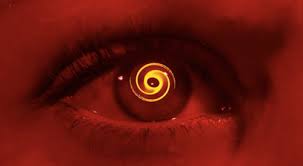
From the very onset of this film, we are drawn into Saul Bass’s striking and boldly colorized introduction to the theme of obsession, via the symbol of a spiral, and accompanied by composer Bernard Herrmann’s score. The spiral is the perfect visual motif as it represents a chaotic and endless loop of beginnings and endings, of death and rebirth, of a past haunting the present, and often in a descending manner. Obsession is defined by a persistent, disturbing, and unreasonable preoccupation in a person’s mind; it’s compulsive and a loss of control. This connection between obsession and its visual signals are depicted throughout the film. We see frequent examples of spirals, of repeating moments and symbols, and of course our protagonist’s obsession.
Bernard Herrmann’s score in the opening credits reflect this rise and fall of notes, a musical blend of unsettling tone of instability, of falling (which is another theme throughout). Two scales at the same time- both ascending and descending- then repeated on a loop. Other scenes scored by Herrmann reflect an array of emotions- it’s grand, sweeping, terrifying, haunting, foreboding, and even romantic. This brilliant score is one of the most memorable in all of cinema history.
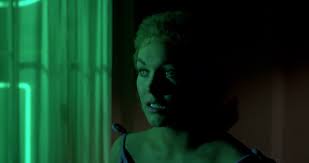
Famed Costume Designer and frequent Hitch collaborator Edith Head shared his love of color to make bold and symbolic statements. She designed costumes on eleven Hitchcock films. Red and green are signature color stories in VERTIGO. Red symbolizes death, fear, danger, lust, fantasies of love/romance. We see red in flowers, on walls, a color wash in an eye in the opening title sequence, on Carlotta’s necklace which is later worn by Judy, and in Scottie’s graveside nightmare. Green symbolizes envy, jealousy, deception, and obsession. Green is frequently tied to Madeleine.
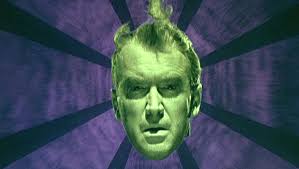
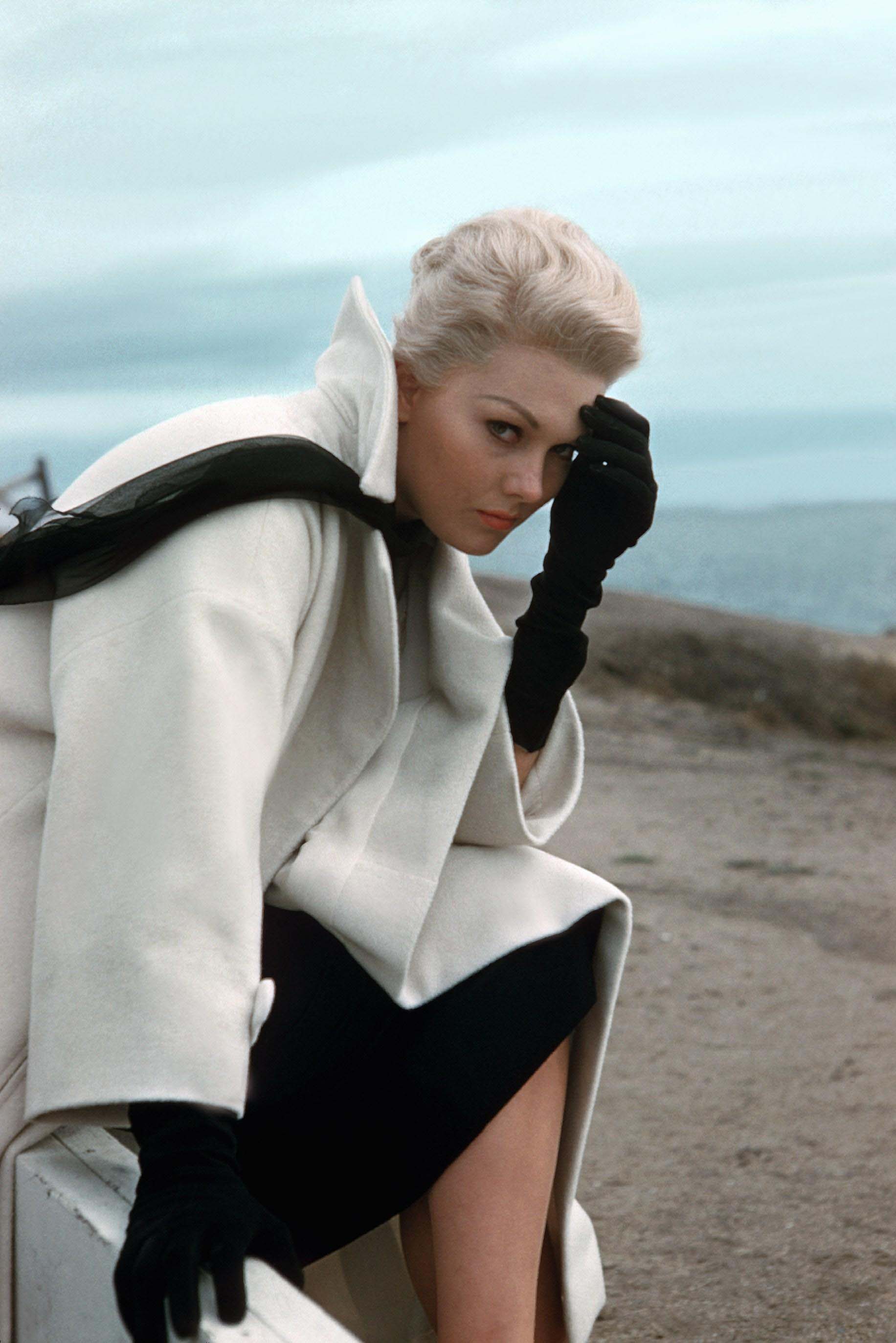
Examples include many costume designs worn by James Stewart and Kim Novak. An interesting color mix occurs with the stunning black and emerald-green evening gown in the foreground against the vibrant red walls of Ernie’s restaurant, when Scottie first sees Madeleine. It’s a striking first impression and saturation of color- for Scottie and for us as an audience- but it also pulls in the merge of the two-color schemes together for the first time. Madeleine’s black outfit with a pure white coat is another breathtaking moment. It’s a gorgeous silhouette and very on trend in Mid-Century Modern couture. In contrast, when we see her in the gray suit, it is not necessarily a flattering color for Novak’s platinum hair nor a stand-out impression. But the neutral gray suit allows her to be influenced by the elements surrounding her… under the influence of Scottie’s obsession and manipulation.
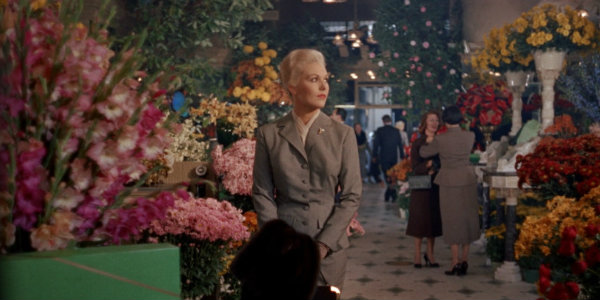
A film theory of note regards the camera movement. Whenever the camera pans from left to right, it is in the natural order, in the same pattern when we read, and suggests truth. The opposite- from right to left- suggests deception, or the world is in lack of balance. When we examine this theory closely as it plays out in scenes, examples are everywhere as we follow Scottie in his chase of Madeleine/Judy, as Midge chases him, as Gavin offers Scottie danger and deception, and as Scottie uneasily toggles back and forth, sometimes chasing the truth, sometimes chasing a deceptive fantasy.
Another theory takes a more radical approach. The premise of VERTIGO is so dream-like in its emotional journey and replete with fantasies that the plot, with the occasional plot holes, is practically insignificant. This theory suggests that perhaps most of the film itself is a dream in Scottie’s mind. Either initiated from the fear-infused crippling moment that he’s dangling from the rooftop in the beginning or perhaps from his room at the sanitorium when he’s in a chaotic state- with everything else conjured from the imaginations in his mind, like a fever dream. After all, there are clues throughout that suggest more fantasy than reality as they wander through the story. Whether you chose to believe that idea, it’s undeniable that psychology is a major theme in VERTIGO.
The concepts of acrophobia (fear of heights and resulting vertigo), obsession, and psychoanalysis are in deep focus. In post WWII cinema, Film Noir often included psychoanalysis and dream sequences. This was the result of the mental health challenges of those who returned from war and European emigrants who faced fascist tyranny. By the 1950s and into the 1960s, psychoanalysis was no longer solely for PTSD veterans, it became mainstream, embraced by celebrities and a feature in motion pictures. But especially in Film Noir.
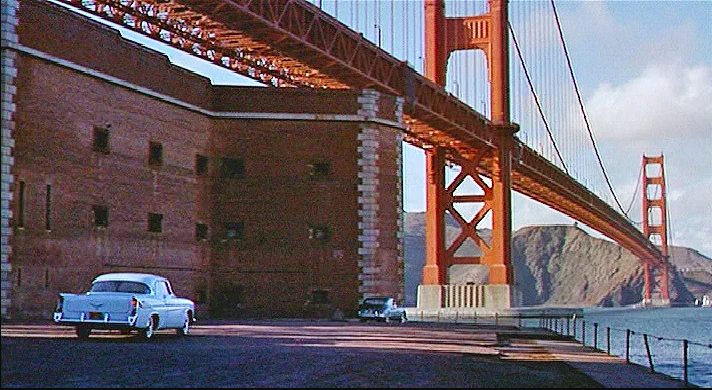
Other filming locations, including in and around San Francisco, included: Fort Point (civil war fortress in Presidio, part of the Golden Gate park area where Scottie rescues her from the bay), Empire Hotel/Hotel Vertigo (Judy Barton’s hotel at 940 Sutter Street), Big Basin Redwoods State Park (used instead of Muir Woods because the National Park Service refused a filming permit), Mission Dolores (aka the Mission of San Francisco de Asis, for the famous graveyard scene), Golden Gate Bridge, Cypress Lawn Memorial Park (in Colma, San Mateo county, where Scottie visits Madeleine’s grave), Nob Hill, (1302 – 1328 Taylor Street- in opening scene when Scottie and his partner chase fugitive across rooftops/ Brocklebank Apartments, 1000 Mason Street where Scottie tails Madeleine from her apartment), Russian Hill (Scottie’s home- at 900 Lombard Street, with Coit Tower in the background), Financial district ( Ernie’s restaurant, 847 Montgomery Street/ Claude Lane, alleyway behind flower shop/ 224 Grant Avenue, site of the flower shop), Palace of the Legion of Honor (Lincoln Park where Madeleine gazes at Carlotta portrait), Union Square (259 Post Street, Ransohoff’s fashion store), The Castro (351 Buena Vista Ave. east, sanatorium where Scottie recovers from his breakdown). Otherwise, most interiors were recreated on a sound stage at Paramount, which took about two months of production filming.
By the 1980s, VERTIGO was nearly lost to deterioration and in badly need of a restoration. It was re-released theatrically in its original format in 1983. At Universal studios where Hitchcock spent his final years as a director, film preservationists Robert Harris and James Katz would rescue VERTIGO to its former glory. Universal spent over a million dollars and two years in this major restoration project that lead to a 1996 major restoration.
According to Universal Press, “… film restorers James C. Katz and Robert Harris discovered that the perfection Hitchcock demanded had deteriorated into shrunken and vinegared sound elements and faded negatives that could not possibly do his dark romantic fable justice. For Harris and Katz the loss was unthinkable.
“Vertigo” is truly one of the most important movies ever made,” says Harris. “It’s on the Library of Congress list of most important films; and on many critics’ Top 20. It’s unacceptable to think that such an incredible and enduring work of both art and entertainment might be lost forever to generations of movie-goers.” Yet that is exactly what almost happened.
Although there is a feeling that once something is filmed it remains forever, it is sadly not the case. Images are fragile, their colors and tones easily fade away, and acetate safety film grows brittle and old. In fact, almost 50% of all films ever made have been lost to the ravages of time.”
Prior to the 1996 restoration, even the sound elements were also in terrible shape, with sound effects and foley tracks completely lost. Luckily, Harris and Katz made one major find: the original orchestral recording sessions under conductor Muir Mathieson, which had been recorded in Germany due to an American musicians’ strike. These sessions had just barely survived a 1967 junking order and sat undisturbed, but rotting, in Paramount’s vaults. Along with discovering Hitchcock’s meticulous notes on sound, “When we played it for some of Bernard Herrmann’s people, they actually heard instruments and notes they’d never known were there,” says Harris.
VERTIGO was originally filmed by a Paramount technical process, ‘VistaVision.’ An extremely high-quality filming technique, it’s photographed from right to left horizontal, a double-frame, 35 mm. With the ‘90s restoration, it could be seen in large format, a 70 mm wonderous view; just as Hitchcock himself intended.
“Hitchcock’s standards of perfection are legendary and nowhere more so than on VERTIGO, admits Katz. “We were under extraordinary scrutiny from people who knew and loved Hitchcock. But even more importantly, we wanted to restore his film in a way that we were certain would make him proud.”
SOURCES:
Restoration of Vertigo, 1996. By: Universal Pictures Press, 1996. https://www.in70mm.com/presents/1954_vistavision/1958_vertigo/restoration/index.htm
“Vertigo” FilmandFurniture.com https://filmandfurniture.com/film/vertigo/
“Hitchcock and Post-War Modernism” By: Molly Musselwhite. Aug 17, 2022. FilmandFurniture.com https://filmandfurniture.com/2022/08/hitchcock-and-post-war-modernism/
 Outspoken & Freckled