
For our 2nd film to explore in our journey into “the Greatest Year in Cinema History: 1939,” we’re taking a liberty with the primary goal of our course by discussing a film from 1940. Initially, I had scheduled Anatole Litvak’s CONFESSIONS of a NAZI SPY (1939), starring dynamic Edward G. Robinson. I do highly recommend CONFESSIONS, but I think there is a more finessed approach to the portrayal of Nazi rise to power in Frank Borzage’s THE MORTAL STORM. (Or perhaps I wasn’t ready to let go of Jimmy Stewart just yet.)
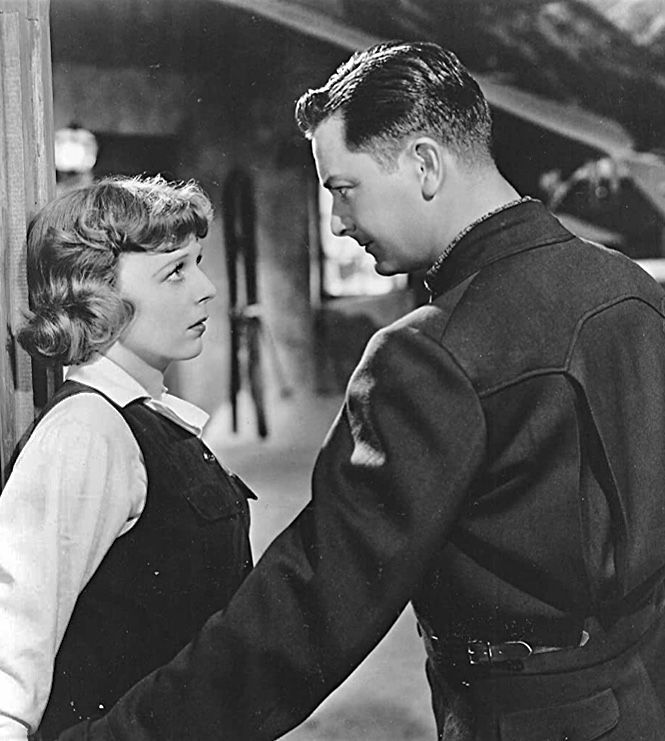
Starring a strong cast, THE MORTAL STORM takes an intimate view of a professor’s family torn apart in the timeline from Hitler becoming Chancellor in 1933 to just before the close of the Austrian border in 1938. This is a critical story to dissect because it reveals the polarization of that time. In looking back in history from a modern lens, we often ask just how could Hitler have taken power and convinced his citizens to join him in his atrocities? How did this impact German families? While not as gritty or realistic as a documentary, THE MORTAL STORM gives us insights into how this could have played out.
Before Adolf Hitler marched into Poland in the Fall of 1939, and after he took power in 1933, many Germans and Europeans had already fled for the United States. During 1939 and 1940, while the U.S. was still contemplating whether to join European allies in a war, major studios began to press with war propaganda messaging in their films. While some films were initially subtle with notes of passivism and neutrality, soon all the major studios were no longer on the fence and released key films that examined themes of corruption and challenged our moral dilemmas and responsibilities of war. Leading up to December of 1941 with Japan’s attack on Pearl Harbor’s fleets and the subsequent Germany’s and Italy’s declaration of war against the United States days later, more Hollywood films took direct aim at Hitler.
From subtle to obvious and sometimes disguised in period pieces, political dramas or even in comedies, a few films like SERGEANT YORK (1941), GONE with the WIND (1939), CONFESSIONS of a NAZI SPY (1939), MAN HUNT (1941), THE GREAT DICTATOR (1940), HITLER: BEAST of BERLIN (1939), A YANK in the R.A.F. (1941), and BUCK PRIVATES (1941) all addressed a stance on war when the United States government was tip-toeing with neutrality.
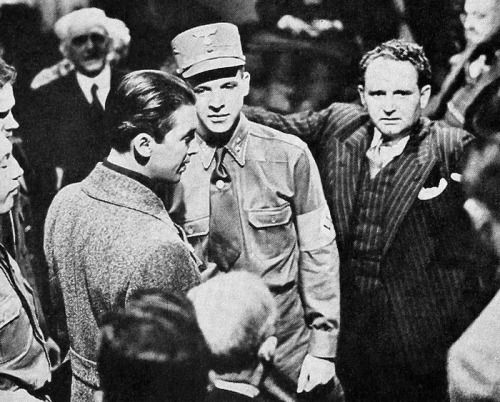
In THE MORTAL STORM, nothing is held back in telling the narrative of the dangers of Germany’s Nazi party. It hits at the heart of our American fears- the targeting and decimation of the family and censoring of our freedoms. The evidence to fight fascism is slowly built up then finally laid at our feet with a resounding call for humanity and action.
Based on “The Mortal Storm” 1937 novel by Brit author Phyllis Bottome (1882 – 1963), her own eye-witness accounts of the rise of the Nazi Party in Germany were reflected as the wife of a British diplomat who was secretly MI6. They were posted in Austria in 1924 and then moved to Munich in 1930. Interesting side note: in 1924 they started a language school based on psychology (she was a devotee of Alfred Adler, founder of individual psychology) and one of their most famous students was Ian Fleming, author of the James Bond novels. It’s been suggested that Fleming created the James Bond character as directly inspired by Bottome’s spy novel “The Lifeline.” Four of her novels were adapted into films.
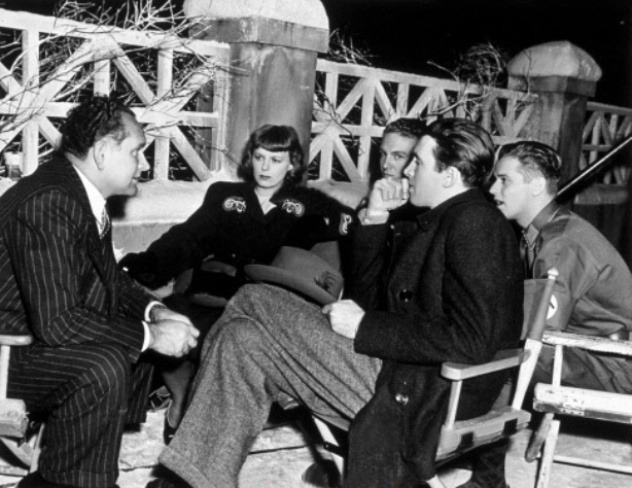
The relationship between Hitler and Hollywood in the 1930s was like an intense, conflicted game of diplomacy. Germany was a huge market, 2nd largest in the world. The major studios didn’t want to lose their business while simultaneously they grew more aware of and strongly opposed Hitler’s activities by the end of the decade. According to a controversial book, “The Collaboration: Hollywood’s Pact with Hitler” by Ben Urwand, the author states that Hollywood studios routinely ran scripts and completed films by German officials during the 1930s and if the German censorship board did not approve because they felt it represented Hitler or Germany in a bad light, scenes were cut and film projects were scrapped entirely. This started as early as Joseph Goebbels outrage over scenes of defeat and anti-German sentiment in Lewis Milestone’s ALL QUIET on the WESTERN FRONT (1930). Protests followed in Berlin with Germany threatening to ban hundreds of American films.
As a result, major studios yielded to Germany’s demands for censorship. Some studio heads like Carl Laemmle of Universal Pictures felt especially conflicted because he was a German-born Jewish man and ALL QUIET on the WESTERN FRONT was his studio’s film- that was used as the first of many “collaborations” of extreme censorship that followed. Additionally, Germany’s insistence on butchering American films came with the provision that this censorship was consistent across all countries via “Article 15.” Hitler was a fan of film as a tool for propaganda and Goebbels as the Propaganda Minister served as an instrumental driver in this plan.
By the end of the 1930s, this “collaboration” between Hollywood and Hitler was becoming unraveled. Only three of the major studios (MGM, Paramount, and 20th Century Fox) were still abiding by the German censors and sending their films to Germany. Some studios pulled out of Germany sooner. Warner Brothers parted ways in 1933, after Nazis beat up the head of its Berlin office. Georg Gyssling, the German consul in Los Angeles was constantly threatening studios and filmmakers to make even more radical concessions to favor Nazi Germany’s whims. At one point, the MGM contact in Germany, Frits Strengholt, divorced his Jewish wife at the request of the Nazi Party. She went to a concentration camp. Between the American censors at the Hays office and the German censors, what handful of films left to ship off internationally were barely making a profit. But the remaining studio heads’ patience were growing thin.
Perhaps it’s no wonder then that films like CONFESSIONS of a NAZI SPY (1939) and THE MORTAL STORM (1940) were a rarity and one of the first films from major studios to take a firm anti-fascist and anti-Hitler narrative. As you may imagine, Adolf Hitler was not pleased. The film THE MORTAL STORM was the first film to mention Hitler by name and set in Germany. CONFESSIONS of a NAZI SPY came with backlash, but it was after THE MORTAL STORM that Hitler banned all MGM films.
After screening THE MORTAL STORM, you may see a parallel between this story (along with each character’s journey through the rise of Hitler’s power) and the studio system itself during this timeframe. How does this play a role in our eventual support of and significant participation in war?
QUESTIONS to Consider:
When we screen this film, be sure to look closely at each character and their evolution. When someone’s courage, strength, and character are tested, how do they respond? Is this film a matter of survival or morality – or both? In what ways is this story relevant today- and has this always been relevant? Regarding corruption in society, who is more to blame- those in charge or those that enable and look the other way to injustices?
What scene or character do you find most compelling?
Does James Stewart’s “Martin” represent America, its initial passivist neutrality, and our views to war (that later turns into standing up against evil forces)?
Does Margaret Sullavan’s “Freya” represent sacrifice (a symbol of the sacrifices of war any nation considers in engaging in a world war)? Is there deeper meaning in her sacrifice vs. other victims?
CAST:
Margaret Sullavan … Freya Roth
James Stewart … Martin Breitner
Robert Young … Fritz Marberg
Frank Morgan … Prof. Viktor Roth
Robert Stack … Otto Von Rohn
Bonita Granville … Elsa
Irene Rich … Mrs. Emilia Roth
William T. Orr … Erich Von Rohn
Maria Ouspenskava … Mrs. Hilda Breitner
Gene Reynolds … Rudi Roth
Russell Hicks … Rector
Esther Dale … Marta
Dan Daily … Holl
Granville Bates … Prof. Berg
Thomas W. Ross … Prof. Werner
Ward Bond … Franz
*Shepperd Strudwick … narrator
PRODUCTION:
Directed by: Frank Borzage
Produced by: Frank Borzage, Victor Saville
Music by: Edward Kane
Cinematography by: William H. Daniels, DP
Film Editing by: Elmo Vernon
Art Direction by: Cedric Gibbons
Set Direction by: Edwin B. Willis
Costumes by: Adrian
*Closing Quotation by: Minnie Louise Haskins
A Few Notes on FRANK BORZAGE:
Born as the fifth of 14 children in Salt Lake City on April 24, 1894, Frank Borgaga (later “Frank Borzage”) began his film career in silents as an actor. Soon, he transitioned to directing with great success. He is the first director to earn an Oscar. Notable awards: Academy Award for Best Director, Dramatic Picture, 7th HEAVEN (1927) and Academy Award for Best Director, BAD GIRL (1931), and the Lifetime Achievement award by the Director’s Guild of America (1961). His films are known for his technical skills, sense of romanticism, pathos, and sentimentality. Two of his siblings also had careers in Hollywood- brothers Danny (small role actor and frequent fixture in John Ford films) and Lew (an assistant director).
 Outspoken & Freckled
Fascinating context about Hollywood’s struggle with Hitler! Never knew studios censored films for Germany. The parallels you draw to today’s polarization are chilling and necessary.
LikeLike