
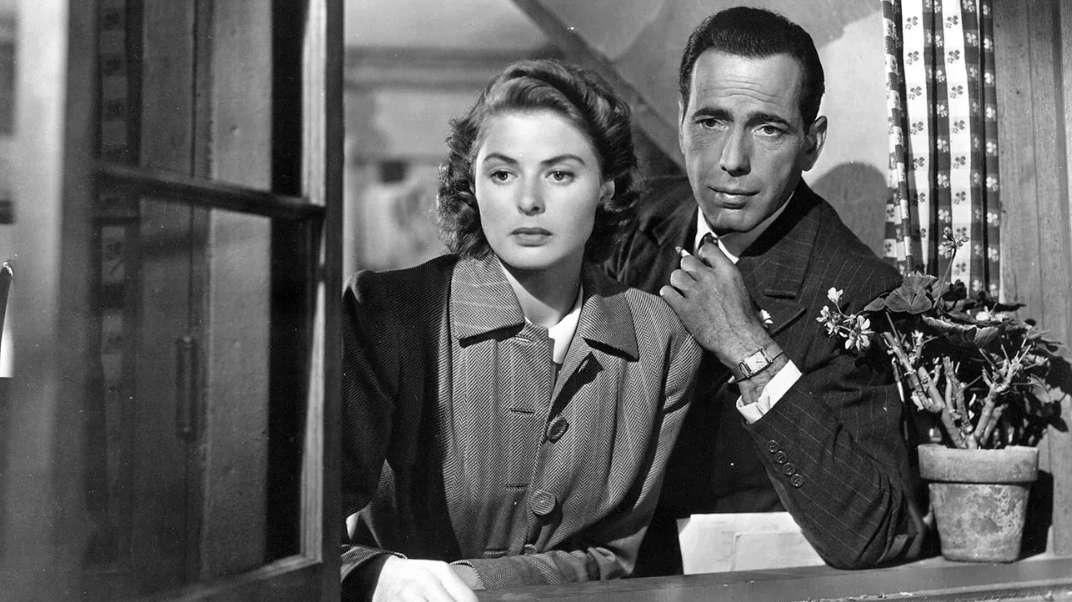
I’m shocked, shocked to find any evidence of a cinematic soul that isn’t in love with the film we’re discussing today, CASABLANCA. It’s not only a film that many a classic film fan would describe as their favorite, but it’s easily a film that could be described as an essentially perfect film. In many ways, with the experience of working within a wide variety of genres so well up until this point was all the necessary training for Michael Curtiz to make this masterpiece of film. Today, we’ll be introducing a film that most of you have seen before, and likely have seen many times. Now, let’s celebrate it.
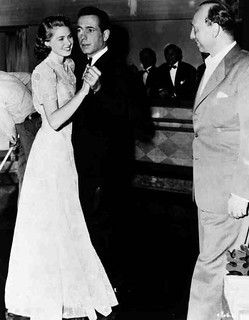
December 7, 1941 is a date that Americans all know as the date that thrust our nation into WW2, following the attack on Pearl Harbor. The very next day, a copy of a play, “Everybody Comes to Rick’s,” authored by Murray Burnett and Joan Alison came to the attention of Warner Brothers, assigned to producer Hal B Wallis. He hired the Epstein Brothers- twins Julius and Philip- and Howard Koch to begin adapting it into a screenplay, then titled CASABLANCA. The Epsteins were responsible for adding the masterfully witty dialogue. Koch structured the main storyline themes such as sacrifice and the political intrigue narrative. Although uncredited, writer Casey Robinson was added to contribute to the love story.
Robinson was instrumental in softening Rick’s character, who initially is portrayed as cold and detached. Thanks to his Robinson’s treatment, we see layers and complexity in Rick- at times an indifferent, aloof soloist, at other times vulnerable, wounded, and willing to sacrifice for the good of deserving others. It is both an evolution of character and a deeper reveal. Robinson was able to bring in a backstory which explains the Ilsa and Rick love story of their past, as her character in the present attempts to explain why her loyalties strayed from Rick to Victor. The Epstein Brothers and Koch continued writing their version of the script, as Robinson came in for a few weeks with his version that focused on the love story, with revisions as the filming began.
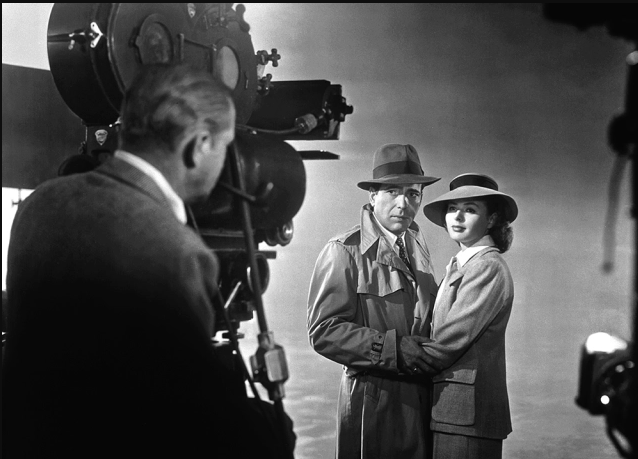
One of the most interesting parts of the writing process behind CASABLANCA is the ending. The ending was not finalized before filming began. In fact, pages were still being freshly inked right up until the last scene- with actors Humphrey Bogart, Paul Henreid, and Ingrid Bergman not knowing how this love triangle would end up. When you watch this film and this complicated trio, keep that tidbit in mind. In fact, one could argue that the mystery of its conclusion adds to the performances. Who would Ilsa choose? How will any of them escape the Nazis? Even the actors didn’t know until shortly before shooting the final scene. However, during the filming of this crucial scene, Bogart was not happy with its interpretation. Things heated up between Bogart and Curtiz to the point that Hal Wallis was called to the set (a rarity). After a long period of discussion, it was all worked out. The end results of this final scene speak for itself. Filming wrapped up in August and the editing by Owen Marks began. They wanted Bogie to return to deliver a pivotal ending line. It was a toss-up between, “Louis, I might’ve known you would mix up your patriotism with a little larceny,” or the alternate, “Louis, I think this is the beginning of a beautiful friendship.” Casey Robinson said years later that the last line of the film was written by Hal Wallis, himself. Today it remains one of the most quoted lines in cinematic history.
On April 27, 1942 YANKEE DOODLE DANDY wrapped up filming, after doubling scheduling (supposed to be 48 days), and came in at a $1.5 million dollar budget. It earned eight Oscar nominations. Yet this marked the last time Cagney and Curtiz worked together. Combining a publicity campaign and a war bonds drive, a gala premiere on May 29th in New York was the biggest ticket in town at $25 a head. $4.7 million was raised in war bonds in one evening. The film grossed more than $6 million, making it the 2nd most profitable release of that year. It was also one of the most patriotic spectacles in an obviously very patriotic time. As hardened of a reputation as Curtiz had, he was growing more sentimental (on-screen anyway) as his career progressed. All of this laid the groundwork for Curtiz’s most memorable film of his career.
Actors Ronald Reagan and Ann Sheridan were touted in publicity rags for Curtiz’s next big flick. Jack Warner pushed for George Raft to portray Rick. But Wallis held firm. He knew from the onset that Humphrey Bogart’s time had come. Notorious as side kick henchmen and tough guys in films like THE PETRIFIED FOREST (1936), Bogart had been gradually evolving his stature into the leading man. This was apparent by the release of THE MALTESE FALCON (1941) that audiences were ready for Bogie in strong leading role. But could they see him portrayed as a heartbroken romantic, as well? Originally, the roles of Rick and Ilsa were supposed to be two American characters, but Casey Robinson suggested a European for the female lead for a more cosmopolitan touch, which also played well into the globe-trekking plot of the characters. Wallis knew 26 year-old Ingrid Bergman’s work from her Swedish films and thought she’d lend the right blend of beauty and talent.

Paul Henreid was added as Victor Lazlo. With production by Hal Wallis and writing by Casey Robinson, NOW, VOYAGER starred Henreid in the lead role. Filming was concurrent in these productions on the lot. CASABLANCA was filmed from May 25 to August 3, 1942 on the Warners’ studios in Burbank. NOW, VOYAGER was filmed from April 7 to June 23, 1942, same studio lot. It was released on Halloween in ’42. NOW, VOYAGER was Wallis’s first film out of his own independent production company at Warners, so he had full authority on casting for both films.
The release date for CASABLANCA was an example of art reflecting history- and history influencing art. In the oddest twist of fate, the setting of CASABLANCA as a bottleneck for fleeing refugees and fighting Nazis as a thing of fiction became reality shortly after the production wrapped up. The Allied invasion of French North Africa (Operation Torch took place November 8 – 16, 1942 in Morocco and Algeria and resulted in an Allied victory) prompted the studio to rush the world premiere date to November 26, 1942 in New York City. The national release followed on January 23, 1943. This was a huge boost not only to the film, but to the patriotism sentiment for the war efforts. Henreid at the time was concerned that he was taking a step backwards with the “Lazlo” role when he wanted more “Jerry” roles. Interestingly, across these last eighty years, he is likely better known for CASABLANCA, even if it is a less meaty role than his NOW, VOYAGER as starring lead. Perhaps less moon, more stars?
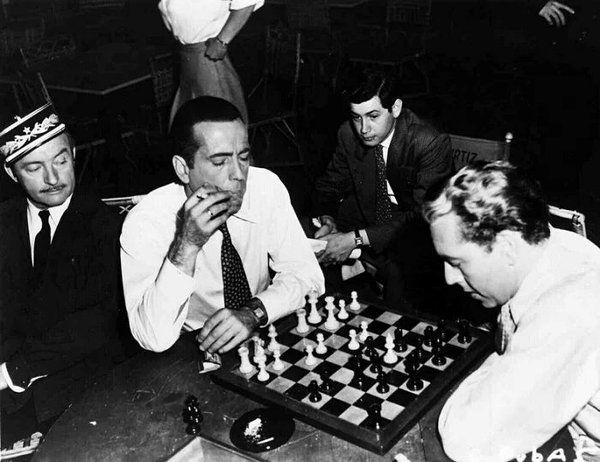
To fill out the cast, it’s another case of art blending real events. Nearly everyone in the cast was an émigré or immigrant, including its director, Michael Curtiz. Paul Henreid, who was trained on the Vienna stage by famed director Max Reinhardt, left Vienna for London in 1935 due to his anti-Fascism politics, made British films such as GOODBYE MR. CHIPS (1939) and NIGHT TRAIN TO MUNICH (1940), and moved to Hollywood in 1940. He was blacklisted by the Nazis twice- in 1934 when he refused to sign a Nazi loyalty oath, and again in 1938 when he was deemed a deportable alien after Hitler annexed Austria.
Also trained under Max Reinhardt, Conrad Veidt was a highly successful German actor (THE MAN WHO LAUGHS, 1928, THE CABINET of DR. CALIGARI, 1920) who married a German Jewish woman and they fled for Britain in 1933 when Hitler became Chancellor. He officially became a British citizen in 1939, then moved to Hollywood for more opportunities the following year. Considering how memorable he is, it’s hard to believe he would die of heart failure only a year later in April of 1943. He didn’t live long enough to see the WW2 victory, but he would get the last laugh on the Nazis for his portrayal as the infamous and iconic Nazi villain in CASABLANCA. Veidt was second-billed but the highest paid cast member of this production.

Claude Rains delivers some of the best lines in CASABLANCA. He was an ideal choice to play a character that is decidedly flawed and corrupt, yet thoroughly likeable. We’ve seen him portray a madman in THE INVISIBLE MAN (1933) and a naughty Prince John in THE ADVENTURES of ROBIN HOOD (1938). He clearly had range. He moved to the U.S. from England in 1912 in his early twenties to pursue theatre. He returned in 1914 to sign up for WW1. He served in the London Scottish regiment alongside Ronald Colman, Basil Rathbone, and Herbert Marshall. He endured a gas attack at Vimy in 1916, which cost him 90% vision loss in his right eye and damaged his vocal cords. (In case you were curious about that recognizable, raspy voice of his.) He moved back to America to continue acting. His move to Hollywood came with his film debut in INVISIBLE MAN in 1933. Rains signed a seven-year contract with Warner Brothers in 1935. He became a naturalized American citizen in 1939.
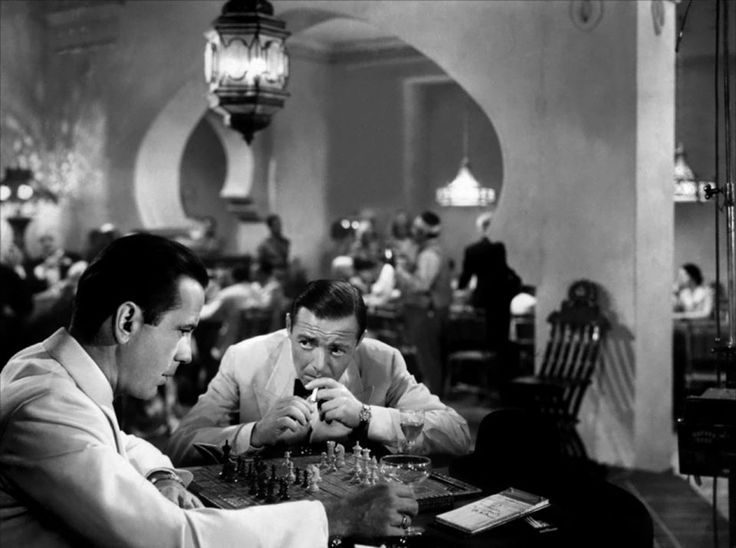
Another emigre includes Slovakia/Hungarian Peter Lorre, who left Germany in 1933 when Hitler took power. He was internationally famed for his role as a child killer in Fritz Lang’s M. He made his way through Paris, Vienna and London, then eventually landed in America in 1935. His American film debut was the horror, MAD LOVE (1935). After a few years on the British stage, Brit Sydney Greenstreet moved to New York in 1905 to pursue theatre. He became a naturalized American citizen in 1925. After decades of performing on stage, Greenstreet’s film debut came with THE MALTESE FALCON (1941), co-starring Bogart and Lorre. The three actors would go on to co-star together in several films. Across only eight years on-screen, Greenstreet made 24 films. He passed in 1954. SZ “Cuddles” Sakall was quite familiar with Michael Curtiz as they both arrived to America from Hungary. He too left his active acting career in his homeland, due to the rise of Nazi power. He had a prolific career in Hollywood as a character actor known for his excitable, chubby-cheeked jubilance. He died in 1955. The list of character actors and extras were chosen by Curtiz- because they were immigrants. He needed the realism of refugees and he got it.

In this stellar and deep bench of talent, only two actors in the main cast were not immigrants: New Yorker Bogart and Texan Dooley Wilson. A drummer/singer, Wilson toured Parisian and London nightclubs in the 1920s, then turned to acting on Broadway and films in the 1930s. Not a pianist himself, Wilson sang on camera and pretended to play while composer/actor Elliot Carpenter tickled the ivories just off-screen. On a loan from Paramount, Dooley was paid $350/week. He passed in 1953.
CASABLANCA doesn’t miss a single note. The score by Max Steiner is one aspect to this film that’s executed superbly. It’s a range of rousing, patriotic, dramatic, and romantic. The song, “As Time Goes By,” written by Herman Hupfeld originally sung in a stage production in 1931 called, “Everybody’s Welcome,” was not to Steiner’s initial liking. He preferred the idea of an original song composed of his own. But, the scene where Ilsa hums along to Sam’s “As Time Goes By,” was already filmed and she had since cut her hair very short to prep for her next film, FOR WHOM THE BELL TOLLS. So, Steiner was stuck with it. In turn, he utilized it throughout the film in a variety of tones and orchestrations. It came to be a vital, invaluable part of the film and was hugely popular outside of the film’s release.
Cinematographer Arthur Edeson served as D.P. He was also the Cinematographer for FRANKENSTEIN (1931) and THE MALTESE FALCON (1941). Edeson reflected Curtiz’s passion for shadows, low lighting, unique angles, and action-paced camera work. The results imbue the film noir style with some of the most stunning closeups, especially of Bergman. This, combined with the Art Direction by Carl Jules Weyl, set decorations by George James Hopkins, editing by Owen Marks, and costumes by Orry-Kelly.
Originally budgeted for $878,000, the final cost to make CASABLANCA was approximately one million. The box office grossed over $10.5 million, worldwide. It won three Oscars- Best Picture, Michael Curtiz for Best Director, Best Writing, Screenplay (Epstein brothers, Howard Koch) and earned five more Oscar nominations- Humphrey Bogart for Best Actor, Claude Rains for Best Actor in a Supporting Role, Arthur Edeson for Best Cinematography, Black and White, Owen Marks for Best Film Editing, and Max Steiner for Best Music, Scoring of a Dramatic or Comedy Picture. At the Oscar ceremony in 1944, when CASABLANCA was announced as winner of Best Picture, Jack Warner beat Wallis to the stage to accept. Jack accepted the award on behalf of the studio, stealing the limelight from Wallis, who worked so diligently to help create it. That was the last straw for Hal Wallis who resigned from Warner Brothers and went solo with his production company and worked across several studios.

As we enjoy screening CASABLANCA, let’s discuss:
-What themes and labels do we see in this film- sacrifice, romance, war, film noir, spy intrigue, drama, action, melodrama, political…?
-It’s a face-paced film, what tools help move this along- story, action, editing, dialogue?
-What examples do we see of sacrifice? How did this help the war efforts?
-Where do we see examples of German Expressionism or Film Noir style? Look for the shadows, lines, low lighting. How does this help set the tone?
-How is humor used? What are some of your favorite examples?
-This is considered the best screenplay of all time- what examples can you give of this?
-How is the use of real refugees/immigrants so effective in this storytelling?
-How do Orry-Kelly’s costumes help to develop the characters?
-Why do you belief this film has endured as such a beloved classic for so many?
Cast and Crew:
Director- Michael Curtiz
Writers- Julius Epstein, Philip G Epstein, Howard Koch, Casey Robinson, uncredited (screenwriters), Murray Burnett and Joan Alison (from a play by)
Produced by- Hal B Wallis (he won the Irving Thalberg award again for CASABLANCA), Jack L Warner
Music by- Max Steiner
Cinematography- Arthur Edeson
Editing- Owen Marks
Art Direction- Carl Jules Weyl
Set Decorations- George James Hopkins
Costume Designs- Orry-Kelly
Humphrey Bogart- Rick Blaine
Ingrid Bergman- Ilsa Lund
Paul Henreid- Victor Laszlo
Claude Rains- Captain Renault
Conrad Veidt- Major Strasser
Sydney Greenstreet- Signor Ferrari
Peter Lorre- Ugarte
SZ Sakall- Carl
Madeleine Lebeau- Yvonne
Dooley Wilson- Sam
John Qualen- Berger
Leonid Kinskey- Sascha
Curt Bois- pickpocket
Joy Page- Bulgarian refugee, Annina -Jack L Warner’s stepdaughter and her 1st screen appearance
 Outspoken & Freckled