

John Ford’s THE INFORMER (1935)
By: Kellee Pratt
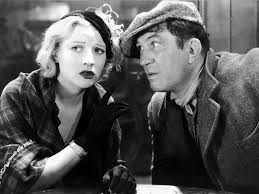
Both haunting and tense, John Ford’s depiction of a day in 1922 Dublin in the struggles for an Irish independence would land him his first Oscar. THE INFORMER (1935) would go on to be unexpected box office hit, gaining rave reviews from both audiences and critics, and earning a total of six Academy Award nominations, winning four.

Against all odds, the studio didn’t have high hopes for this film that was forced into tight budgetary constraints and resulted in the first major studio ‘art film.’ The story was not the first film adaption of Liam O’Flaherty’s 1925 novel and RKO feared it would not be a commercial success. German director Arthur Robison directed a silent version in 1929.
Screenplay writer Dudley Nichols (April 6, 1895 – January 4, 1960) wrote scripts for John Ford a total of thirteen times throughout his career. He would later produce and direct films, too. As we’ve noted, Ford was not a fan of a lot of dialogue. But Ford had a knack for collecting loyal talent, both cast and crew; and Nichols obviously had a thick enough skin to watch pages of his scripts either ignored or ripped out entirely. Dudley is also known for penning scripts such as: BRINGING UP BABY (1938), FOR WHOM THE BELL TOLLS (1943), SCARLETT STREET (1945), THE BELLS OF SAINT MARY (1945), and for John Ford with STAGECOACH (1939), to name a few.
Dudley is also famed for being the first to reject his Oscar statuette. His Academy Award win for Writing for THE INFORMER (1935) was accepted by Ford, on his behalf, even though Ford himself was known as a frequent no show. Dudley was participating in a writers’ boycott due to a dispute between the Academy and the Screen Writers Guild, of which he was a founder. He would later accept the Oscar at the 1938 ceremony. He served as president of the SWG in 1937 and 1938. He would later co-write Ford’s THE BATTLE OF MIDWAY, which won the Oscar for Best Documentary, 1942.
Ford worked with Victor McLaglen, Wallace Ford, JM Kerrigan… (cast), Dudley Nichols (screenplay), and Max Steiner, (music), on THE LOST PATROL (1934). He knew he needed Steiner again. To ensure Max Steiner’s contributions for THE INFORMER, Ford requested Nichols to collaborate with him. It was the only time the composer recalled conferring with a writer on a score. Max Steiner was notoriously overworked during this time. In 1934, he wrote music for 36 films and was the music director for two more films. In 1935, he wrote music for six films including THE INFORMER, plus served as music director for three more.**
Austrian born Maximillian Raoul Steiner (May 10, 1888 – December 28, 1971) fled German occupation during WWI and made his way eventually to Hollywood. He was a child prodigy of music (conducted his first operetta by age twelve) and composed over 300 film scores with RKO and Warner Brothers. He was one of the first notable composers to write scores for films and was nicknamed, “the father of film music.” He was nominated for 24 Oscars- his first win was for his work on THE INFORMER (1935). You will recognize his music from some of the most iconic film scores in cinematic history, including: KING KONG (1933), GONE WITH THE WIND (1939), CASABLANCA (1942), and another film in our FORD study lineup, THE SEARCHERS (1956).
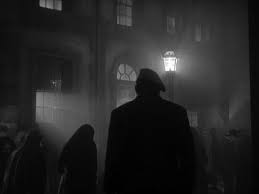
One of the strongest appeals to THE INFORMER (1935) as a film is the cinematography. It’s difficult to understand how its cinematographer, Joseph H August, was not nominated for the Academy Award for this beautiful film. August (April 26, 1890 – September 25, 1947) would work with Ford many times, including his time at the OSS in WWII, shooting THE BATTLE OF MIDWAY (1942) and later, THEY WERE EXPENDABLE (1945). He was one of the 15 original founding members of the American Society of Cinematographers, founded in 1919. His last film was PORTRAIT OF JENNIE (1948), which he was unable to complete because he suffered a massive heart attack and died. He was posthumously nominated for an Oscar. He worked on 160 films, including GUNGA DIN (1939) and THE HUNCHBACK OF NOTRE DAME (1939). Yet he never won an Oscar.
For production on THE INFORMER (1935), Ford was inspired by another great director. Impressed by FW Murnau’s use of dark shadows and low lighting within the German Expressionism style, Ford sought out a short filming schedule, essentially non-existent minimal sets, tight camera shots, a lot of smoke for fog effects, and a disciplined use of back lighting. He also insisted on his own choice of actors to create his desired performances. In particular, from Victor McLaglen.
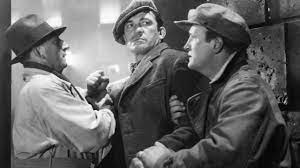
London-born yet of Scottish ancestry, Victor Andrew de Bier Everleigh McLaglen (December 10, 1886 – November 7, 1959) was the boxer turned actor with 65 acting credits (mostly minor character types) under his belt by the time Ford pushed for him to be the star of this film. In addition to an impressive boxing career, McLaglen had also served as “Chief of military Police” for Baghdad (Mesopotamia, now Iraq) in the British army during WWI. He received his American citizenship in 1933.
Much of McLaglen’s portrayal of “Gypo Nolan” required varying degrees of an inebriated performance. Rumors spread that McLaglen was actually drunk on set to achieve his Oscar-winning performance were later denied by both Ford and Victor’s son, Andrew. Ford pointed out that “Victor had to run too many gamuts of emotion, bravado, nervousness, fear, sometimes all in one scene, and go back to bravado again and resume the whole thing. He had too much to do to take a drink.”*
Andrew McLaglen defended his father’s character as a direct contrast from his “Gypo” role and strongly refused the drinking rumors, as well. “That’s so wrong. My father was the furthest thing from the blowhard that story makes him out to be. He was a quiet, soft-spoken man, not an alcoholic. He didn’t drink when he was working. I distinctly remember this: I was fifteen, and we were walking across the lawn of our estate. My dad stopped and looked at me and said, ‘Laddie, I guarantee you that if I get THE INFORMER I will get the Academy Award.’ When he got that part, he was the happiest man going.”*
A wee bit of Irish history.
It’s important to consider Irish history and its relationship with Britain in terms of understanding the background to this story. Ireland was the British Empire’s first nation to colonize and did so for over 700 years, starting with the Norman invasion in 1169. It wasn’t until the first World War that the Empire began to erode and thus the fight for Irish independence gained traction in earnest, including the 1916 Rebellion and the partition of Ireland (1920). The Irish War of Independence lasted for over two years (January 1919 – July 1921) in guerrilla war conflict between the IRA (“Irish Republican Army”) and British forces. Intense violence that pitted the Irish against the Brits, and the Irish Protestants against Irish Catholics, raged on for years but was intensified during this time of “The Troubles” and in peaks of violent clashes such as Dublin’s infamous “Bloody Sunday” in November of 1921. “The Informer” was written with all of this backstory in mind.
As mentioned in my John Ford overview, Jack was connected to these Irish/Brit conflicts personally. He and his Irish Catholic family supported the IRA so this story had personal meaning. Joseph Breen and the Production board feared censorship from Britain. A total of 129 cuts were made to appease the British censors. All references to the IRA, any support for the Irish cause, and to the ‘Black and Tans’ were all removed. As butchered as that sounds, I cannot imagine any Brit not already comprehending the facts behind the plot. Even censored, it was pretty clear.
What’s the most fascinating points for discussion for tonight’s film are the themes, aesthetics, and symbolism. Let’s discuss:
-The consistent look of darkness, fog, shadows, back lighting. Practical for the low budget, but how does this work effectively for the storyline?
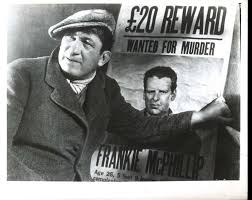
-The wanted poster sticking to Gypo’s leg. He can’t shake it off initially. What symbolism do we see here?
-What biblical/Christian symbols and themes do you see played out?
-What examples do we see as a “Judas” character? (Note the prologue regarding 30 pounds of silver)
-How does the tight camera frames, the close-ups create a sense of feeling trapped?
-What other examples do we see of visual storytelling?
-How do we see “Gypo” as both a weak character and a sympathetic character?
-Sinner vs Saint theme for the female characters
-What parallels might be drawn with James Whale’s FRANKENSTEIN (1931)? Or Fritz Lang’s M (1931)?
-What character actors did you notice- from Ford stock and otherwise?
-Betrayal, Regret, Survival vs Honor…. what other themes do you see?
CAST and CREW:
Victor McLaglen – “Gypo” Nolan
Heather Angel – Mary McPhillip
Preston Foster – Dan Gallagher
Margot Grahame – Katie Madden
Wallace Ford – Frankie McPhillip
Una O’Connor – Mrs. McPhillip
JM Kerrigan – Terry
Joe Sawyer – Bartly Mulholland (credited as Joseph Sauers)
Neil Fitzgerald – Tommy Connor
Donald Meek – Peter Mulligan
D’Arcy Corrigan – the blind man
Leo McCabe – Donahue
Steve Pendleton – Dennis Daly (credited as Gaylord Pendleton)
Francis Ford – “Judge” Flynn
May Boley – Madame Betty
Directed by: John Ford
Produced by: John Ford, Cliff Reid
Writing by: Dudley Nichols, Liam O’Flaherty
Cinematography by: Joseph H August
Music by: Max Steiner
Film Editing by: George Hively
Budget: $243,00 (RKO Insisted below $250k so Ford took no salary)/ Box Office: $950,000
*SOURCES: Scott Eyman’s “Print The Legend: The Life and Times of John Ford” (1999),
IMDB

 Outspoken & Freckled
I enjoyed this interesting and informative post, Kellee! I’ve had The Informer on my radar for decades, ever since I read about it in a book(50 Classic Motion Pictures by David Zinman). All these years later, I still haven’t seen it, but I’m determined to remedy that this year!
— Karen
LikeLiked by 1 person
Thanks, Karen!! I do hope you take the opportunity to watch it soon. Hope you enjoy it as much as I do, too!
LikeLiked by 1 person